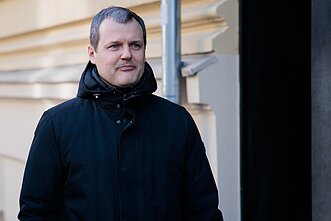
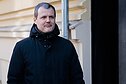










Silvester Belt became a star in Lithuania overnight after he was selected to represent the country at the Eurovision Song Contest in Malmö, Sweden. In an interview with LRT.lt, he speaks about waiting for this moment all his life and the courage to be himself.
After winning the national selection, you said that you felt like you were in a dream, and it was hard to comprehend what had happened. How do you feel now, a week later?
These days, I’m living in a dream, although I don’t have time to daydream or think too much. There’s not much time left before Eurovision, so right after the final, I fell into work and meetings, and we’re already thinking about how to adapt my performance to the stage in Sweden. I’m excited about this stage and I’m trying to take this experience with open arms, even though I know it’s going to take a lot of mental and physical strength.
Eurovision fans are sharing reactions to national selections online. The foreigners are very positive about your performance, including your decision to sing in Lithuania, your vocals, and the dancing.
I’ve watched several of these videos myself, so the reactions are very gratifying. We Lithuanians often underestimate ourselves, so it’s good to hear when we are compared to the best, to hear praise for both the song and the performance. That’s how we want to present Lithuania.
What is the meaning of your Eurovision song Luktelk for you?
I don’t really like to push my own interpretations or ideas on people – I’m always very interested to see what the listeners hear in my work. After all, I write my songs to resonate with the people around me and their experiences. Luktelk does have many layers and different meanings, so it’s fair to say that all the interpretations that come up are correct.
After you won the national selection, a video from the 2010 Junior Eurovision selection went viral. How and when did music come into your life?
Probably my family would answer this question best because as far as I can remember myself, music has always been in my life. When I was very young, I used to watch Dainų Dainelė [a Lithuanian singing competition for children] and sing in front of the TV. When I was four, my parents took me to music school.

Apparently, I chose my path without realising it at the time, and music became my plan A in life. After graduating from music school, I continued my studies at the Juozas Gruodis Conservatoire. Finally, because I was interested not only in music but in the world of entertainment in general, I went to London to study commercial music at the University of Westminster.
When you were still studying, you tried your luck in various TV projects, which seems to require a lot of courage, but you’ve said that you sometimes lack self-confidence.
When I say I lack confidence, I’m talking more about the doubts I have – whether I’ve really done the best I can at the moment. But it was the self-discovery and the desire to find my own way that led me to these projects, and there I found both courage and determination.
Did it take a lot of courage to speak out about your sexual orientation in one TV project? Many LGBT people choose to live in secret...
Although this topic often receives very heated reactions in Lithuania, for me, a person’s sexual orientation is as much a fact about them as the colour of their eyes or their height. So, I didn't see the point in hiding it. I also wanted to be an example to myself and to others that you have to be open and honest and accept yourself as you are.
I know that there are many people who hide this fact about themselves, often under the guise of not wanting publicity. When I was a teenager, I was also very shy to talk about it, but seeing talented foreign artists who accept themselves and are brave about it has given me the courage to do so. I hope I can inspire someone to be open and not be afraid to be themselves.

When you won the selection, you said that you had been waiting for this moment all your life. What did you have in mind – the dream of performing at the Eurovision or the fact that the victory was a kind of a breakthrough for you?
Both. I’m impatient by nature – if I come up with something, I want it here and now, not tomorrow. But life is not that simple – everything happens in its own time. For a long time, I felt like I was failing, with many disappointments along the way. In competitions, I was also often somewhere in the middle – neither the best nor the worst. I was noticed, but it seemed that I was not able to show what I was really capable of.
Now, I realise that the door that once closed for me didn’t close because I’m not good or not good enough, I just had to learn my lessons. And I have been learning, improving, putting in a lot of effort, so winning the selection is like the result of my long and consistent work, failures, stumbles, and lessons learned. I feel that all the experiences have been a preparation for this moment, and I face it with strength and readiness.
Finally, my work has been discovered by a wider audience. I hope that it will find its audience in the big Eurovision, which is also a dream come true – there is hardly a bigger and more important music event for Lithuanians.
You mentioned disappointments and failures. Have you ever thought that maybe music wasn’t your path?
I’ve been involved in music for more than 20 years, so it’s natural to have all sorts of ideas – it’s part of the process. Fortunately, I was patient with myself and my experiences. I had other activities besides music, but they were always just an addition to what I was doing because music has always been and remains the most important thing to me.

What are the most common sounds in your playlist, and what were the biggest influences on your work?
When I was at music school, I tried different genres – from classical to jazz, although I mostly listened to popular music. But over time I discovered electronic, techno, and rave – I never thought I would be interested in it, but these styles have taken over and I feel that they are starting to infiltrate my work.
And what about Eurovision? Have you always been a fan of this song contest?
Since I was a kid! Because I was studying music, I’ve always been interested in both the Lithuanian selections and the main Eurovision.
Obviously, music is the most important part of your life, but what do you like to do when you want to take a break from it?
I admit I’m a homebody, but I have a friend who always pulls me out and comes up with all sorts of activities for us to do, like playing pool, climbing, or finding other more active things to do. I also go to the gym.
But do you have time to rest and recharge the batteries? People nowadays often complain about the crazy pace of life, which leaves little time for ourselves.
I notice that people often get caught up in their own activities and aspirations and forget about their physical or emotional state, so diet, exercise, and self-care take a back seat. I have done my best to prevent this from happening to me – since my teenage years, I’ve tried to take care of my well-being. And now, after a stressful time, I allow myself to relax, to go out for a nice meal, to exercise, to get a massage, to talk to my friends, and I can feel myself getting better.

It’s quite a busy time ahead, with the upcoming Eurovision buzz. What would you wish for yourself during this period?
I would like to enjoy this experience, keep the calmness, strength, and good mood that I have had so far, be confident, and not read the online comments. Also, rest and sleep well.
Further reading

Newsletter
Every Friday morning.