













Saturday marks two years since the fateful February 24 when Russia launched its full-scale invasion of Ukraine. These years have taught the West many lessons about warfare and geopolitics, but not all of them have been learned, according to experts interviewed by LRT.lt.
Experimental phase
Russia’s war against Ukraine, which was launched in 2014 and turned into a full-scale invasion two years ago, is the first industrial-scale war of this century, testing not only tactics and strategies but also the capabilities, resilience, and endurance of national military industries. While drones and other new technologies are playing a key role in the war, Europe and the US are forced to relearn long-forgotten lessons, says Gustav Gressel, Senior Fellow at the European Council on Foreign Relations (ECFR).
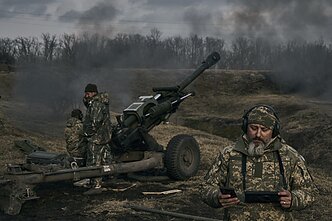
One of the biggest challenges is the scale of use of weapons and ammunition not seen since the Second World War and the fact that it is not the sophistication of the equipment that determines the situation on the front. Ukraine is successfully using American howitzers, infantry fighting vehicles, and German Leopard 1 tanks, dating back to the Cold War, while Russia is bringing Soviet tanks and other heavy weapons to the battlefield.
“Our fetish that quality will substitute quantity has been shattered. Yes, Westen weapon systems in many parts are superior to Soviet ones, but the quality factor does not guarantee you can match for quantity, especially if you have to cover a very long front,” Gressel told LRT.lt.

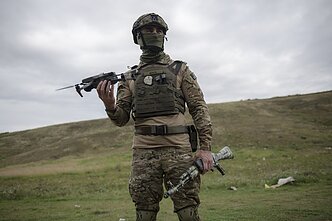
Another lesson of the war is the increased importance of drones. Ukraine was the first to use them for reconnaissance and long-range fire control, while the Russians have successfully copied and expanded drone use. In the Second World War, billions of dollars worth of bombers were used against targets, such as power grids, factories, railway junctions, etc. Now, the Russians are attacking these targets with drones “because they are mass-produced and readily available”, according to the expert.
This war has therefore shown the importance of integrated air defence, using missile systems, military aircraft, and electronic warfare. These components are becoming an integral part of combined arms manoeuvres when operations are carried out by artillery, infantry, tanks, and engineers.
“We are still in the experimental phase [...]. Both sides are making excellent use of these technologies in defence and are preventing the adversary from launching a major breakthrough. But neither side has been able to use these technologies for offensive purposes, to choose the right combination of electronic warfare, air defence, drone reconnaissance, drone strikes, and conventional manoeuvre to ensure effective manoeuvres. I cannot predict which side will be the first to find the right recipe,” Gressel said.
Western military experts are also learning from this war experience. They are in constant contact with the Ukrainian military, adjusting their training programmes and their approach to future conflicts accordingly. “Such support to Ukraine is also useful for the conventional deterrence of NATO allies,” the ECFR expert noted.

A more pessimistic conclusion drawn by many states is that conventional deterrence is extremely limited without a nuclear component. The right to self-defence as enshrined in the UN Charter can also be severely curtailed in the event of an attack by a nuclear state.
“This is the shadow of the bomb. Many countries have observed that if a nuclear state becomes imperialistic and aggressive, the nuclear threats will limit the amount of aid and solidarity you get. Therefore, you must build a nuclear deterrent, either by joining a nuclear deterrent or by building up your own arsenal,” Gressel said. “In terms of nuclear postures, the 21st century will be very different from the 20th.”
Back to the future
Although European countries are announcing an increase in the production of arms and ammunition, they will not be able to fulfil their promise to deliver 1 million artillery shells to Ukraine by the beginning of March this year. Other military aid to Ukraine is also stalling, which is why there is now a shift towards initiatives to invest and build armaments factories in Ukraine itself.
“Europe seems to have scraped the barrel of conventional capabilities it can send. In the UK, we no longer have tanks, artillery, even off-road vehicles and armoured vehicles, almost nothing that we could send that wouldn’t hurt our already weakened forces,” said Frank Ledwidge, a lecturer in warfare and military history at the University of Portsmouth.
Other mid-sized Western powers, such as France, the Netherlands, Belgium, and Norway, face similar problems.
“One of the things we seem to be doing right, and for which we have the resources, is building up Ukraine’s arsenal of first-person view and other drones. Europe is sending this equipment to Ukraine, and we will see what effect it will have,” Ledwidge noted.
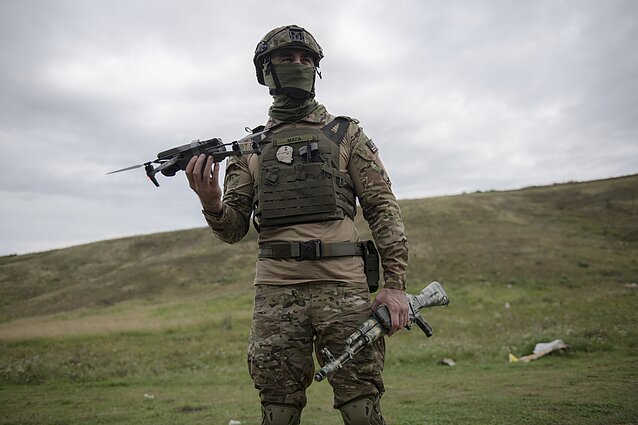
However, predictions that cyber and hybrid operations, rather than tanks and heavy artillery, would be the key elements in the war have not materialised.
“The nature of future warfare will be very different from what has been thought so far. In a sense, we will be back to the future in trench positioning and a war of attrition. But this will overlap with exponentially fast-developing technologies, such as drones,” the expert said.
That is why the Baltics have decided to mine and fortify their borders, and Poland has already installed barriers to stop armed vehicles on its border with Kaliningrad.
“Nuclear deterrence self-evidently hasn’t worked, and many of us question the utility of nuclear deterrence more widely,” Ledwidge said. “But the huge oil tanker of Western European defence policy and posture is only beginning to turn, and it will take many years for the UK, for example, to produce an effective conventional defence of our own homeland, let alone some form of capability to project onto the continent.”
No objective
The war taught the West major lessons in terms of the clarity of objectives and the importance of military personnel, according to retired General Ben Hodges, former commander of US ground forces in Europe.
“The West, in particular the US and Germany, have not defined the objective in this war. We have not been able to make good policy decisions and our support for Ukraine has been intermittent. The aid was substantial but not enough because the objective is not clear,” he told LRT.lt.

According to him, the West was also reminded of the importance of logistics, as well as armaments and ammunition.
“Of course, technology, especially drones, has changed the character of the battlefield. But still, it’s about the women and men in the battle and their ability to learn, to adapt, to endure. No amount of technology can make up for weak, undetermined soldiers,” Hodges added.
But it is not only the West that is learning from war. According to the US general, Russia’s ability to operate and use drones is evident. It has also been able to adapt strategically to the West’s delay in transferring the necessary weapons to Ukraine, digging trenches and preparing minefields that have complicated the long-awaited Ukrainian counteroffensive in 2023.
But there are still some lessons the Russians have not learned in terms of its air force and the Black Sea Fleet, which has been forced to retreat from its positions because of Ukraine’s attacks.
“Russians are not stupid, but they have not learned or adapted everywhere. And, of course, the Russian way of war is always about mass, and they have no qualms about losing thousands of casualties. This is just ‘meat’ for them, and they will continue doing that,” Hodges stressed.
The year 2024 will also be full of lessons for Ukraine, which has recently changed its army chief.
“I think this year the Ukrainians will continue to put pressure on Crimea and Russian oil and gas infrastructure,” Hodges said, adding that it will be a year of industrial competition for the West and Russia, with both sides trying to build up their diminished capacities.

Lessons not learnt
In the wake of Russia’s war in Ukraine, the West has underestimated Moscow’s intentions and threat, but overestimated its capabilities and strategic wisdom, said Tomas Jermalavičius, head of studies at Estonia’s International Centre for Defence and Security Studies (ICDS).
“The Russian regime is making very stupid strategic mistakes, acting arrogantly, incompetently, but it should not be underestimated that they are learning from their mistakes, they are able to adapt, to mobilise, especially when they start to realise what is at stake in this war,” he said.
While there was talk of isolating Russia at the start of the war, Moscow has shown that it is able to mobilise in difficult times and find allies to support it. One of its most prominent supporters has been Iran, which has transferred hundreds of missiles to Russia.
An important lesson that the West must still learn is that avoiding escalation is not effective in the face of the war. On the contrary, the logic of escalation dominance must be applied, according to Jermalavičius.
“In the West, especially in Washington, Berlin, perhaps Paris, and elsewhere, the strategy of avoiding escalation dominates, and it leads to very slow aid delivery [...]. This allows Ukraine to survive, but it doesn’t help to bring it closer to victory,” he said.
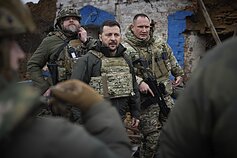
In his words, a key lesson for the Baltics was about the importance of political leadership and the strength of civil society in difficult times.
“Ukraine could have ended up like the Baltic states in 1940. But it was a big surprise for the Russians,” the expert stressed.
The West also realised that NATO’s eastern flank needed strengthening: “This is one of the key strategic shifts in the alliance’s thinking on defence.”
But while there is much talk about war lessons, not all of them are learnt or even noticed. Particularly worrying are the statements by leaders, saying that the West will have to talk to Russia in the future.
“We still don’t have a broader strategy on Russia, a consensus on what we do with Russia, what we want in the long term, how we fit Ukraine’s victory in this war into that strategy,” Jermalavičius said.

Newsletter
Every Friday morning.