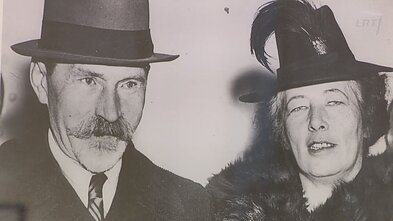










January 9 marked the 80th anniversary of the death of the first Lithuanian President Antanas Smetona. He fled Lithuania in 1940, as he did not want to be a “puppet” in the Soviet occupiers’ hands. His life in exile was marked by rejection and poverty, says Ingrida Jakubavičienė, a historian at the Historical Presidential Palace in Kaunas.
On June 15, 1940, the first Lithuanian President Smetona and his family left Lithuania. He decided to take this step as he did not want to remain in the Soviet-occupied country.
At the last meeting of the Lithuanian government, which took place on the morning of the fateful day, Smetona put forward the idea of armed resistance, which was not supported, Jakubavičienė says.
“President Smetona was the first to say that ‘we cannot accept these demands of the Soviet Union and we must resist’. Unfortunately, this position was not supported by the Armed Forces commander, nor by the ministers who were present. Only a couple of ministers supported Smetona’s position.
“Today, it is difficult to explain logically what happened to those statesmen who suddenly wanted to have it out with the president in such a tragic situation. For some reason, it seemed to them that Lithuania’s only problem at the time was the authoritarian leader who had been in power for too long and that by getting rid of him, it would be possible to reach an agreement with the Soviets. But this was the biggest mistake,” the historian explains.

According to her, Smetona then realised that remaining in occupied Lithuania would only make him “a puppet in the hands of the Soviets”, so he decided to leave the country.
Crossing the brook
There were already Soviet garrisons in Lithuania at that time, so Smetona’s journey from the Presidential Palace in Kaunas to the border was risky. He was accompanied by security officers.
“His wife Sofija was in the family residence in Užugiris at the time. [...] She was told over the phone that she needed to take the car to Kybartai,” the historian says.
According to her, if Smetona’s wife had not arrived at the border in time, the president would probably not have left Lithuania without her.
"He wrote in his memoir: ‘I was really worried and waited for my wife to show up.’ Only when he saw that his wife had arrived did he decide that they could try to leave for Germany together,” Jakubavičienė says.
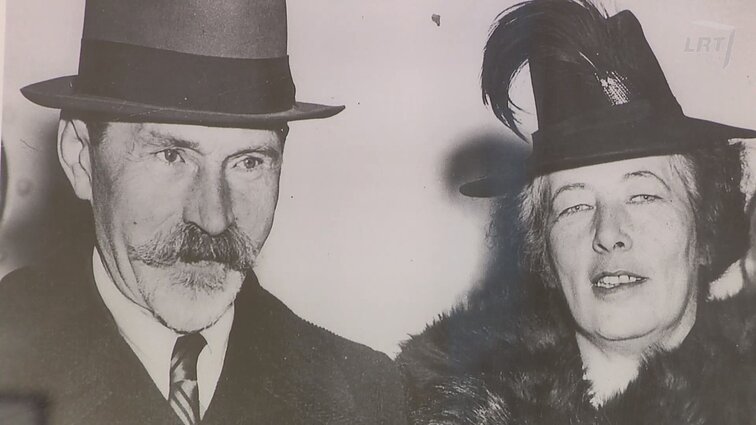
The Soviets were surprised to learn that Smetona had left Kaunas, she says. They had planned that the president would sign documents after Lithuania was occupied. Therefore, the occupiers sent Colonel Pranas Saladžius and Smetona’s former adjutant Vaclovas Šliogeris to the border with the request “to bring the president back to Lithuania”.
“But with the help of a local lawyer, the president and his security officers crossed the brook and walked through the woods to the Eitkūnai border post on the German side,” the historian explained.
Here, Smetona waited for a call from Berlin telling whether Adolf Hitler would allow him in. Meanwhile, his family members – his wife Sofija, daughter Marija with her husband, and son Julius with his wife and a young daughter – managed to cross the border as ordinary citizens.
Leaving for the US
When Smetona and his family found themselves in Germany, the president was informed that Hitler welcomed him only for a short period, so he had to think about where to go next.
“President Smetona really wanted to stay in Europe, as close to Lithuania as possible. It seemed to him that if he stayed closer to all the events that were directly related to Lithuania, perhaps there would be a chance for him to return or somehow turn those events around.
“However, very soon he realised that he was not wanted in any European country. No European government wanted to anger either Hitler or Stalin, so it quickly became clear that he would have to go to the US,” Jakubavičienė notes.

Smetona and his family obtained the US visas quite quickly, as they were vouched for by former American diplomats, who asked the government to grant them the documents by way of exception.
However, Smetona then faced financial difficulties, as the family had to go to Portugal and take a boat to the US. The savings of around 10,000 US dollars the president withdrew from a bank account in Kaunas were running out, so he had to borrow money for the expensive trip.
Not welcome
Smetona disembarked at the port of New York on March 10, 1941 – nine months after he fled Kaunas. Only Lithuanian-American nationalists, who supported Smetona’s “nationalist policy” met him at the port. Meanwhile, the Christian Democrats, the socialists, and the communists did not welcome the president.
According to Jakubavičienė, Smetona also faced strong opposition from Povilas Žadeikis, the Lithuanian envoy to the US in Washington. The latter took steps to ensure that Smetona had as little involvement in the political life of Lithuania-Americans as possible.
“Žadeikis’ position was rather selfish,” says the historian, adding that the diplomat did not even accept Smetona into the diplomatic mission building when he and his family had nowhere to stay.
Although it was difficult for the president to engage in any political activity in exile, he sometimes appeared in the press, talking about the Soviet occupation of the Baltic states. He also travelled around the US to give lectures but was constantly denounced by his opponents.
“I have seen more than one document in the archive on how Lithuanians complained to the FBI that Smetona was a communist agent and that they needed to find out what lectures Smetona was giving on the theme of February 16 and other patriotic celebrations in Lithuania,” Jakubavičienė explains.

Poverty and death
Smetona’s life in the US was poor, says the historian of the Kaunas Presidential Palace. He was paid a salary of only 800 US dollars, from which he had to provide for the big family.
“The house where he died was in a working-class neighbourhood, and he only rented part of it. A Swedish family lived on the ground floor, and his son Julius with his wife and two small children lived on the first floor. Only the attic of two small rooms was occupied by the president and his wife,” Jakubavičienė says. “It was always cold there, and both the president and his wife were often ill.”
However, what hurt Smetona and his wife Sofija the most was realising that “after having sacrificed their entire lives for Lithuania, they suddenly felt as if they were not welcome anywhere”.
The first Lithuanian president died on the morning of January 9, 1944, when a fire broke out in the basement of his home, and toxic smoke spread to all floors of the house.
“The fire was noticed by a neighbour who lived across the street [...]. She immediately rushed to inform the residents on the ground floor about the fire,” Jakubavčienė says.
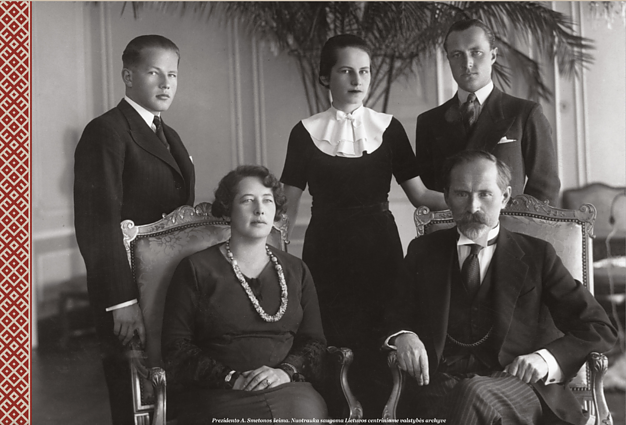
The ground floor resident and the family of Smetona’s son Julius managed to get out of the house safely. Sofija also got through the smoke plumes out on the street, but the president was trapped.
“President Smetona had been seriously ill with the flu the week before, and he knew that he had to get ready to take part in a very important Lithuanian-American event on February 5. Realising that he had to run out into the -20-degree cold, he thought that he should still put on his coat. Then, through the smoke, he could no longer see the exit,” Jakubavičienė explains.
When the firefighters arrived, they found Smetona not in the attic but on the first floor of the house, lying on the floor with a fur coat over him. He was taken to the hospital where he was pronounced dead.
“The president had suffocated,” the historian says.

Newsletter
Every Friday morning.