














While Lithuania’s political leadership agrees that the country needs to significantly increase its defence spending, discussions continue about how to finance it.
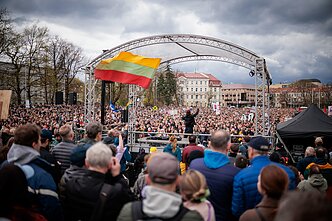
The debate on whether and what kind of defence taxes are needed unravels in government halls as well as on the streets. Opinions vary on the need for a specific defence tax.
“In principle, there can be a tax, but everyone must contribute, not just the individual people,” a man interviewed in Panevėžys tells LRT TV.
“We need more defence, we need to be safer, calmer, and more peaceful,” he adds.
Others are more sceptical about additional taxes.
“I think as a taxpayer I already pay a large enough share,” says a woman.

“What tax for defence? It will impoverish people completely,” says a man in Panevėžys.
Those in favour or more spending on defence would prefer a specific tax rather than, for example, a hike in the value added tax.
“I don’t know, maybe 50 euros per year,” says a woman from Šiauliai when asked how much she would be willing to pay.
“It has to be a separate tax, the VAT is already high, let it be a separate tax, at least you’ll know how much you pay,” she adds.
Some suggest that the tax should be voluntary.
Further reading
Inga Ruginienė, the president of the Confederation of Trade Unions, insists that additional taxes should not fall on the shoulders of all people.
“We need to go back to the tax reform proposed last year, where it was suggested that higher income earners could contribute more to the common good, and this would be an opportunity to do so,” says Ruginienė.
According to her, the VAT rate is already high in Lithuania, while the corporate tax paid by companies can still be raised.
“Businesses need to understand that it is not just the ordinary citizens who have to pay for everything and plug the holes in the budget,” Ruginienė says.
Small businesses say that there is no need for new taxation at all, suggesting that the government should use part of the VAT already in place.
Dalia Matukienė, chairwoman of the Council of Small and Medium Enterprises, recalls that the government raised the tax from 18 to 21 percent to deal with the 2008 financial crisis, promising that the hike was temporary and the rate would go back down. “Since the government has failed to deliver on this, our proposal is to take that 3 percent and divert it to defence,” she says.
The big business, meanwhile, advocates a universal tax.
“The business community understands that there’s no way around this, because we do business here,” says Andrius Romanovskis, president of the Business Confederation. He cites Cyprus as an example where both individuals and companies pay the tax.
Moreover, the business community would like to see part of the defence budget spent on local production.
“To the best of our ability, we won’t be making tanks, of course, but there are many other components that can be and are produced by Lithuanian industry, but we want 50 percent of the defence spending to stay in Lithuania. Taxes would be paid on that, which would increase our budget,” argues Vidmantas Janulevičius, president of the Confederation of Industrialists.
The entrepreneurs stress that the tax must be clearly dedicated to defence only and insulated from any changes that could be attempted by successive governments.

Newsletter
Every Friday morning.