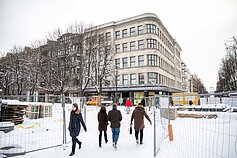








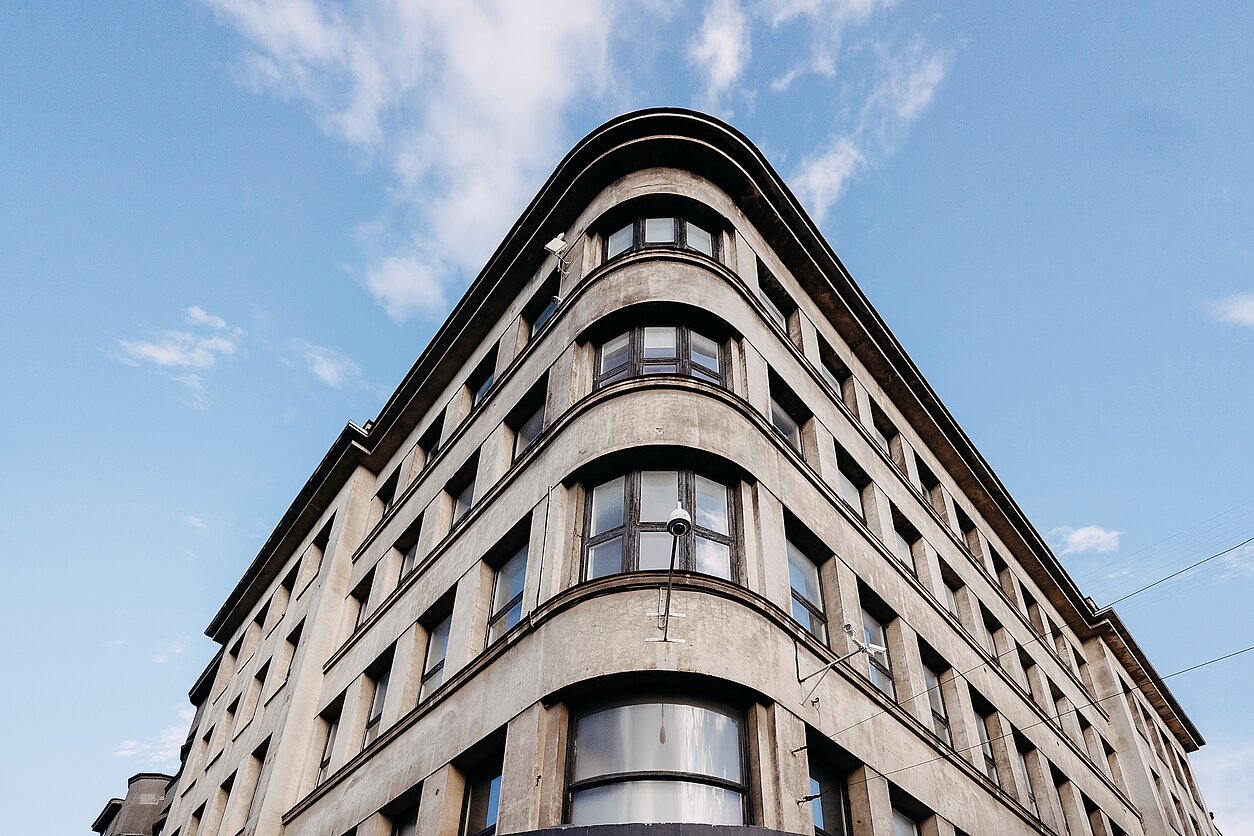
Kaunas interwar architecture has recently earned a place on the UNESCO World Heritage list. Developed in a very short period, in the 1920s and 1930s, this modernist part of the city was meant to represent the fledgeling statehood of the first Republic of Lithuania. Here are some of the icons of modernist Kaunas.
Icons of modernist Kaunas I: monumentalising nation, history, and modernity
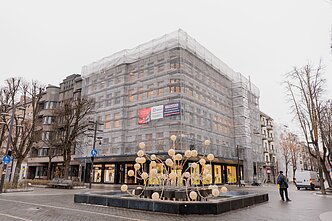
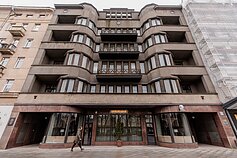
The diversity of stylistic expression of Kaunas modernism is well exemplified by two adjacent buildings on Laisvės Avenue: the Pienocentras building (55 Laisvės av. / 18 Daukanto St.) and Pažanga building (53 Laisvės av.), says architectural historian Jolita Kančienė.
The Pienocentras building is a distinctly minimalist piece of architecture, where proportion and rhythm play a key role, she says. The exterior of the Pažanga building highlights diverse forms and decorative elements, making it a showcase of national art deco modernism.
Both buildings are five storeys high, attesting to the desire to give the city a metropolitan big-city look. In both buildings, the ground floors are commercial, the middle floors are for offices and the upper floors are residential. “This layering of functions is also popular in the office buildings that are being built today” notes Kančienė.
Piece of America: Pienocentras building
Pienocentras (Dairy Centre) was until 1927 the central union of cooperative milk processing companies in Lithuania, which was engaged in the production, sales, and exports of dairy products. It later expanded its activities, buying up and exporting eggs, selling fruit and making juice.

The company established dairy plants all over Lithuania, built a huge production complex on the banks of the Nemunas River, in what is now Karaliaus Mindaugo Avenue, and had 14 specialised shops in Kaunas alone, as well as five snack bars that served sour milk and hot potatoes, says Kančienė.
The administrative building for Pienocentras was designed by the architect Vytautas Landsbergis-Žemkalnis, who won the architectural competition in 1931. The building was constructed with a reinforced concrete frame, designed by the renowned specialist Pranas Morkūnas. When they saw the unusual skeleton of the building, locals called it “American construction”. Horizontal scrolls dominate the corner part of the solid volume, framed by vertically divided planes at the ends.

The rounded corner of the building was emphasised by bent glass windows, which also frame the main entrance. The ground floor, with its shop windows and polished black labradorite finish, is a clear highlight of the exterior, covered by a glass canopy.
The building was recognised at the 1937 International Exhibition of Art and Technology in Modern Life with a bronze medal and a diploma of honour, says Kančienė.
The ground floor housed a shop, a diner and a milk bar, as well as the famous Murali hairdresser salon stretched over two floors and was designed by the German-born architect Arno Funk.
The search for national expression: Pažanga building
Pažanga (Progress) was a publishing and distribution company founded in 1928 by the ruling Nationalist Party, whose leader was President Antanas Smetona. The company’s headquarters, built in 1934 according to the design of engineer Feliksas Vizbaras, housed various party bodies and organisations under its patronage, including the nationalist youth union Young Lithuania, the Lithuanian Teachers’ Union, the Central State Library, the publishing company Dirva, the editorial offices of the magazine Vairas and the government newspaper Lietuvos Aidas.

The third floor of the building, Kančienė continues, used to house the Nationalist Club, a restaurant and a bar open to all, and a terrace on the flat roof.
“All visitors had access to an elevator, which was not a common facility in Kaunas at that time. On the fifth floor, a spacious five-room apartment was reserved for the chairman of the Pažanga company, the chief chaplain of the Lithuanian army, Vladas Mironas. The first floor was rented by a haberdashery shop and a bookshop. The building had a meeting room under the inner courtyard, lit through a glass-block ceiling. During the Soviet era, the courtyard was filled with asphalt,” the architectural historian says.
Vizbaras, the architect, designed the main façade of the building as a spatial-cultural composition, the emotional impact of which he had already tested in the Central Post Office, Kančienė notes.
“The ornamentation of the various functional and decorative elements, inspired by Lithuanian folk art, reflects the search for national expression in architecture,” she adds.
Iconic window and Italian spirit
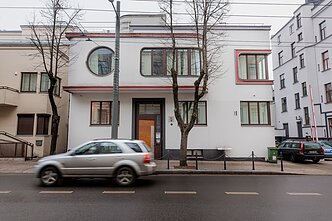
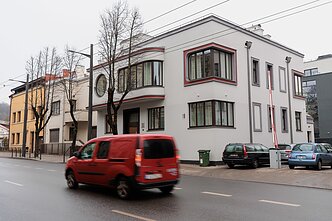
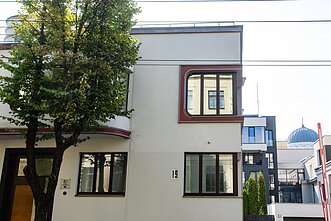
For Dainius Lanauskas, an enthusiast of interwar architecture, furniture collector and restorer, the favourite building in Kaunas is the so-called Iljinai House (19 Donelaičio St.).

He notes that the round window of this residential house attracts the attention of everyone driving or walking along Donelaičio Street. The window, which reminds of a ship illuminator, has become a symbol of the Kaunas modernist architecture as a whole, underlines the technical progress of the time.
“Modernist architects brought technical innovations into living spaces. It is also interesting that the round window became the symbol of Kaunas’ UNESCO application,” he notes.
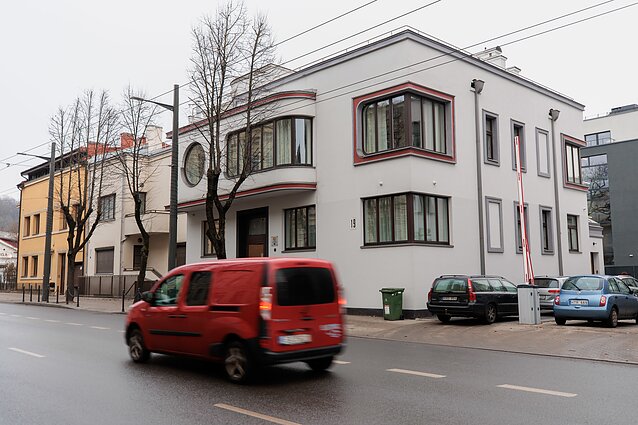
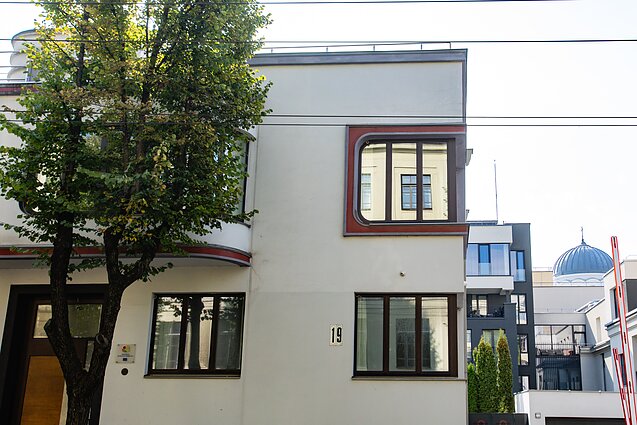
The house, built in 1933, was the work of the talented German-born architect Arno Funk. It was owned by the railway engineer Jurgis Iljinas and his wife Aleksandra. When the family bought the plot, it came with the finished designs to be constructed. Funk, who had graduated in Berlin and started his career in Kaunas, did not have a licence yet so the drawings were signed by his father-in-law Silvestras Grinkevičius.
Another favourite of Lanauskas is a less well-known but no less valuable interwar gem, the impressive villa of architect Stasys Kudokas (11 Mykolaičio-Putino St.). It stands out, among other things, for its unusual location on the steep slope.
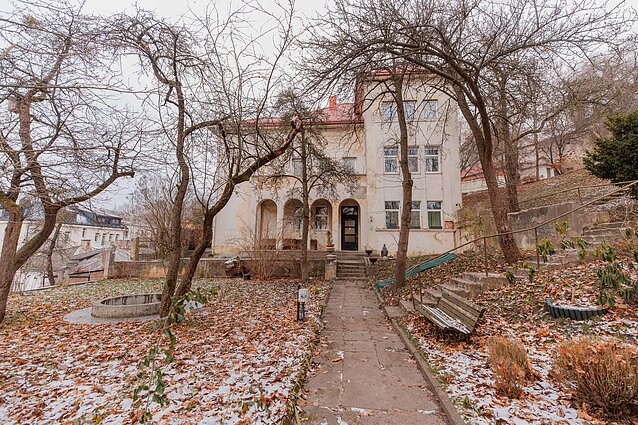
“Kudokas was educated at the Royal School of Architecture in Rome, Italy, and he studied many houses built on slopes, so he was not intimidated by the challenge,” Lanauskas notes.
Kaunas inter-war architecture, he says, is rich in features of the Italian and Berlin schools of architecture. New ideas, he explained, were brought to Kaunas by architects who had spent time in foreign countries.


Newsletter
Every Friday morning.