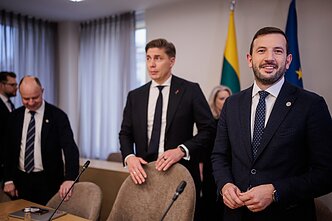











NATO’s rotational air defence presence in the Black and Baltic Sea regions would be an appropriate response to the Russian threat, Lithuanian Foreign Minister Gabrielius Landsbergis said as he hosted his Romanian counterpart Luminița Odobescu in Vilnius.
NATO allies agreed on such a model last June, but it has not yet been implemented. The Baltic countries are currently in discussions with countries that could deploy air systems to the region.
“I believe a rotation of air defence both in the Black Sea region and in the Baltic region would be an appropriate response to the Russian escalation that is already taking place,” Landsbergis said at a joint news conference with Odobescu on Thursday.
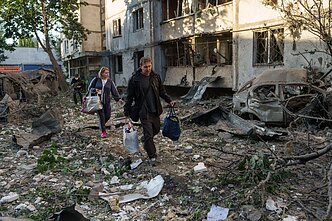
A Russian drone crashed on Romanian territory during Moscow’s attack on Ukraine’s port infrastructure last December, following a similar incident in September. A Russian missile also entered Polish airspace in late December.
“Actions like the drone crashes, even if seemingly unintentional, are escalation. They would not be happening if Russia were not waging war against Ukraine,” the Lithuanian foreign minister said.

Odobescu said these incidents highlighted the security situation in the Black Sea region, not just Ukraine.
The Romanian minister underlined the importance of implementing the commitments agreed on at NATO’s Vilnius summit.
“One of these is related to security in the Black Sea region, but also with full implementation of regional plans and increased military presence in our region,” she told the news conference.
On the eve of the Vilnius summit last July, NATO approved new regional defence plans reflecting changes in the alliance’s strategy.
Previously, the approach was that the Baltic countries should try to hold off an offensive until allied reinforcements can arrive to help them. The new plans aim to ensure that NATO is ready to fight back immediately.

Call for deal on new Russia sanctions
Landsbergis also stressed the need to agree on the strongest possible new package of sanctions on Russia before the second anniversary of the war in Ukraine in late February.
For her part, Odobescu said that her country will support Ukraine “as much as needed”.
“Moreover, allowing Ukraine to achieve its objective according to its own choosing, rendering justice to the victims and fighting against impunity – all this remains a fundamental objective not only for Ukraine but also for us,” she said.
Romania remains firm in its position that only Ukraine has the political and moral legitimacy to decide whether it wants to negotiate with Russia.
At their meeting, the two ministers also discussed Romania’s efforts to increase its capacity for transporting Ukrainian grain, and measures to support Ukrainian refugees.
According to the Reuters news agency, Ukraine is one of the world’s biggest grain exporters, and the Romanian port of Constanta has become Kyiv’s largest alternative export route since Russia’s full-scale invasion in February 2022.

Newsletter
Every Friday morning.