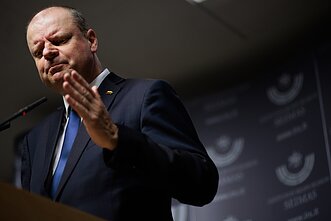











“During the Soviet era, when the collective experience of religious celebration was severely curtailed, Christian celebrations became confined to the family circle. There, it quickly became an empty mantra or even a caricature of customary elements,” says historian Arūnas Streikus.
According to him, during the Soviet era, Christmas turned into an exotic celebration, and it was not very clear what it meant. The Soviets also sought to substitute the religious holiday with the New Year celebration, the traditions of which are still alive today.
How was Christmas being undermined in the Soviet public sphere? The newspapers of the time were full of atheistic articles explaining the origins and meaning of the festival.
Yes, before the main Christian holidays, the Soviet press printed at least one article about the Church’s allegedly invented legend of the birth of Christ, about priests collecting alms as a source of income, about Christianity’s adaptation of a pagan festival for its own purposes, and so on.
The book “Catholic Religious Festivals and Rites” by Jonas Ragauskas, a former priest and a devout atheist, was also published in several editions. The book interpreted the origins and functions of religious festivals from an atheist perspective.
What other measures did the Soviet regime take to stop or at least make it more difficult to celebrate Christmas?
The first and most important measure was to remove Christmas from the calendar of holidays and erase it from people’s memories. Even if in some years Christmas fell on a weekend, efforts were made to organise official government events on Christmas Eve so that people would not go to church and would have as little time as possible to gather for a festive dinner.

As with other major Christian holidays, an alternative to overwhelm and supplant the religious celebration was sought. In this case, it was convenient that there was a very short period of time between Christmas and New Year. This allowed the New Year to be used effectively as a tool to diminish the significance of Christmas.
What were the risks of celebrating Catholic holidays and going to church in the Soviet Union?
There were probably no tangible consequences for those who didn’t hold higher positions, weren’t members of the Communist Party, and didn’t work in the ideological or educational sectors.
Moreover, with the rapid secularisation of society, the habit of associating Christmas with religious practices was weakening quite quickly. Often, the decision to neglect the religious side of the celebration was (and still is) easy to justify to oneself as being determined by external prohibitions.
What was the logic behind the encroachment on Christmas in the Soviet Union?
The main reason for targeting religious festivals was to reduce the influence of the Catholic Church, which still had a strong authority. After the end of the armed resistance, it was the last and greatest obstacle to the Sovietisation of society. With no means of completely erasing Christian festivals from the Lithuanian calendar, efforts were made to at least wash away their religious content.
Alongside the parallel processes of secularisation that characterise modern societies, this led to the loss of the religious meaning of Christmas and Easter. We are seeing the consequences of this now. Christmas has a religious meaning for only a small part of the Lithuanian population who consider themselves Christians. For many it is, at best, only a cultural tradition.
You mentioned that the New Year was the tool to diminish the meaning of Christmas. How did people celebrate it?
Many of the attributes of the Soviet era New Year celebrations are still popular today, including Olivier salad and copious consumption of champagne and other alcoholic beverages.

In Soviet times, children used to wait for Ded Moroz and Snegurochka. How were these characters different from Santa Claus?
Ded Moroz and Snegurochka were deliberately created as a substitute for Santa Claus in the Soviet Union. They emerged after the Second World War. The gifts were, of course, more modest than they are now. Children could be cheered up by oranges that were a rarity, tastier sweets, or deficit toys.
On the one hand, it created a Soviet prototype of Santa Claus in the Coca-Cola pre-war advertising campaign. On the other hand, it reinforced the carnival element of the Soviet New Year, which had to accustom people to this holiday.
As far as I know, before the war, the idea of the Western Santa Claus reached only the Lithuanian city. In the countryside, it was not well known. Ded Moroz and his companion were new characters to most people, and I wouldn’t say that they were unattractive.
What were the differences between the celebrations in the countryside and the city?
At least in the first two decades of Soviet rule, the difference was quite significant. First, even after the establishment of collective farms, almost nobody worked on holidays in the countryside for a long time, as people were not forced to do so.
The older generation that stayed in the village kept a more authentic connection to the religious meanings of Christmas. Even priests were not forbidden to visit the homesteads of parishioners until the early 1970s. Those who were not advised to go to church because of their position often came to the countryside to celebrate Christmas.
Before the destruction of the homesteads and the mass construction of urbanised collective farm settlements, Christmas in the countryside was essentially the same as before the occupation.

How have Lithuanians managed to preserve their traditions, customs, and religion?
For many, especially those born after the Second World War, Christmas Eve dinner primarily meant a family feast with traditional culinary attributes: herring, kūčiukai, kissel, and poppy milk.
Before the occupation, Christmas celebrations usually moved to a public space after family dinners. During the Soviet era, when the collective experience of religious celebration was severely curtailed, Christian celebrations became confined to the family circle. There, it quickly became an empty mantra or even a caricature of customary elements.
In the 1980s, the Soviet holiday theorist Petras Pečiūra acknowledged that Christmas and Easter were still celebrated in families. However, he was probably right when he claimed that it was “no longer a religious mood, but a mood of specific interesting meals”.
So, can we say that the Soviet bans not only failed to produce the desired results but also helped Christmas become a symbol of religious and national strength?
I wouldn’t agree with that. During the Soviet era, New Year became more important in the calendars of many Lithuanians. Christmas was more of an exotic station in the cycle of the year when it was not very clear what it meant.
Nowadays, it is not uncommon to hear that in Soviet times, unlike now, people decorated their Christmas tree at home only on Christmas Eve. But did they really decorate the tree in anticipation of Christmas and not in anticipation of the New Year, which was only a week away?

Newsletter
Every Friday morning.