












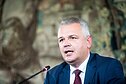


While Taiwanese Foreign Minister Joseph Wu was visiting the Baltics last week, his Lithuanian counterpart Gabrielius Landsbergis unexpectedly announced the possible normalisation of diplomatic relations with China. Does this indicate a turn in Lithuania’s foreign policy?
In 2021, Lithuania allowed Taiwan to open a representative office under its name in Vilnius. At the time, Landsbergis spoke about the value-based foreign policy and Lithuania’s desire to strengthen relations with democracy-loving states in the Far East.
But when China downgraded diplomatic relations with the Baltic country and imposed a de facto embargo on Lithuanian imports, things started to change.
Further reading
Although Lithuanian MPs are visiting Taiwan, no official government meetings between the leaders of the two countries are taking place. Landsbergis also did not meet with his Taiwanese counterpart when he was visiting Lithuania last week.
“We subscribe to the ‘one China’ policy, which implies that we have no official contacts [with Taiwan],” Landsbergis explained last week.

Lithuania now says that it maintains economic and cultural, but not diplomatic, relations with Taiwan. But economic interests also require official meetings, according to political analyst Marius Laurinavičius.
“The development of economic interests essentially requires to have the closest possible relations. I believe the meeting was necessary,” he told LRT.lt.
Lithuania is expected to reap the economic benefits of rapprochement with Taiwan. In January, Lithuanian IoT company Teltonika and Taiwan’s Industrial Technology Research Institute signed a deal to share semiconductor chip technology. In September, it was announced that Taiwan will invest in biomedical research in Lithuania.
However, if Lithuania starts to turn away from its bold foreign policy, the list of benefits may end here, Laurinavičius argues.
“Now Lithuania is already lagging behind other countries, such as Germany or the Czech Republic. The only advantage we had over other countries is our policy of helping Taiwan to break out of its international isolation,” he said.
“My biggest criticism is this personal position of Landsbergis, which is completely inconsistent. We started by allowing Taiwan to open a representative office, which I welcome because it was a strategically sound move, and then we turned the whole policy 180 degrees and started looking to China,” the analyst added.

Meanwhile, Zsuzsa Anna Ferenczy, associate professor at Dong Hwa National University in Taiwan, says there are no changes in Lithuania’s policy towards Taiwan, and the fact that the ministers did not meet should not be seen as a huge mistake.
“After two years, I don’t see any deterioration in bilateral relations,” she told LRT.lt.
Following EU line
In an interview with LRT TV on Thursday, Joseph Wu noted that from Taiwan's perspective, relations with Lithuania are “developing well”.
“Lithuania has supported Taiwan in a way that no other country has. Moreover, both countries are facing huge challenges on the geopolitical stage. Lithuania faces the threat from Russia, while Taiwan faces the threat from China. In this context, the people of Taiwan feel a very close bond with the people of Lithuania,” the Taiwanese minister said.
Lithuania was the first to leave China’s 17+1 format and announce greater cooperation with Taiwan, which not only allowed Lithuania to attract investment but also helped Taiwan build its image as a reliable partner.
“Taiwan’s importance has increased not only in Lithuania but also in the region,” Ferenczy said.
According to the expert, Lithuania and Taiwan need time to identify their desires, strengths, and weaknesses in their relations, but it should also not be forgotten that Lithuania is a member of the EU. The bloc’s policy towards China limits Lithuania’s relations with Taiwan, according to Ferenczy.
“Lithuania needs to work in a 27-nation bloc. It is more valuable for Lithuania and for each member state to move forward together with the rest of the EU when it comes to China, as the recent difficult experience of Lithuania has shown,” she stressed.

Last week, Thierry Breton, EU Commissioner for Internal Market, pointed out that the bloc was seeking to re-engage with China ahead of a major summit on December 7-8.
“For me, this was an opportunity to rebalance our relationship, to reduce the risks to our economies and societies, [...] and to tackle global challenges together,” he said after meetings in Beijing.
On the same day, Landsbergis announced that Lithuania and China were in talks to normalise relations, which was probably not a coincidence.
However, it is still difficult to define what “normalisation of relations” could mean, not only in the EU but also in the Lithuanian context.
“Normalisation probably means following the EU political line. I assume that it does not mean the end of cooperation with Taiwan, but it is too early to draw conclusions,” Ferenczy said.
Assessing Landsbergis’ actions, political analyst Laurinavičius said that there could be various reasons for this, including fear of worsening relations with China, pressure from the president or the opposition, or even the foreign minister’s future plans and ambitions.
“The mix of these reasons can lead to inconsistent policies,” he said.
Further reading

Newsletter
Every Friday morning.