















The highly concentrated banking sector in Lithuania, offering lofty profit margins, does not appear to invite more competition, despite the government’s efforts to attract new banks.
Konstitucijos Avenue which runs past most of the Vilnius skyscrapers is turning into a banking street. Four commercial banks are headquartered here, with one more moving in from January.
Not only this location but the banking sector itself in Lithuania is highly concentrated. Three big banks dominate the market.
The country’s politicians and banking regulators agree that it is a problem, but the only solution they envisage is getting more commercial competitors to enter the market. Last week, it was one of the topics discussed by Finance Minister Gintarė Skaistė and her German counterpart.
“I think this is a good business opportunity. We have seen interest from various private sector players, but in any case, it is their decision. I think it can happen because there is certainly interest. But the result is not so quick because it takes time,” Skaistė told reporters.
German Finance Minister Christian Lindner, however, said he had no information about any German banks considering expansion into Lithuania. Either way, the “decision is for the private sector to make”, even if there are “no obstacles from the German government”, he stressed.
Further reading
According to the Bank of Lithuania, the country is looking for medium-sized or large banks with a strong deposit base to enter the market and offer cheaper services to the population.
This year alone, the central bank has held individual meetings with 21 foreign banks. In total, 80 have been contacted this year.
However, a former head of analysis at the Banking Association says he sees neither structural nor economic reasons for foreign banks to enter the Lithuanian market.
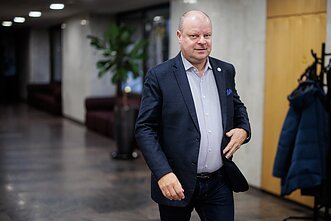
On the contrary, there are some that want to leave, insists Vilius Tamkvaitis, currently a senior analyst at the Investors’ Forum, a lobby group for big foreign investors.
“I count over 10 banks that, to my knowledge, are currently looking for investors, looking for buyers,” he tells LRT TV.
If any new players are coming to Lithuania, he says, it will most likely be by acquiring an already operating bank. “That would be a much easier and faster way to reach the market, to build a loan portfolio, to have a client base,” according to Tamkvaitis.

A month ago, the Bank of Lithuania announced that a new bank is definitely coming to Lithuania – without giving any more details.
Last summer, Spain and Poland were mentioned. Of all the Polish banks, only the government-controlled one showed interest some five years ago.
Kęstutis Kupšys, member of the European Economic and Social Committee, reckons it wouldn’t be easy for a state-owned player to enter Lithuania.
“It would be in a constant dilemma how to develop its business here and, at the same time, please political circles in Poland and Lithuania. But what happens if suddenly there’s a change of the ruling coalition in one or both countries at the same time? Such political anchors can prevent the bank from operating freely,” he says.
In Lithuania, currently, 13 companies have banking or specialised bank licenses, and there are also six branches of foreign banks.
This does not mean, however, that ordinary consumers can have their pick from all of them. Some only operate electronically.
“A new bank, especially if it were physically here, with branches, with tellers, with service, with a telephone line to answer questions, with a live person to consult, that would be a huge advantage,” says Kupšys. “At least we can hope that first there would be a greater variety of services and then, presumably, banks would start to compete more on prices, margins, service rates.”

Lithuanian banks made a profit of 515 million in the first half of the year, 2.5 times more than in the first half of last year. This is largely thanks to the European Central Bank’s hikes in interest rates. Banks in Lithuania have been charging high interest rates on their loans, without a corresponding increase on deposits.
Part of these windfall profits are to be taxed away by the temporary “solidarity levy”, expected to contribute 440 million euros to the government coffers over the coming couple of years.
Tamkvaitis, of the Investors’ Forum, says that while the profits seem impressive on paper, they come with risks due to the Baltic countries’ geographic proximity to Russia. Moreover, he argues that the windfall profit tax represents a disincentive.
Kupšys, of the European Economic and Social Committee, says that many other European countries could introduce similar taxes, so it does not make that much of a difference when it comes to investment decisions.

Newsletter
Every Friday morning.