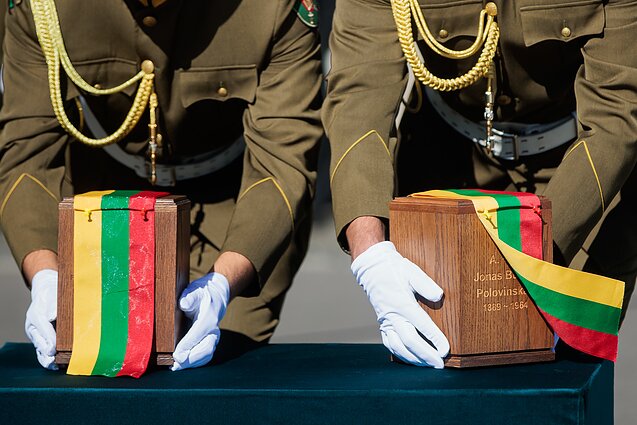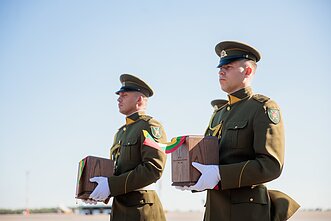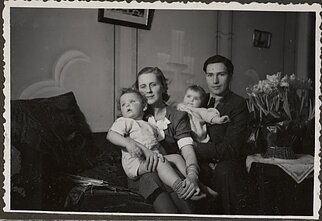
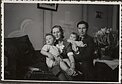





The remains of Jonas Polovinskas-Budrys, one of the organisers of the Klaipėda Region’s incorporation into Lithuania in 1923, and of his wife were brought from Chicago in the United States to Lithuania on Thursday.
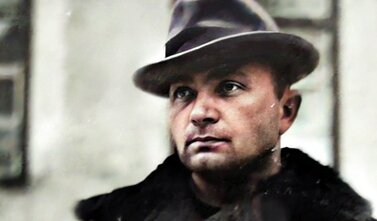
Polovinskas-Budrys, a counterintelligence officer and diplomat, was the commander of Lithuanian forces during the so-called Klaipėda Revolt in January 1923 and the region’s first governor.
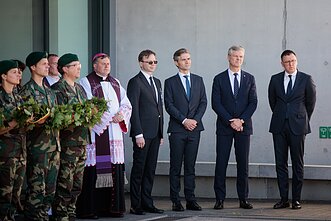
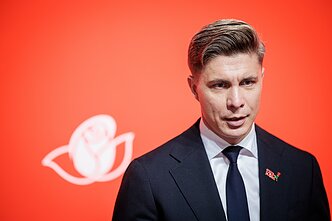
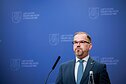
“I thank for this operation – logistical, sacral and historical – that has brought his remains back to Lithuania, to Klaipėda,” Deputy Foreign Minister Jonas Survila said on Thursday.
The vice-minister described Polovinskas-Budrys as an intelligence officer, soldier, diplomat, and statesman in the broadest sense.

He said that the January 1923 operation that led to the Klaipėda Region’s incorporation into Lithuania 100 years ago was a “unique political, diplomatic, and military operation that we can be proud of and from which we can draw inspiration today and tomorrow”.
Jeff Budrys, a grandson of Polovinskas-Budrys, said he was proud of his grandparents.
Timothy Budrys, another grandson of the diplomat, said he was impressed by the respect shown to his grandfather and grandmother at Thursday’s the ceremony.
In his memoirs and comments in the Lithuanian diaspora press, Polovinskas-Budrys said he was proud of the “liberation of Klaipėda” and considered his leadership of the operation as “a great honour”.
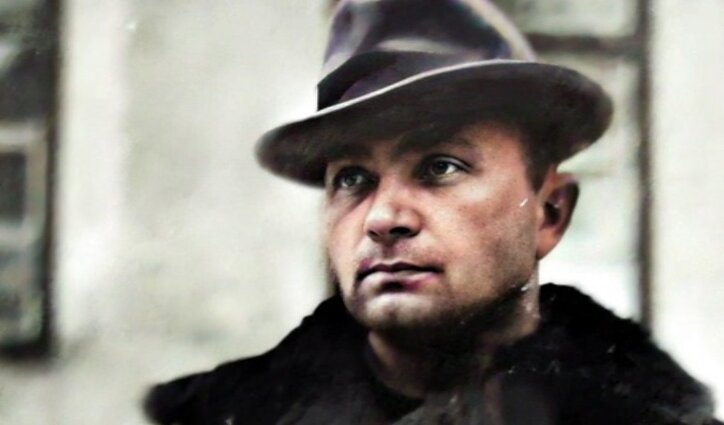
The city of Klaipėda – or Memel, as it was known in German – was part of East Prussia until the end of World War One, when it was detached from Germany and put under a temporary administration by France. Both Poland and Lithuania campaigned for their right to the region. However, with a tacit support from Berlin, Lithuania sent soldiers in civilian clothes in 1923 and staged a revolt, after which the German-speaking town and its mostly Lithuanian-speaking hinterlands were incorporated into Lithuania. However, Nazi Germany took it back on the eve of World War Two.
Polovinskas-Budrys and his wife Regina Kašubaitė-Budrienė were buried in the Lithuanian cemetery in Chicago, but he had expressed his wish to be buried in his homeland.
The reburial ceremony will take place at Klaipėda Sculpture Park on Friday.

Newsletter
Every Friday morning.