











Russia continues to fight in Ukraine according to its doctrine, but now, it no longer has the reserves to maintain its defensive lines. This is not the only problem facing the Kremlin, and it is becoming more and more difficult for the regime to find a balance in critical situations, Riley Bailey, an analyst at the Institute for the Study of War (ISW), says in an interview with LRT.lt.
Let’s first talk about Ukraine’s counteroffensive. Mark Milley, chairman of the US Joint Chiefs of Staff, says that Ukraine still has plenty of reserves for this counteroffensive. Would you agree with such an assessment?
Ukrainian officials have routinely indicated that they have not launched the main phase of their counteroffensive operations. And we have seen both from Russian and Ukrainian sources that there are many new manoeuvre brigades that Ukraine created specifically for the counteroffensive. So, I would say that Milley’s statements are true.
How prepared are the defending Russian forces for Ukraine’s counteroffensive?
Russians continue to conduct defensive operations, at least in southern Ukraine, where they had prepared to receive a mechanised Ukrainian assault. They continue to appear to be conducting a defence according to Russian doctrine. This is where a first line of units will try to slow and degrade Ukrainian assaults, and then a second line of units will come and counterattack to roll back Ukrainian assaults.
We’ve seen that pattern of lot – operations where Ukrainian forces gain a little bit of ground and then Russian forces counterattack and push those forces back. That has been probably the most instrumental part as to why Russian defences have proved pretty difficult to overcome for Ukrainian forces.
But there are a lot of indications that those defensive positions are brittle. ISW assesses that Russian forces do not have operational reserves that they could introduce in the case of a Ukrainian breakthrough. We see a lot of the current formations in units that Russian forces have committed to the front line, and those units and formations are not being rotated out. As time goes by, those units and formations become more degraded as they defend against Ukrainian operations.

The Ukrainian counteroffensive right now is trying to attract Russian forces and kind of create breaks and gaps in the defensive line that they then can exploit for a breakthrough. Right now, I would say, the greatest Russian weakness is the continued degradation and the fact that they don’t have reserves to bring in fresh units and try to replenish those degraded forces.
Could Russians announce another wave of mobilisation in the near future for this reason?
It’s definitely possible. [...] I think they learned a lot of mistakes from the last partial mobilisation wave that created a whole lot of internal discontent and logistical and training issues. We’ve seen that the Kremlin was forced to address those issues, and it currently looks very unlikely to launch that mobilisation wave.
I think a lot of the discontent they saw was concerning for them, and for the sake of internal security and stability, they don’t want to launch that now. They might be forced to do so if the Ukrainian counteroffensive progresses, as that’s very much what prompted the last mobilisation wave [...].
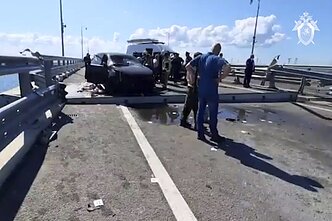
The Crimean Bridge has undergone the second attack since the start of the large-scale invasion. We also see the panic rising as Crimea, which was supposed to be an untouchable fortress, seems to be losing that status. What is the importance of this bridge from a military perspective?
The Kerch Strait Bridge is probably one of the most notable bottlenecks in Russian logistics. It is one of Russia’s most important transport links. Russian forces in southern Ukraine can be supplied either through a longer highway that goes through much of occupied Ukraine or this single bridge that goes through occupied Crimea.
We saw after the last attack in October that Russian logistics were very much degraded for a while. Russian forces had to fix the bridge, which reduced how much traffic could go through, and they also intensified security regimes, which slowed down the movement of military personnel and equipment to areas in southern Ukraine.

Degrading Russian logistics so that it’s harder to supply personnel and equipment to frontline positions is very much an element of the ongoing Ukrainian counteroffensive. That was a key element to the success of the Ukrainian counteroffensive in Cherson. There was a widespread interdiction campaign against Russian targets on the left bank. It thoroughly degraded the Russian supply route to the right bank and prompted Russians to conduct that withdrawal.
That kind of leads to a larger argument, at least here in the West, that there were expectations that the Ukrainian counteroffensive would be a much more aggressive and quick-paced set of operations.
It appears that those expectations were wrong. Ukrainians intended to conduct a series of operations that were reminiscent of their previous counteroffensives, where it’s a much more gradual set of operations intending to trick Russian personnel and degrade those supply routes and defensive positions until you can exploit them when they become very weak.
And how is the strike on the Kerch Strait Bridge detrimental to Russian propaganda?
The Crimea in a way is what Putin staked his legitimacy on for the Russian invasion of Ukraine. Crimea serves as an example of what they’re trying to do elsewhere in the occupied territories.
It embodies the idea that you can create these occupation administrations and integrate occupied territories economically, socially, and politically, that you can very much erase Ukrainian identity and heritage from occupied areas and that these occupied territories can become part of Russia.
I think if we continue to see strikes on Crimea, there might be a lot of the people, the Russian citizens who moved to Crimea as part of that effort to make Crimea a part of Russia, start to leave. If we start to see that, it could be an informational crisis for the Kremlin.

Coming back to the battlefield, the US decision to send cluster bombs to Ukraine, which are banned in more than 120 countries, has received mixed reactions. Why are cluster bombs important at this stage of the war?
I’ll highlight that before Ukraine received the US-provided cluster munitions, they already had cluster munitions of their own. I will not comment on how Ukrainian forces might use cluster munitions. Ukrainian officials have indicated that they do not intend to use them anywhere near populated areas.
My understanding of this is that there are specific targets where cluster munitions would be much more helpful than regular long-precision strike munitions. For example, there is an airfield in southern Ukraine, where Russian aircraft take off to attack Ukrainian mechanised forces. At such airfields, the Russian forces, like any army, disperse the planes so that it takes one cruise missile to destroy one plane, which is very unhelpful for Ukraine. If Ukrainian forces were to use cluster munitions, they could destroy more aircraft at that airfield and weaken an important tactical element of Russia’s defence.
As for the other problems facing Putin, it is not only counteroffensive, but we have also seen Prigozhin’s march to Moscow. Experts are divided into two camps: some say that this was the beginning of a possible coup, while others believe that it could have been a special operation by the Kremlin itself to get rid of disloyal commanders. How do you see it?
I think Prigozhin’s rebellion was real. There was widespread discontent that he sought to seize upon to elevate his standing and get rid of who he perceived to be enemies.
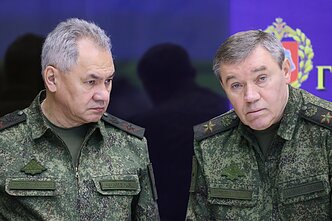
There is this long-standing resentment against Russian Defence Minister Sergei Shoigu and the Chief of the General Staff and the overall theatre commander Valery Gerasimov. As the war has gone along and Russian forces have suffered very heavy losses [...], a lot of this ire and outright hatred from certain Russian forces in Ukraine have been directed at the Russian Ministry of Defence and the General Staff. Gerasimov and Shoigu have kind of become public faces for everything that’s wrong with the war effort for a lot of sections of the Russian information space and for a lot of Russian forces serving in Ukraine.
That was particularly heightened with Wagner, partially because it was a paramilitary company that was given its own sector of the frontline in Ukraine. And so, the dynamics of it not being really under the control of the Ministry of Defence but also relying on receiving equipment and supplies in order to continue their operations generated a lot of conflict.

I think the rebellion was a miscalculation on Prigozhin’s part that he could force the Kremlin to replace Shoigu and Gerasimov. The Kremlin does not want to do that, and they’ve indicated that time and time again. From the fallout of the rebellion, it appears that they want to back Shoigu and Gerasimov. But the rebellion has made that very difficult. It was already difficult to continue to back Shoigu and Gerasimov as these prominent failures kept accumulating and critics could point to a whole laundry list of very famous incidents to say that the Ministry of Defence and the General Staff don’t know how to run the war. [...] This becomes increasingly difficult for the Kremlin to balance.
We now see that Russian Army General Sergey Surovikin is supposedly on holiday after Prigozhin’s rebellion and that General Ivan Popov, who has criticised the government, has also disappeared.
There’s speculation that he got exiled to Syria. We sometimes see that unliked generals are sent to a kind of exile in Syria or Nagorno-Karabakh. In this way, they’re given slight hope that they could return to Putin’s favour.
What does this situation show about the Kremlin regime and its power, because in the past we have not seen such direct criticism from within the regime?
Placating the field commanders and addressing their concerns while not also completely undermining choice becomes harder and harder to balance. On one hand, the Kremlin could allow Shoigu and Gerasimov to do the whole overhaul of the Russian command that they have been wanting to do for a while. But where it stands now, how these commanders complain, how they reject the Russian chain of command, creates these controversies that can spiral out of control so much that it would threaten Russian morale on the front line.
I think the Kremlin is very aware that they can’t crack down on these commanders and units that are in charge of key sectors of the front.
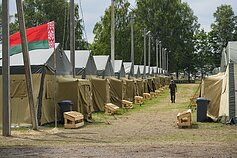
There are now reports of Wagner mercenaries arriving in Belarus. Why did Putin decide to leave it in Belarus?
I think, first, it proved an easy way out. In this case, they managed to avoid a major confrontation, which could have started if the Wagner convoy rolled into Moscow. Prigozhin has had previous contacts with the Belarussian military, and I think it was very advantageous for Lukashenko to get this bargaining chip for his ongoing interactions with the Kremlin. [...]

This is actually a big win for Lukashenko because he now has the concern about Wagner to push back against some of the Kremlin demands. It made a whole lot of sense for Lukashenko to broker this agreement and have Wagner come to Belarus. [...]
Going back to Ukraine’s counteroffensive, it is expected to continue in the summer, but what can we expect in the autumn when the rainy weather arrives?
I think a whole lot could happen. I’m not going to try to forecast where we’re going to be in autumn. I will say that I still expect Ukrainian counteroffensive operations to be occurring past this summer. [...]
So, would you agree with Milley’s statement that the war will be long and bloody?
On that point. We can see that this will be a long-term war, with a pattern of a Russian offensive campaign followed by a Ukrainian counteroffensive campaign. It is very likely that both sides will launch one major offensive per year. Ukraine is pursuing its goal of liberating all its territories, and it only gets one chance each year to do so. There is Southern Ukraine, Eastern Ukraine, and Crimea, so that is three years right there.

LRT English Newsletter
Every Friday morning.