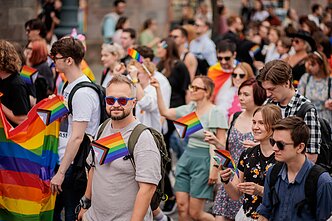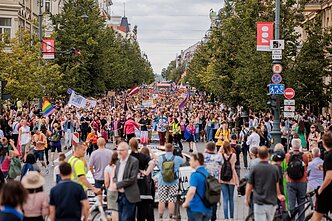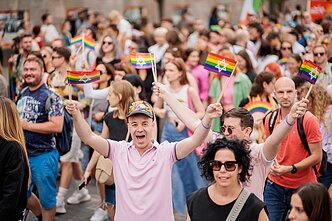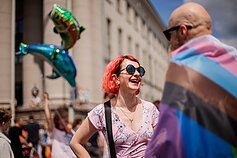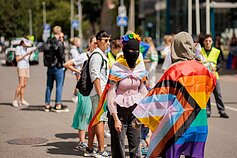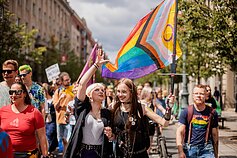















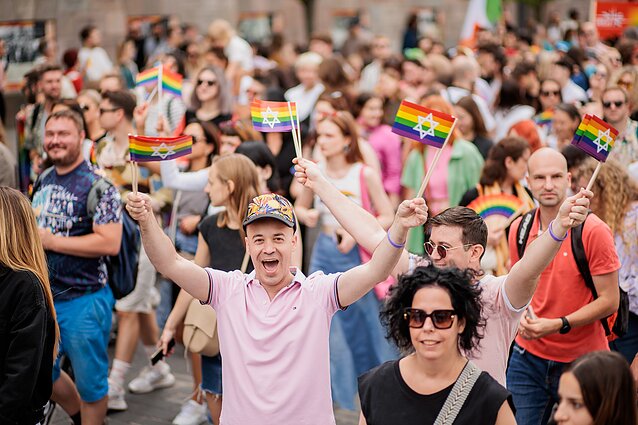
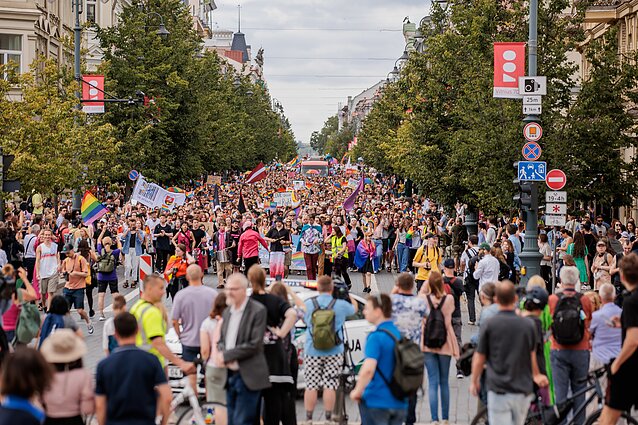
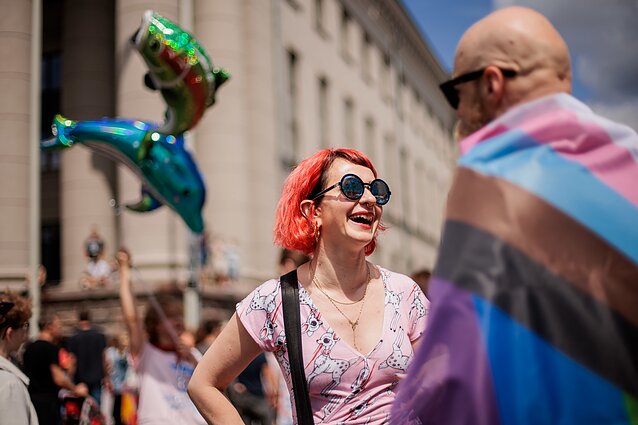
Around 5,000 people marched in Vilnius on Saturday in support of the LGBTQ+ community and demanding active support for trans people and marriage equality. The police are looking into an incident where a car suspectedly attempted to drive into the crowd.
The march started in the early afternoon at the National Library and continued through Gedimino Avenue to the Cathedral Square.
The Vilnius Pride marchers waved the flags of the European Union (EU), Ukraine and the colours of the rainbow, and carried various placards, such as “Love doesn’t choose your gender”, “I want to go home and love who I want to love” or “Love is love, no matter whose it is”.
The marchers chanted “We are everywhere!” and “Let’s demonstrate!”.
The Vilnius Pride march took place after Estonia had become the first Baltic country to legislate marriage equality. In Lithuania, the draft Civil Union Law, which would legalise same-sex partnerships, is making its way through the parliament.
“I am happy for Estonia and a bit jealous. We wish for some small victories, but there are none, and it seems that the LGBTQ+ community is encouraged to reconcile, to compromise, and some end up with nothing,” Ajus Jurgaitis, one of the organisers of the march and co-founder of the association Trans Autonomy, told BNS.
“We are just waiting for progress, which is not there,” Jurgaitis added.
Jurgaitis said there is hope that at least the Civil Union Law – which is short of full marriage equality – would be adopted soon.
“It is up to us to say what we want, to demand equal rights. Equal rights are not the subject of some big debate, it is something everyone deserves,” the activist said.
Dainius Daukantas, head of the Public Order Board of Vilnius County Police, told journalists that the march started from the library with about 2,000 to 3,000 people, but people kept joining the march. According to his data, between 5,000 and 6,000 people reached the Cathedral Square with the procession.

It is important to march
According to the organisers, the community is making four main demands: legal and medical conditions for gender reassignment, the right to marriage, partnership and adoption, the abolition of the censoring provisions of the law on the protection of minors, and the full protection against discrimination.
The marchers deplored Lithuania’s slow progress in guaranteeing the rights of LGBTQ+ people.
Rokas Keršys, 26, who works in the field of non-formal education, said he was very happy about Estonia’s decision to legalise same-sex marriage.
He said the decision shows that guaranteeing LGBTQ+ rights is a matter of political will, not a matter of cultural differences between Eastern and Western Europe.
“If there was the will [in Lithuania], it could be done tomorrow. [...] How much time it will take to grow that will, God only knows,” Keršys told BNS.
Simona Aukštulevičiūtė, a 24-year-old teacher, said she was sad that “we have been stuck in the same place for 30 years”. She said she hoped the march would help draw even greater public attention to the community’s problems.
“I think it is important to go and tell people that we exist, we are alive and we don’t have human rights,” she told BNS.
Arūnas Šidlauskas, a 55-year-old lawyer who marched with his children at Vilnius Pride, said Lithuania didn’t do enough to guarantee the rights of LGBTQ+ people.
“But compared to previous years, we can see that there is much less police, much fewer hostile people. So I think we are making progress a lot in this area,” he told BNS.
Incidents during march
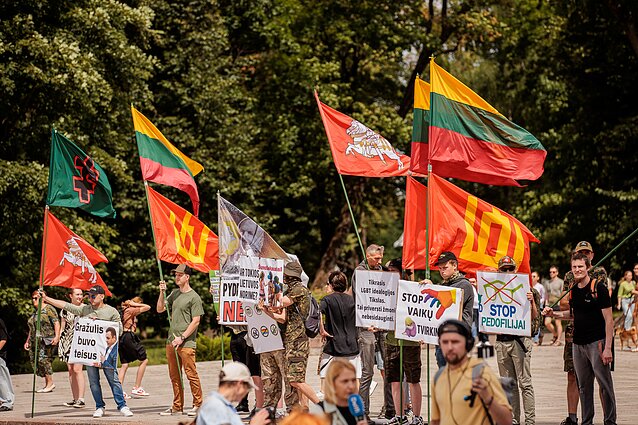
Dozens of protesters gathered in the Cathedral Square to oppose the pride.
They shouted “Shame!”, “Lithuania!” and displayed posters with slurs and slogans like “Stop child abuse”.
Raskevičius, the liberal MP, approached one of the leaders of the protesters, Antanas Kandrotas and kissed him on the cheek.
In another incident, a car drove into Gedimino Avenue and almost hit the marchers who moved away to avoid a collision.
The police initially commented they had not received any reports about the incident. On Monday, however, Vilnius police spokeswoman Julija Samorokovskaja said people had filed reports and even sent video footage from what she said is a suspected “provocation”.
“At the moment, the police are clarifying all the circumstances of the incident and will start administrative proceedings in the near future,” the police spokeswoman said.
Politicians split
The march was also attended by conservative Vilnius Mayor Valdas Benkunskas and members of the liberal Freedom Party, including Justice Minister Ewelina Dobrowolska and the chairman of the parliamentary Human Rights Committee, Tomas Vytautas Raskevičius, who is himself openly gay.

Benkunskas told BNS that the city is open to all.
“What has been common in Western European cities and capitals for decades is slowly taking on a new look here,” the Vilnius mayor said.
“We are doing everything in our power to ensure that the Civil Union Law is adopted,” wrote the leader of the Freedom Party, Aušrinė Armonaitė, who was absent from the march due to illness, on Facebook.
Meanwhile, President Gitanas Nausėda, who has in the past indicated his opposition to LGBTQ+ rights, commented that “everybody deserves [...] the right to civilized relations”, but added: “I think that we will solve these problems, but for the time being we are arguing about the best way to deal with this.”
On Saturday, Nausėda attended a festival of foster families, It’s Good to Grow Here, which was organised in Vingio Park.
“Everything’s fine, I don’t see why we should counterpose the interests of individuals, but I wanted to be here today because children are our future,” the president told reporters on Saturday.

Newsletter
Every Friday morning.