















Lithuania’s fintech sector is widely considered a success story. But as the market seems to enter a new phase, many observers wonder whether it can continue to grow at the same rate.
The sector has benefited from Brexit quite a bit, says Agnė Klimavičienė, an adviser at Invest Lithuania, the country’s investment promotion agency. Five or six years ago, many fintech companies from the UK came to Lithuania in order to still have access to the European market. According to Invest Lithuania, there are about 260 fintech companies in the country these days. If you look at those that have their headquarters outside Lithuania, the UK comes first.
Probably the most famous British company that opened an office in Lithuania was Revolut, a so-called neobank. Andrius Bičeika, Deputy CEO at Revolut Bank, points out that initially, Brexit was not the reason, but “that really helped us to prepare for Brexit. Because we really needed to have another license outside of the UK”.
Marius Jurgilas, an economist, was a member of the board of the central Bank of Lithuania for many years. According to him, the reason to develop Lithuania as a fintech hub a few years ago was not Brexit. The goal was to modernise a market dominated by Scandinavian banks, he says.

“The innovations that had been very prevalent, very groundbreaking in the Nordic countries” were not introduced in Lithuania. “And the strategy was to introduce new players or new opportunities for new players on the financial map here domestically so that we could put competitive pressure on the incumbents,” Jurgilas points out.
“It’s hard to believe, but in terms of licenses issued, Lithuania is the largest fintech centre in Europe,” Klimavičienė from Invest Lithuania stresses. According to her, more licenses have been issued in Lithuania by the central bank than in Germany, Sweden, Ireland, the Netherlands, or Luxembourg.
Risks as well as opportunities
When it comes to fintech, there are risks as well as opportunities. That became clear in 2021 when a company in Lithuania, Finolita Unio, was involved in a scandal concerning the German financial service company Wirecard.
Regulation is therefore an important topic. Bloomberg recently wrote that the Bank of Lithuania is “tightening the screws”.
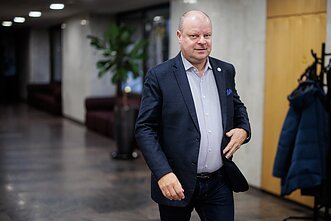
However, Gediminas Šimkus, chairman of the board of the Bank of Lithuania, does not think the metaphor is accurate.
“I think we are moving to the next phase of development where newcomers, new kids on the block, they started growing, they started taking more risk,” he says. “And it’s no surprise that the Bank of Lithuania, as a supervisor, intensifies its supervisory efforts, it enhances its supervisory capacity and capabilities in order to supervise those risks.”

Asked how long the sector can continue to grow, Šimkus emphasised: “We don’t have numeric limits.”
Although many look at the number of licenses issued, the head of the Lithuanian central bank thinks that the focus should rather be on the question of whether the service provided by market participants is of good quality, whether they comply with the prudential requirements, and whether the society is benefiting from it.
“If there is a company that wants to open up its business in Lithuania: please, welcome, we are open. And if you have a good business model and an idea of how you can start the business and grow: please, welcome,” he says.
Limits to growth
But would there also be enough skilled workers to sustain further growth?
“The actual population is decreasing, the workforce technically is decreasing,” says Revolut’s Bičeika. “So the more players you get in, the more we are fighting for a finite number of professionals.”

Jurgilas, who left the Bank of Lithuania and is now working as senior vice president for research and innovations at the Vilnius-based startup Super How?, thinks that the most limiting factor right now is talent.
“Of course, you could rely on [...] remote work. But then it’s kind of a virtual hub. Because, you know, is this person working from Vilnius or actually from Thailand?”
Klimavičienė from Invest Lithuania is more optimistic: “With the development of the sector, the talent pool is growing.”
“It’s a paradox,” Klimavičienė stresses, as according to her, while the Lithuanian population is shrinking, the number of IT specialists is actually growing.

Newsletter
Every Friday morning.