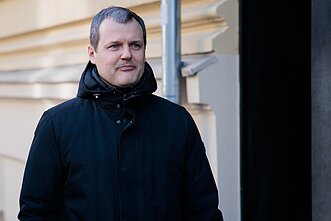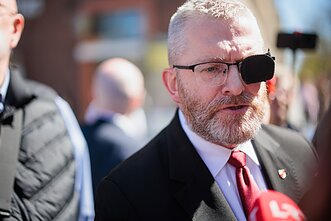
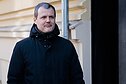







Although Philippe Edel, a Frenchman living in Strasbourg, does not speak Lithuanian, he probably knows more about Lithuania than most natives. In Strasbourg, he heads the Alsace-Lithuania Association and publishes the only magazine about Lithuania in French.
Philippe fell in love with Lithuania during the country’s struggle for independence in the late 1980s. To the young Frenchman, who learnt about the Baltic states’ quest for independence from books and little snippets in the press, they seemed like an exotic, “forbidden” land.
Philippe is married to a Lithuanian Liudmila, who assists in the conversation with her French-speaking husband. The couple laughs that Philippe first fell in love with Lithuania, and then Liudmila came along. “Not the other way around,” they smile.
It was Philippe who, inspired by the events of January 13, 1991, in Lithuania, gathered like-minded people and took to the streets of Strasbourg with posters reading “Freedom for Lithuania”. His initiative eventually gave birth to the Alsace-Lithuania Association, which is still in operation today.
As a president of the association, Philippe has been publishing Cahiers Lituaniens, the only magazine about Lithuania in French, for over 20 years. The magazine, published every autumn, includes texts not only by French and Lithuanian but also by Polish, German, Belgian, or Italian authors.

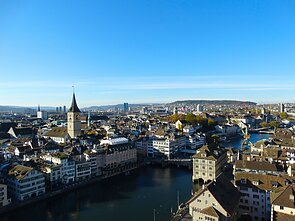
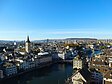
We meet Philippe in Strasbourg, in a nine-story building where the association’s small office is located.
How and when did you first learn about Lithuania?
In the 1970s or 1980s, a few friends and I took an interest in the whole of Europe, especially what was going on behind the Iron Curtain. We were always very interested in what was happening there, and when the Berlin Wall came down, we realised that it wasn’t just a wall that was coming down, there was also a second wall – the Soviet regime.
During the January events, a few friends and I organised, I believe, the first demonstration to support Lithuania in the whole of France. It was held in Strasbourg, in the large Kleber Square. The former president of the European Parliament, the mayor of Strasbourg, the president of the Alsace Region, and other activists participated in the demonstration. We put up posters saying “Freedom for Lithuania”, but we received a backlash in the press.
At that time, it was a bold move. Nobody in France wanted to get involved because there was a lot of support for Mikhail Gorbachev in Europe, especially in France. Supporting the Baltic countries was tantamount to trying to undermine Mikhail Gorbachev, who had just received the Nobel Peace Prize and was “leading” the policy of the thaw.
Is that how the Alsace-Lithuanian Association came about?
It was after these events that we set up a small association, initially to provide humanitarian aid to Lithuania because there was a shortage of medicines.
The aim of the association was to make the voice of the French people on the quest for Lithuanian independence heard. Later, we established contacts with Lithuania. Since I was the one who worked on it the most, I was asked to chair the association. There were about 15 of us then.

But why were you so interested in Lithuania in particular?
When I was a student, European Railways offered the possibility to travel all over Europe very cheaply. It was a great opportunity. I first went to Scandinavia and I wanted to do a tour around the entire Baltic Sea. But I was always stopped in Finland; it was impossible to get to the Baltics from Finland – you had to go back to Paris and ask for permission.
So, the Baltic states were like terra incognita for you?
It was not an unknown but rather a “forbidden” land. I knew about the Baltic states, Ukraine, Belarus. I read a lot. I was very interested in them. [...]
When did you first visit Lithuania? What was your impression of it?
In 1992. The trip was organised by the Lithuanians themselves, quite a few of whom had already come to Strasbourg to visit us. Zenonas Streikus, the chairman of the Druskininkai City Council at the time, and his friends showed me around. I went to Klaipėda, Palanga, and, of course, Kaunas and Vilnius. They organised a big tour.
They knew that I was setting up an association, and friendly relations were established, which allowed me to establish contacts with more associations. It’s all connected. I’m also the vice president of the Franco-Lithuanian Association, which is based in Paris.
What surprised you the most? Did you notice any differences between Lithuania and France?
Our countries are both very different and not so different. In Alsace, we are part of Central Europe, and we communicate in a simple, direct way. I saw the same thing in Lithuania, but here, I also found more creativity – people are more inventive, more artistic, and I’m not just talking about the artists.

You also have a certain sensitivity, subtlety, which is noticeable, for example, in your sculptures, your streets, your parks. To illustrate the cover of my first magazine, I chose a photo from the Klaipėda Sculpture Park and I was very impressed by it. I was always impressed by the simplicity of your people. That is your strong point.
Alsace is the easternmost region of France, and we even share some history with Klaipėda. At the beginning of the 20th century, Strasbourg, like Klaipėda, was part of Germany. Now, we are united by the flag of the European Union. So, it is very important for us to maintain our links while recognising our differences.
Have you tried to learn Lithuanian?
Personally, I’ve always had difficulties with languages because I’m dyslexic. But I’m interested in languages, and we write a lot about the Lithuanian language in our magazines. It has a distinctive character. I know that Lithuanians say it is the oldest language in Europe, but as one linguist said, all languages are old. But Lithuanian is the most archaic language and, therefore, very impressive.
I have even found some similarities between Lithuanian and our region. For example, in Alsace, until the 19th century, married women used to add the ending “-ine” to their surnames, just like in Lithuania.
For example, if a husband is Pecquer, a wife is Pecquerine. This makes me think about the old Indo-European roots of Lithuanians. The sound of the language itself is very beautiful to me, and I quickly recognise Lithuanian in the crowd.
But your publication is aimed at French speakers. Why so?
We want Lithuania to be better known not only to Alsatians but also to all French people. We have only one-third of our subscribers in Alsace. We want them not only to get to know Lithuania but also to learn more about the links between Lithuania and France or neighbouring countries.

For example, we recently published an article on the application of the Napoleonic Code in Lithuania in the 19th century. Many people do not know about this even in Lithuania. This work was done by a French lawyer who worked in Lithuania.
Another interesting article was about Prosper Mérimée’s book Lokis. It is interesting that Mérimée, writing about Lithuania and its identity, made a lot of mistakes and introduced a lot of Russianisms (he never visited Lithuania but consulted Russian writers, such as Ivan Turgenev).
As I recall, he even wrote about how lions roam the forests of Lithuania.
Yes. There are five versions of the Lithuanian translation, and they are all different. A Lithuanian woman living in the Netherlands made an analysis, which interested both the French and the Lithuanians.
It turns out that the first translators wanted to correct the mistakes, then the others changed the translation a little, and then the others changed it some more. This is the only literary work in 19th-century France that mentions Lithuania, but there are many inconsistencies in the story.
Who is your favourite Lithuanian author?
I’m more interested in history, geography, and science. The magazine is not a literary magazine, although, of course, there are literary works in the magazine as well and we are trying to introduce poems by Lithuanian authors. There is one author who is special to me – Oskar Milosz, who wrote in French.
Our authors are mostly academics or researchers from Lithuanian institutes. We try to find unexpected links between Lithuania and France, and there are many links that we don’t even suspect.

For example, I was interested in an article about the Lithuanian diplomatic service after 1945. The state no longer existed, but the diplomatic service of Lithuania survived, the diplomats who worked in the diaspora continued to try to represent Lithuania, and this service was recognised by a number of countries. They worked as diplomats for a country that no longer existed. […]
Another interesting event was French philosopher Jean-Paul Sartre’s trip to Lithuania. We published three articles about it. The first one was written by an eyewitness, and the French were very interested in it and especially in the picture of Sartre on the dunes of Nida. The French thought it was snow, not sand – like the Alps in Lithuania.
The other two articles were much more critical – Sartre’s journey was presented as a spectacle prepared by the Communist authorities, where the writer played a prominent role. It was intended to show how the Baltic countries were supposedly living well and that the Soviet Union was not eliminating national groups, such as the Lithuanians.
In any case, we have to understand that most nations are interested in other nations if they can find links and connections with themselves.
What Lithuanian historical event or personality inspires you the most?
It is very difficult to answer. I would like to stress that we never wanted the magazine to be under any political patronage. But there are some characters that stand out for me. Of course, Professor Vytautas Landsbergis is the best-known in France. It is Landsbergis who has always embodied for me the fighting spirit of the Lithuanians.
Your society is very strong. These are people who have a very strong ability to adapt, stand up, and find their place. One cannot help but admire that.

Lithuania in the Soviet Union was the westernmost republic – one of the richest and most modern. When Lithuania joined the European Union, it was the most westernised [out of the former Soviet republics], even though the standard of living was much lower there. I think it was not easy for Lithuanians to remain optimistic and integrate into this community, but you have succeeded, and the Westerners do not appreciate that enough.
I regret that it is sometimes harder for Westerners, especially the French or the Germans, to understand how much you have had to endure and what a long way you have come.

Newsletter
Every Friday morning.