









The mayoral race in Kaunas has a clear frontrunner, but his rivals hope they have a decent shot at qualifying for a runoff.
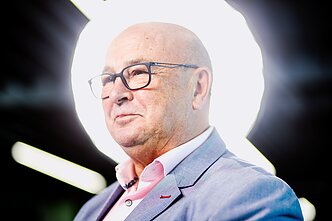
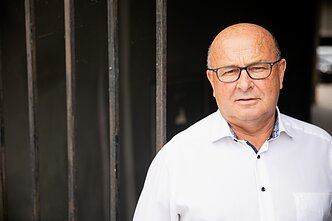
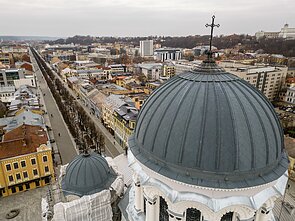
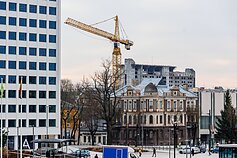
The incumbent mayor, Visvaldas Matijošaitis, likes to count the cranes that tower above the city when he talks about his achievements in Kaunas: for the politician, they symbolise progress and good conditions for business.
His main rivals in the municipal elections on March 5 are not disputing the fact that under the current mayor, the city has seen a surge in infrastructure projects.
However, with scandals over family business affairs eating away at Matijošaitis’ hitherto unshakable popularity, they are expecting to have a decent chance of deposing the incumbent who has been in charge for eight years.
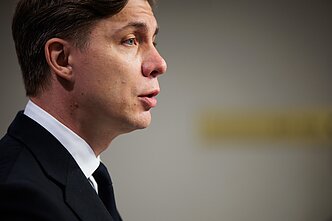
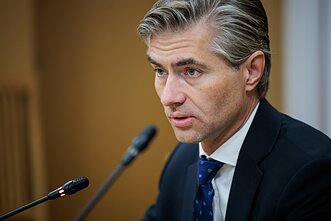
Polls, however, show Matijošaitis to be by far the frontrunning candidate (one, published by 15min.lt in early February, put his rating at 43.6 percent), followed by former health minister Aurelijus Veryga of the Farmers and Greens Union (8.2 percent), and the conservative MP and opera singer Vytautas Juozapaitis (6.6 percent).
In total, 11 candidates are running in the Kaunas mayoral election.
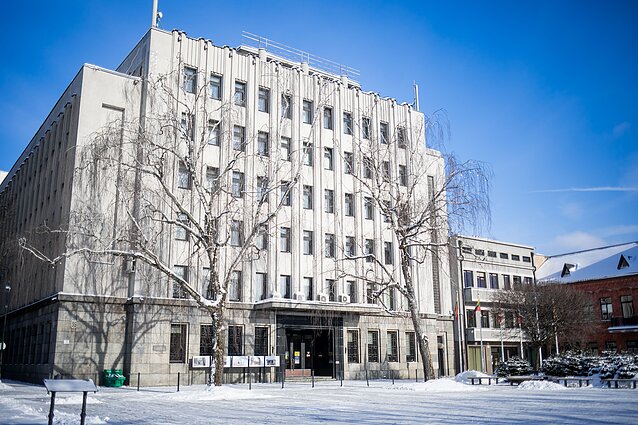
Forcing the ruling party to talk
Vidmantas, 83, who is planning to vote for Matijošaitis, says he has “cleaned up all of Kaunas”.
“Everything is renovated. Take the Darius and Girėnas Stadium, the Hall, the swimming pools, the Science Island is under construction, and many reconstructions are planned for the future. Streets, everything...,” says the man who did not want to give his last name.
In 2019, Matijošaitis was among the first mayors to pop the champagne on election night, beating his rivals by a landslide in the first round of voting with 79.6 percent of the vote. His closest rival, current Minister of Education Jurgita Šiugždinienė, won just 12.7 percent of the vote that time.
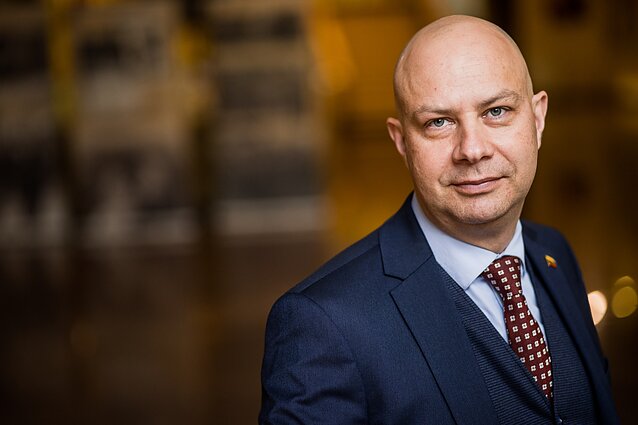
Matijošaitis is not a member of any party and is running with his own electoral committee, United Kaunas, which also enjoys an absolute majority in the city council, 32 out of 41 seats. This part explains the mayor’s energetic construction programme.
Council meetings in Lithuania’s second largest city sometimes lasts less than an hour, while councils in other cities need more time just to decide on the agenda.

However, the smooth running came at a price: the ruling group has often been criticised for its indifference to dissenting voices and for ignoring the opposition.
Political opponents therefore say the most important goal in these elections is to break up the monopoly of United Kaunas, so that it can no longer rule single-handedly.
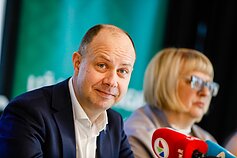
“I myself would focus not so much on winning the mayorship as on changing the composition of the council,” says Juozapaitis, one of the candidates and currently a parliament member with the conservative Homeland Union (TS-LKD) party.
“The mayor is important [...], but a mayor without a council is like a mayor without hands,” he adds. Juozapaitis also compares the monopoly of United Kaunas to the authoritarian politics of Russia. “This is not democracy,” he quips.
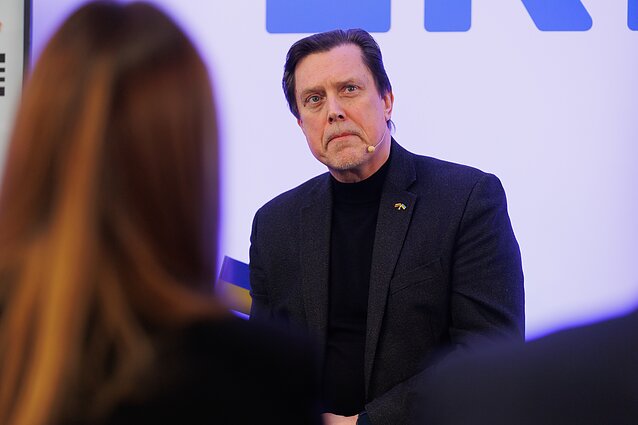
Another candidate, Veryga, also says that a real counterweight to United Kaunas in the city council “would be a step forward”.
“I think it is important that people vote for the list and not just for the mayoral candidate, because the mayor does not take decisions alone, the council does and it is very important that we have members on the council,” says the politician.
The former healthcare minister says that he cannot yet say whether he would give up his seat in the parliament if he is elected to the Kaunas City Council but comes short of winning the mayorship.
Undecided voters keep suspense alive
Adding to the intrigue is the fact that, according to the above-mentioned poll, almost a quarter of Kaunas residents are still undecided how they’ll vote.
“My husband and I are talking: who are we going to vote for?... My husband says: no, not for Matijošaitis!” says Vanda Mačiukaitienė, a resident of Kaunas.
The 72-year-old woman is critical of the ruling group, saying that it protects its own people and does not look for people who can do the job more competently.
However, she does not see any clear alternative among Matijošaitis’ rivals.
“The singer would be ok, if he wasn’t a conservative,” the woman says, referring to Juozapaitis, who is an opera singer and a resident of Vilnius.
The election campaign in the city is in full swing, with more and more election leaflets appearing in letterboxes and the candidates themselves handing them out in the city’s central pedestrian street.

“We are all trying to get your vote,” says the Freedom Party’s volunteer as he hands out a leaflet to the BNS reporter.
“Let’s liberate Kaunas”, “Let’s give decency back to the city”, “Let’s take ownership of Kaunas” – the slogans of Matijošaitis’ rivals point to their main lines of attack on the incumbent: his opaque decision-making, his disregard for the community, and the mayor’s family business affairs.
Vičiūnai Group, one of the biggest food processing businesses in the country, has attracted criticism for failing to cut all business ties with Russia following its invasion of Ukraine.
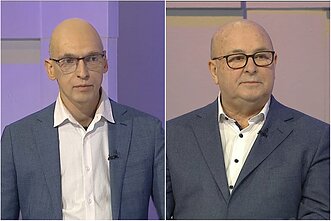
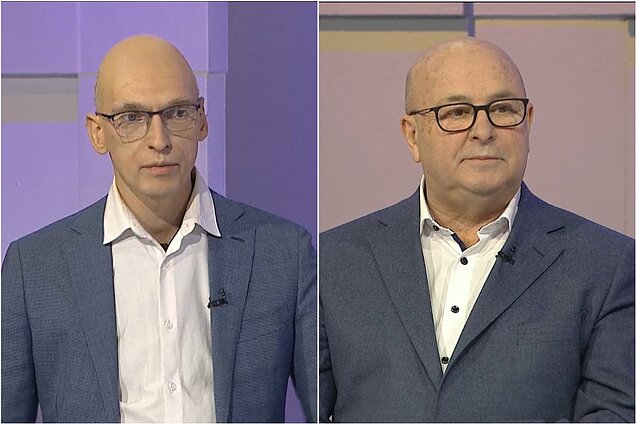
Some rivals are fighting Matijošaitis with humour: Mantas Bertulis, of the Freedom Party, dressed up to imitate the current mayor during a televised debate, even wearing a bald cap to match Matijošaitis’ hairstyle.
Meanwhile, the incumbents of United Kaunas put their bets on their achievements and promise to carry on with construction projects. They also promise to make public transport free, to revitalise nightlife, and give more attention to families and communities.
Good work or good luck?
The mood in the corridors of the municipality is calm: representatives of the ruling group say that work continues as usual, and they are not yet thinking about how the elections will play out.
“In our team, it is customary to talk when there is something to talk about,” says Kaunas Deputy Mayor Andrius Palionis.
Matijošaitis himself is not inclined to speculate about whether he can repeat his previous successes and win the vote without a runoff: “I can’t answer that – I’m not the one to vote.”
Speaking about his vision, Matijošaitis gives his favourite example: he points out that when he came to power in 2015, there was only one crane in Kaunas that was being tested, and it was down. Now, the machinery that the mayor associates with progress can be seen all over the city.
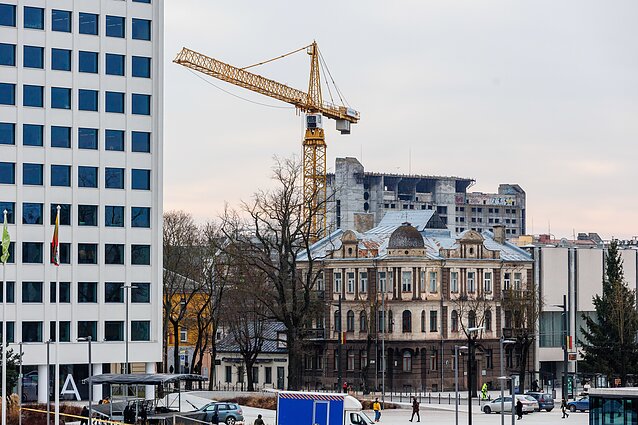
“Of course, it is not the city government that builds, but the city creates conditions for businesses to come, to develop, to build,” says Matijošaitis.
The main rivals of United Kaunas do not dispute the breakthrough that was achieved in the last eight years, but stress that this is not the personal merit of the mayor or his team.
According to Juozapaitis, Matijošaitis’ coming to power coincided with the new funding period of the 2015 European Union Structural Funds.
“Great that they got this going, it’s how it should be, but it is not the merit of one person or one party,” the conservative says. “These are funds from the European Union, these are funds from our budget that came to Kaunas.”
Infrastructure development of which the mayor of Kaunas is so proud was booming all over the country, he insists.
Veryga stresses that major projects in Kaunas were implemented with the help of the central government during the time when his party, the Farmers and Greens Union, was in power.
“We have done a lot of work for Kaunas or for the benefit of Kaunas citizens,” Veryga says. “We were in that last government, when a lot of money came to Kaunas for projects, where ribbons were cut, but nobody said anything.”
Matijošaitis has in fact repeatedly praised Saulius Skvernelis, the former prime minister who headed the government of the Farmers and Greens, but has since parted way with the party.
Skvernelis is now the leader of the Democratic Union ‘For Lithuania’, whose candidate in Kaunas is Gintautas Labanauskas, a veteran of city politics.
The taint of Russian business
Matijošaitis, who has long been one of the most popular Lithuanian politicians, has recently attracted much negative attention due to his family business.
Although Vičiūnai Group announced that it was looking to sell its assets in Russia, one year into the war it has not done so.
“There are businesspeople who have managed to sell their businesses and are very happy – even in Russia,” says Matijošaitis. “And I envy them because they did it before the war started.”
He says he didn’t expect Moscow to launch an attack on Ukraine. “We will definitely not work in that country, we will never return,” says one of the richest politicians in Lithuania.
Other scandals have also marred the rule of United Kaunas.
In March last year, the director of the administration, Vilius Šiliauskas, was arrested on suspicion of taking a bribe from a construction company that was a frequent winner of municipal public tenders. Moreover, several journalistic investigations have been published about members of the mayor’s family allegedly privatising land in the city under dubious circumstances.
The parliamentary Anti-Corruption Commission subsequently carried out an investigation, concluding that decisions in Kaunas municipality are made in informal meetings, which creates corruption risks.
The ruling group tends to dismiss this criticism and media reports as political attacks.
Juozapaitis, the conservative rival, argues that his candidacy is an alternative to the current situation that he calls appalling and incomprehensible.
“I very much hope that the people of Kaunas [...] will wake up from their lethargic sleep,” the conservative says.
Veryga also claims that Matijošaitis’ alleged misdeeds were what made him decide to run in municipal elections, even though his party backed the incumbent in the last election.
“There are certain nuances that have emerged, both against the background of the war in Ukraine and all the stories that have taken place in the municipality now – both with the director of the administration, who was arrested with bribes, and now with the mayor’s own activities, the activities of his sons in buying more plots of land,” Veryga says.

Newsletter
Every Friday morning.