









When Russian forces started shelling Kyiv in February, the public sentiment in Lithuania went overwhelmingly in support of Ukraine and against Russia. However, there is a danger that Lithuanians’ indignation at Moscow’s actions may turn into hostility towards ethnic Russians, including their fellow citizens. Researchers say opinion polls show “alarming” trends.
A recent poll indicates more hostile attitudes towards the local Russian-speaking population. The share of respondents who say they do not want to live next door to Russians has grown from 6.2 percent last year to 16 percent now. Moreover, 74.6 percent say that their attitudes towards local Russians have worsened over the last five years.
Read more: Survey shows growing hostility towards local Russian speakers in Lithuania
Vida Montvydaitė, head of the government’s Department for Ethnic Minorities, considers the trend disturbing and even dangerous.
“These trends are of course regrettable, alarming and even dangerous,” she tells LRT.lt.
She says part of the explanation is the war in Ukraine, which “very much reflects Lithuania’s painful experience”.
At the same time, the same survey shows Lithuanians becoming more welcoming to refugees. “We have become more positive towards immigrants – identifying them with Ukrainians fleeing the war – and less positive towards local Russians, identifying them with Russian citizens,” Montvydaitė comments.
It is important to see a difference between ethnic Russians living in Lithuania, Russian-speaking refugees coming from Belarus and Ukraine, and Russian citizens, she stresses. “The results of the survey suggests that our society is not yet able to clearly distinguish these people,” says Montvydaitė.

Some of the initiatives prompted by Russia’s invasion of Ukraine seem to be targeted not just at the Russian government or Russian citizens. The Culture Ministry has renamed the Russian Drama Theatre in Vilnius. Several bookshop chains removed Russian-language books from their shelves. The government is now discussing plans to phase out or restrict the teaching of Russian as a foreign language in the country’s schools.
Russians are the second-biggest ethnic minority in Lithuania, accounting for 5 percent of the population, according to the 2021 census. Belarusians are third at 1 percent.
In recent years, however, Lithuania accepted thousands of Ukrainians fleeing war and Belarusians fleeing repression at home, many of whom are Russian speakers. Russian citizens persecuted by Vladimir Putin’s regime are also coming to Lithuania, albeit in smaller numbers.

Russian spoken not only by Russians
According to Montvydaitė, Lithuania’s Russians are a long-established community.
“They have contributed to both the establishment of Lithuanian statehood and the restoration of independence. Lithuanian Russian-speakers are Lithuanian citizens who use Lithuanian as well as Russian in their daily lives, regardless of their ethnicity,” she says.
There are also many Russian speakers in other ethnic communities, Montvydaitė adds: among Lithuania’s Poles, Belarusians, Ukrainians, Jews, Armenians, Tatars.
“Russian is also often spoken by Ukrainians and Belarusians, as well as refugees from other countries for whom it is the main means of communication in Lithuania. And finally, there are Russians who come to Lithuania. Undoubtedly, and this is confirmed by experts, hostility towards Russians is directly linked to the war in Ukraine, ie it is directed against Russian citizens, but the lack of clear distinction between different groups means that public anger can be directed against all Russian speakers,” Montvydaitė warns.

Back in spring, when Moscow invaded Ukraine, representatives of Lithuania’s oldest Russian public organisation, the Russian Cultural Centre which was founded in 1988, called for immediate condemnation of Russia’s military actions. At the time, the Alexander Pushkin Literary Museum in Vilnius, together with other representatives of Russian community, called on everyone to join a protest action condemning Russia’s attack.
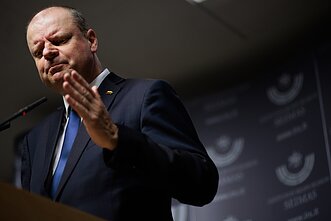
Initially, when shock at Moscow’s actions took more sinister expressions directed against Russian speakers, Prime Minister Ingrida Šimonytė stated that “people of Russian or Belarusian descent living in Lithuania are patriots of our country, just like everyone else” and said that blaming them for the actions of Vladimir Putin or Alexander Lukashenko “must be avoided at all costs”.
According to Montvydaitė, this message is even more important today.

Bad associations
The role of the media is crucial in shaping the society’s attitudes towards Lithuania’s ethnic minorities, notes Monika Frėjutė-Rakauskienė, senior researcher at the Lithuanian Centre for Social Research.
“Years of research on the portrayal of Russians in Lithuanian media have shown that the press and online newspapers often write about them or associate them with politics and propaganda of modern Russia rather than with representatives of the Russian minority living in Lithuania,” she tells LRT.lt.
“Teun van Dijk, a well-known scholar and discourse researcher, said about ethnic Russians in Estonia about 17 years ago that manifestations of discrimination are based on sociopolitical rather than ethnic grounds, because Russians are treated similarly as Germans in the Netherlands after the Nazi occupation,” says Frėjutė-Rakauskienė.

Even events in other countries, as long as they are widely covered, influence attitudes towards local communities, she notes.
“For example, the Roma community, which is still a disliked group, comes to mind. In 2010, opinions about them took a plunge and this was related to the French president’s campaign to deport Roma migrants from France, which was widely covered in the Lithuanian media,” she says. “Public attitudes are influenced not only by events themselves, but also by the intensity of coverage and its content, which is usually negative towards certain ethnic groups.”
Negative public sentiment against Russians also intensified following Russia’s annexation of Crimea in 2014, Frėjutė-Rakauskienė says.
“And this current war unleashed by Russia will obviously and naturally be reflected in public sentiments for a long time to come and evoke negative emotions when speaking about Russians in general, without regard to whether they are members of the Russian political elite or ordinary citizens who do not support the war or Russians living in Lithuania,” the sociologist argues.
On the other hand, previous surveys suggest that public opinion will inevitably fluctuate and change depending on political, social and other developments.
“We are all aware of the tense geopolitical situation today […]. I believe that Lithuania should continue to support, especially in politicians’ public statements and the media, a discourse that does not incite ethnic strife and divide Lithuania’s society,” Frėjutė-Rakauskienė says. “Perhaps it is also reasonable to adhere to the principle of citizenship, by which regardless of ethnicity we are all first and foremost citizens of Lithuania.”

Newsletter
Every Friday morning.