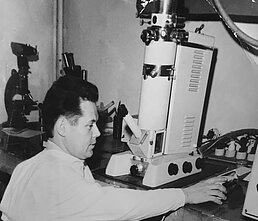




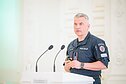









Adolfas Laimutis Telksnys, a researcher at Vilnius University, brought the internet to Lithuania 30 years ago. In the 1960s, he also predicted the emergence of smartphones. Most recently, he said we will live with servant robots in the future.
Telksnys passed away on October 24 aged 92. This is what he had to say in his last interview with LRT.lt, originally published in February 2021.
What is your most memorable work?
All that I have done. Whether it's big or small, [...] if I put in the effort, every job gives me satisfaction.
And which one is the greatest, others can tell. If the effort that I have put in has produced results, made others feel good, that's very good. But that is for others to say, not me.
So what do others say to you then?
For example, they do say that it is good that the internet was brought to Lithuania 30 years ago. It was brought in three months, not [...] like the Vilnius stadium which is being built for 30 years. It is an example to me of how not to work.
And the second thing, which everyone is also happy about, is broadband internet. That was done not 30 years ago, but ten years ago. But broadband internet was hindered by powerful forces in our government.

Hindered how?
The media wrote about how Telksnys and [Juozas] Kazickas, the Lithuanian-Americans, want to hijack all the networks. Then I called Kazickas and asked him what we were going to do. And he said: "Let them bark."
At first, it was said that the two of us wanted to steal the whole connection. Then they started saying that [Lithuania] didn't need it, because wireless, which is much more modern, is better. I also said that wireless is good and we need it, but in order to have it, we need to have a wired, widely-developed connection. Wireless is like a road from the motorway to your house. But there has to be a motorway.
There was so much stalling, in such ugly ways. There was one meeting in the government. I was explaining why we need broadband, and the then prime minister, [Algirdas] Brazauskas, said to me: "What are you doing? The countryside is all drunk."
He said that because this broadband was intended primarily for rural areas. I said this to the surprise of all the ministers: "Prime minister, when you go hunting, maybe your guards are drunk. But in the countryside there are teachers, there are doctors, there are veterinarians."
[Finance Minister] Butkevičius then said, "Let's get this project off the ground.” It was all, I would say, on very thin ice. And now it is good that all our activities have brought 100 million euros to Lithuania, even more.
Over half a century ago, you guessed the advent of smart devices. I am curious, how did you predict it? Back then, these things probably seemed like something out of a fiction book.
A correspondent from Tiesa came to me and asked me to tell him what would happen in 50 years. And he didn't say it was nonsense. Probably because people were already aware [of technology], computers had appeared, and people were already talking about their possibilities.
A computer back then needed a big room. The first computing centre, which was in the Lithuanian Academy of Sciences, had more than 10,000 lamps. Thousands of tube televisions, where everything was breaking down, the heat was terrible, there were fans at the bottom to cool the air, etc.

But it was obvious that these lamps were going to be replaced by transistors, the size of a lollipop. There are now 100,000 transistors in your mobile phone. So you could see that they were going to get smaller.
[Internal] memory – it was okay if it was in the tens of figures. But when you get a little bit of imagination, based on some experience, why can't memory grow? That is what I was saying, that the transistors themselves will be smaller, less electricity will be needed, and the memory will be much bigger. That fantasy was not [far fetched], as it had a certain basis.
What kind of technology do you think we will live with in the future?
There will be completely new machines, no longer the traditional computers where you change the keyboard. There will be computers that you can talk to, that will walk around, that will serve us, so-called robots. You probably drive a car. It was built by robots. But those robots are still manned by humans, because they are insanely complicated.
Now we need to teach students not only computer literacy, but also robot literacy. To show how they will work with the machines that will come. Some of them have already arrived, there are self-driving cars and other devices, intelligent things. They will have to be used, but nobody is showing how to use them.
I will give you one example. I suggested to the Ministry of Education that we need to start working seriously on robotic literacy in schools. They invited me to a meeting.. I can tell you that they are pushing the idea away.
There was a proposal to do trials in schools within 24 months, to put it into practice after training the teachers, after preparing some robots. But we have already made robots, and the children are already starting to work with them.
Others explain that there are robotics schools. But they are doing completely different things there. What I am talking about is robotic literacy, just as everybody knows how to use computers now, in the future everybody should know how to use all kinds of smart devices, self-driving devices and so on.

But I think the field of robotics itself may still seem a bit exotic to Lithuanians. In general, people are scared of both 5G and other technologies.
But that's the media's fault, it's fake news [...] It's already been drilled into people's heads that 5G is wrong. [...] When we moved from 3G to 4G, nobody said anything. But now it is a different situation because some people want to ;shoot us in the brain'.
They explain that the Chinese will follow us and so on. We are now being followed, that is not news. When we go shopping, we are followed, when you put your card in, you have already given yourself up to be followed.
But that is not a bad thing, because those companies that are tracking what the customers have bought, when they bought it, etc., are getting information on how to improve supply so that there is no shortage of goods.
Even with a knife you have in your kitchen, you can get bread or you can stab someone. So you can use 5G for all sorts of things.
So they explain that they will put a chip in, they will watch where we go. But they know all of this even now. If you have a mobile phone and even if it is switched off, you can still know where you are. If you want to avoid being tracked, you have to take the battery out, but the most modern phones no longer do that.
There is 5G now, but soon there will be 6G, which is already being tested at universities, and there will be 7G and more G.
What will 5G bring? There will be a self-driving car, if it encounters an obstacle on the road, it has to receive a signal very quickly. When a person sees an obstacle on the road, this message appears in his head within 100 milliseconds. For example, short distance runners train themselves to react quickly,.
Imagine if you are running and you react to an obstacle after only two seconds. So you're going to run into it. That's a 5G-connected device reacting so fast that it will react to obstacles it sees at about the same speed as a human. That's dozens or maybe even 100 times faster than current 4G.
Is that good or bad? It will be a self-driving car, you will be lazy to drive, you will be able to start the autopilot, look out of the window and drive in peace. Because it will be 5G.
Now you can order online instead of going to a shop. It's delivered to your door. But now there are drones flying around, so why not give them that task. It might not put the goods at the door, but leave them on the balcony. Or you can open a window. This is an example of what you can already do.

When it comes to robots, people think that they will take over jobs or otherwise change the daily routine too much. Is that perhaps the fear of change?
There was also fear when computers came along a few dozen years ago. A correspondent asked then: "Will machines be smarter than people or not?" So tell me now, 60 years later, are machines smarter than people or not?
I think not.
I think so too. I do not know if they will ever be smarter. There is a system in our brains that nobody has figured out what is going on there yet. But we live.
When the first car came along, it was going at this horrible speed – 12 kilometres per hour. When it first came out, there was a man running in front of it and telling everybody to be very careful, because now there is going to be a car going at an awfully high speed. Isn't that hilarious?
Then, when computers came along, they also started telling us that they were going to take away our jobs. For a while, even the cashiers didn't believe in calculators. But it's human, it's nothing special. Innovation always causes some distrust.
You ask if there will be unemployment. Yes, robots will make people unemployed. Parents should know that nowadays, it is not just sociology and some other sciences where diplomas are easy to get.

People need to know how to manage their efforts, have knowledge and be able to use it. To be creative. Because there will be no need for the uncreative. It will be bad for the lazy – those who want to get a higher education diploma just for the sake of a piece of paper, not for the sake of knowledge.
Robots will also have social consequences. The old computers also raised social issues. You want a job but you don't know how to use a computer, so what does that tell you? But now it's normal, people have learned how to use computers. And in the long term, robots are good because you can make them do what you need. It's the same as a computer, but they will be able to walk, and you will be able to talk to them.
We now have two robots, one called Oak and one called Linden.
Do they speak Lithuanian?
Yes. They will go to St Petersburg and say some things in Lithuanian.
What will they say?
Whatever you put in their heads, that's what they say. But that's good, too. Now we are doing something where you tell him something and he responds to it. It is not finished yet, but it will be in a couple of years.
The difficult work, the work that is not human, needs to be given to robots. When they need workers, they bring them from Ukraine or somewhere else, they don't speak Lithuanian. So we will make the workers we need ourselves.

Today, most of us really cannot imagine life without technology and the internet. However, there is also more talk about the other side of it – dependence on it.
Me and you are dependent on the internet.
So is this the bad side of technology?
It is the good side, because [for our conversation now], we are not polluting the environment now, whereas we might have gone to our meeting by car or by public transport, which also pollute.
We do not need to go to the other extreme, saying that we are just sitting on the internet. I think the internet is very good, and if you ask young people, if something is not clear, they do not go to books, they google. I do that myself.
Are Lithuanians ready to develop new technologies themselves?
Yes! It's not just talk, it's action. As I said, the humanoid robots that we are developing now are already being introduced in schools. Children are very fond of robots.
We all like to play and play is creative. Then, at school, that play disappears. Mothers and fathers want their child to get very good grades, they don't even help the teacher, they shout at the teacher if he or she puts a little pressure on the child.

It is necessary to put the effort in the head to do something. And to do something that is pleasurable, but will also bring benefits. Even our national anthem says: "Let him work for his own benefit and for the good of the people." Lithuanians are very creative, but we just need to create the right conditions.
Is it possible that we tend to underestimate ourselves?
Not us, you. You are saying that we are a little undercooked. I used to work as a designer, so I can say that Lithuanian designers are very inventive. Another important thing is that, at least in those days, they were very meticulous and honest.
Do you think technology can reach a tipping point where people won't invent anything new? When progress simply stops?
Well, don't scare us. I know that people like horror very much. But that is not the point. Our brain is such a complex system that it directs all our efforts both to where we need to go and where we don't.
There is so much in there and so much complexity that to make a technical device that is superior is beyond our comprehension. Progress will not stop because the brain will not stop.

Newsletter
Every Friday morning.