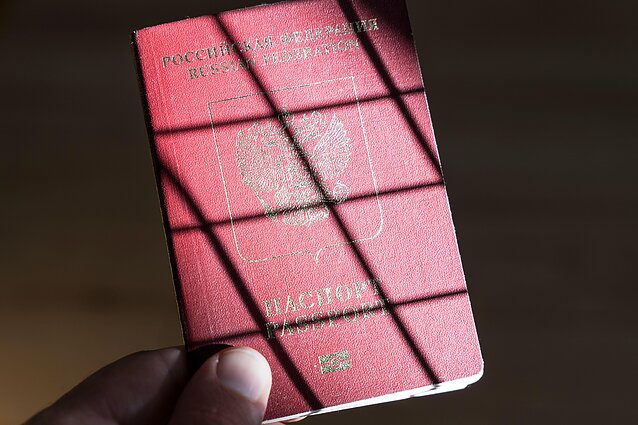












Almost two-thirds of Lithuania’s population support the decision of the Baltic states and Poland to close borders to Russians, according to a poll conducted in September by Vilmorus for BNS.
In the survey, 34.3 percent said they fully supported the decision, while 28.2 said they were generally in favour.
Meanwhile, 11.1 percent disagreed completely and 13.2 said they generally disagreed with the government’s policy of barring Russian citizens with tourist visas from entering the country.
A further 13.2 percent of respondents indicated that they had no opinion on the matter.
Fear of Russia
Support for the ban is higher among people with higher education and income, people living in large cities and civil servants.
Meanwhile, sceptics of the policy tend to be people with lower education levels, residents of rural areas, retirees.
Voters of the ruling parties – the conservative TS-LKD and the Liberal Movement – are the most supportive of the decision.
Nerijus Maliukevičius, a researcher at Vilnius University’s Institute of International Relations and Political Science (VU TSPMI), says that the results of the poll reflect the Lithuanian people’s fear of Russia.

“In principle, the current geopolitical situation is reflected in people’s fears. There is an expectation that fewer Russians will be here and that they will not be allowed in. I would say it is representative of the current situation,” Maliukevičius told BNS.
Different voters
According to Maliukevičius, the results of the poll showed a fairly clear distribution of people’s voting preferences in Lithuania, reflecting the “perennial and different attitudes towards Russia demonstrated in other studies”.
For example, among the conservative voters, 89 percent support keeping Russians out.
Meanwhile, among supporters of the opposition Lithuanian Peasants and Greens Union, 41.1 percent support the policy of not allowing Russians.
Ainė Ramonaitė, a researcher at VU TSPMI, says that the results of the survey may have been influenced by the mobilisation announced in Russia on September 21, since the survey was conducted between September 15 and 24.

“Since the mobilisation in Russia, these people, their exclusion, have taken on a different meaning,” Ramonaitė said.
According to her, some people see the ban through a geopolitical prism, others from an economic point of view.
“Right-wing people, who support the actions of the current government, look at the issue from a values-based policy perspective, while more left-wing voters, those with lower incomes, living in the provinces, look at all issues related to sanctions against Russia through a pragmatic prism,” said Ramonaitė.
“It cannot be said that they are pro-Russian, but they are looking at the costs that the Lithuanian population and businesses are suffering because of this policy and they are not very supportive of it. This issue is a reflection of broader geopolitical attitudes,” she added.
The Baltic States and Poland closed their borders to Russian citizens with tourist visas on September 19. Finland later adopted similar restrictions.

Newsletter
Every Friday morning.