


Russians living in Lithuania are reacting with indignation to the partial mobilisation announced in Russia. “It will further undermine Putin’s regime,” they believe.
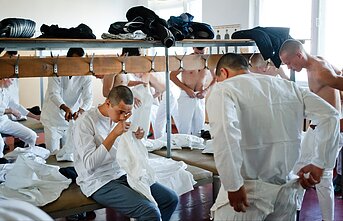
On Wednesday, Russian President Vladimir Putin announced partial mobilisation for the war in Ukraine. Later, Russian Defence Minister Sergei Shoigu said that around 300,000 reservists would be called up.
According to Elena Kotenochkina, a Russian activist living in Lithuania, the news of the mobilisation was expected and corresponded to the logic of Putin’s war in Ukraine.
“It was inevitable because no one wanted to fight. Putin recruited prisoners, around 2,000 criminals were drafted. Most of them have already died because they were used as cannon fodder, as they don’t know how to fight. So mobilisation is a logical move,” Kotenochkina told LRT.lt.
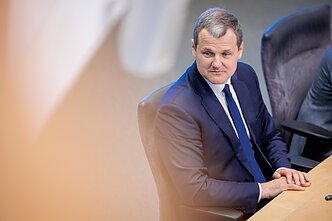
In the words of Vlad Shipitsyn, a political refugee from Saint Petersburg, Putin’s mobilisation is not partial, as is declared, but “hybrid”.
“This mobilisation is hybrid, like everything with Putin. The decree speaks of partial mobilisation, but it does not specify to whom or which regions it applies. […] Although this decree is called ‘On partial mobilisation’, absolutely everyone could be called up under it,” he said.

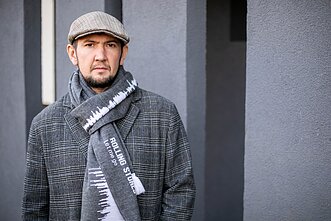
Dmitry Novikov, an activist from Kazan living in Lithuania, pointed out that covert mobilisation in Russia has been going on for a long time. He spent more than 10 years in various prisons in Russia for his democratic beliefs. According to him, back in 2014, FSB officers started visiting Russian prisons, offering prisoners opportunities to “provide voluntary assistance to the people of Donbas and Luhansk”.
“It seems to me that they will not stop here. The defence minister said that Russia’s mobilisation capacity is 25 million people. His words should be taken seriously,” Novikov said.
Intensifying protests
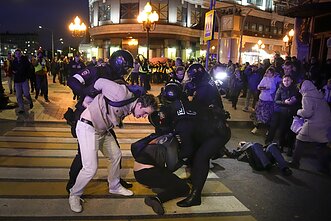
On Wednesday, more than 1,400 people were detained during demonstrations across Russia against the mobilisation.
The Russian activist Kotenochkina does not believe that the protests in Russia will grow in scale. Notably, the Moscow prosecutor’s office threatened protestors with administrative or criminal offence charges, “including imprisonment for up to 15 years”.
“Those who came out to protest and were detained are young people who usually come out. Many of them are supporters of Alexei Navalny who stayed in Russia,” Kotenochkina said.
“As for the silent majority, they will try to get out of the situation individually in some way – negotiating bribes at the military enlistment offices or leaving,” she added.

By contrast, Shipitsyn expects the protests to intensify.
“Now, the egoistic motive of ‘we don’t want to become cannot fodder’ has been added to the altruistic motive of ‘we don’t want to kill Ukrainians’. For some, this is an even stronger activator. So, I think that protests, including violent ones, […] will only intensify,” he said.
Beginning of the end
On the first day after the announcement of mobilisation in Russia, all direct flights from Moscow to countries where Russian citizens do not need visas were sold out. Car queues also formed on Russia’s border with Finland.
“Mobilisation, of course, will further undermine Putin’s regime,” Kotenochkina said. “Many have already tried to go abroad. Now, they will be closing the borders for those leaving […]. I think that in the future, you’ll need a permit from the military recruitment centre to leave the Russian Federation.”
On top of the announcement of partial mobilisation, Putin has also threatened the West with nuclear war. The political refugee Novikov hopes that Russia will soon “get rid of Putin and live peacefully in a friendly international family”.

“It seems to me that this move by Putin only brings his end closer. After all, Putin’s path is very reminiscent of that of Adolf Hitler. Even if you take his February 24 speech and compare it to Hitler’s 1939 speech before he attacked Poland, it’s clear that they spoke the same words,” Novikov said.
“And in Germany, too, there was mobilisation at first. But I hope that very soon we will be able to publicly question Putin at the military tribunal in The Hague,” he added.

Newsletter
Every Friday morning.