





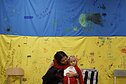






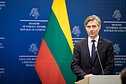


At times, Lithuania seems to feel the same pain as Ukraine. What’s behind this passionate, emotional identification with the struggle against Russian aggression? Dovilė Budrytė, professor at Georgia Gwinnett College (GGC) in the US, investigates.
“Vicarious identification” is a concept well known to psychologists. It refers to a situation when people adopt the identities and stories of others as their own, making them part of their lives and their biographies. Rachel Dolezal’s story is a case in point.
A civil rights activist who represented herself as an African American, Dolezal was outed by her biological parents as racially white, despite her identification with the black community. Dolezal’s story resulted in a public debate about the meaning of “race”, and what it means to be Black. Apparently, Dolezal’s traumatic experiences, including domestic abuse, increased her willingness to identify with Black culture.
In their recent book, drawing on the story of Dolezal, political scientists Christopher S Browning, Pertti Joenniemi and Brent J Steele argued that the concept of “vicarious identification” can be applied to international relations. They identified three areas where vicarious identity can be observed.
First, in society, when individuals identify with the state and nation, for example, identifying with victims during traumatic events. Second, vicarious identity can be observed at the national level, when individuals show support for their nation-states, when experiencing nationalism and identifying with the nation-states’ troops. Third, processes of vicarious identification can be observed between states as the states create collective identities.

These processes are linked to traumatic experiences, as the traumatic experiences redefine identities and make states rethink their narratives. According to Browning et al, vicarious identification with another state can produce a sense of stability and security as well as help states to reassert their biographical continuity in an uncertain world.
Such observations raise a possibility that Russia’s aggression against Ukraine, which started in 2014 and escalated to a full-scale invasion of Ukraine in February 2022, has resulted in vicarious identification felt by Lithuania with Ukraine.
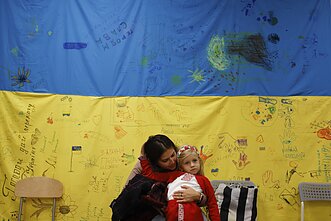
Lithuania was the first state to support Ukraine with lethal weapons even prior to Russia’s 2022 invasion. The population of Lithuania has collected funds to buy a drone for the Ukrainian military. Thousands of Lithuanians have opened their homes to Ukrainian refugees, and the number of refugees (according to Lietuvos Statistika, 64,443 as of September 5, 2022) is the largest in the Baltic states.
Ukrainian flags are flying everywhere in Lithuania, and the slogan “be as brave as Ukraine” is one of the most popular slogans in Vilnius. Furthermore, together with the other Baltic states, Lithuania has become a leading voice in Europe supporting Ukraine, arguing for its EU and NATO memberships and for stricter Western sanctions against Russia. In April 2022 Lithuania became the first EU state to suspend all imports of Russian natural gas.
This is despite the fact that Lithuania and Ukraine adopted relatively different paths after regaining independence from the Soviet Union in 1991, with Lithuania earning membership in the EU and NATO, and Ukraine struggling with transitional and identity challenges, being left out of the transatlantic community.

What explains this vicarious identification? And can it be sustained as the war continues? What are the wider implications of such vicarious identification for European identity?
Collective memory provides a partial answer to this question.
It matters that the Baltic states (including Lithuania) and Ukraine constructed similar collective memories about the Soviet past, especially the repressions under Stalin. They created similar memory regimes, both of which came to the fore in 2014, consolidating around the experience of previous traumas – including the Holodomor, or “death by hunger”, a genocidal policy pursued by the Soviet Union in 1932-33 (in the case of Ukraine) and deportations under Stalin (in all cases).
This explains the immediate identification of Lithuania with Ukraine as well as its emotional adoption of Ukraine’s self-defence. This is especially true about vicarious identification at the individual level.
As told in the ABC News story published on February 24, 2022, when the invasion started in February 2022, Jaunius Kazlauskas, a 50-year-old Lithuanian teacher in Vilnius, said: “My grandparents were sent away to Siberia. My father was persecuted by the KGB. Now I live in a free democratic state, but it seems that nothing can be taken for granted.” This feeling of existential anxiety was shared by many Lithuanians, and the Lithuanian state as well.
The mobilisation of traumatic memories has a powerful impact on identities, and this impact is going to be felt for a long time, as the war continues and even as it comes to an end.

As reported by LRT, in July 2022, during the fifth month of war, one-third of Lithuania’s residents acknowledged that they gave money to support Ukraine’s fight against Russia. It is estimated that the war affected most Lithuanians emotionally, and those who were constantly following the news from Ukraine felt the impact of the war especially severely. But will this “vicarious identification” felt by Lithuania and many other Central Eastern European states with Ukraine continue? Will it become part of the lines of division in Europe and even globally?
As the aggressive war continues to drag on, there are some signs of empathy fatigue.
According to BNS, in July 2022, it became clear that the donations for organisations delivering aid to Ukraine have declined, and volunteering for organisations delivering aid to Ukraine, such as the Red Cross, has also declined. The shock associated with the beginning of the invasion in February 2022 is gone, and the condemnation of genocidal war crimes witnessed in Bucha and Mariupol, has also vanished from the headlines.
However, despite these signs of fatigue, the war has already had an indelible impact on Lithuania’s identity. Its biographical story told to other states in the global community has become linked to the story of Ukraine, and vicarious identification, which has been in the making since 2014, is not going away any time soon. The recent successes of the Ukrainian counter-offensive only make the sense of vicarious identification stronger.

In this biographical narrative, Lithuania became one of the first countries in Europe to articulate hopes about Ukraine’s NATO membership. In September 2022, Lithuania’s President Gitanas Nausėda was telling Ukraine that Lithuania will do everything to make sure that Ukraine becomes part of the transatlantic community in 2023, during NATO’s Vilnius summit –as long as Ukraine is able to achieve a significant victory in the war. And Lithuania continues to provide various help to Ukraine to win this war.
In the medium and long-term perspective, the vicarious identification felt by Lithuania and other Central Eastern European states with Ukraine may have far-reaching consequences for a European identity. It is not a secret that the states that were referred to as “Old Europe” by US Secretary of State Donald Rumsfeld (primarily Germany and France) in 2003 (when states in “New Europe” supported US in its invasion of Iraq, and the states in “Old Europe” did not) were much slower than states in Central and Eastern Europe to feel Ukraine’s pain and provide significant military assistance.
There have been continuous hopes in these countries for a negotiated agreement in which Ukraine would have to give up parts of its territory, and there have been continued attempts to “talk” with Russia (by France). Although in February and early March the “Western rejuvenation” and Western unity triggered by the war seemed real, differences between the “Old” Europeans and the “New” Europeans have remained and become visible as the war has gone on.

A united Europe remains important for Lithuania’s security and Ukraine’s security. However, one thing remains clear – it is impossible to refer to the reaction of Western Europe to the war in Ukraine as “vicarious identification”. Historical differences, different trauma narratives and different memory regimes prevent such identification.
However, the perception of Russia as a threat as well as the need to strengthen European security with Ukraine in it may help to address the unintended consequences of vicarious identifications and help to maintain European unity.
Dovilė Budrytė is a Professor of Political Science and International Studies at Georgia Gwinnett College (GGC) in USA. These views are her personal opinion and do not represent the official position of GGC.

Newsletter
Every Friday morning.