















It is doubtful that pandemic-era benefits for furloughed workers are to blame for the record-high inflation in the Baltic states, says Jeffrey Sommers, professor of political economy at the University of Milwaukee in the US. The payouts have been quite low by European standards, while inflation seems to be higher in countries bordering Russia and Ukraine.
Sommers has been studying the Baltics since he first came to Latvia in 1995 and teaches at the Stockholm School of Economics in Riga. He watched the real estate bubble inflate a decade and a half ago and burst in the 2008 crisis. Back then, what caused it was irresponsible lending by Scandinavian banks. While the current house price inflation has somewhat different causes, changes to the tax system could help address it, Sommers says.
Economists from the major banks tend to dominate economic discussions in the Baltics, although, according to Sommers, their advice on how to regulate property markets should be taken with a grain of salt. Banks have their own interests in the matter – the higher house prices, the bigger mortgages they can sell and the more money they make.
“It is in the interest of banks to keep taxes as low as possible as it eats into the share of income people can pay for real estate, and thus, for bankers,” Sommers says in an interview with LRT.lt.
The Baltic states have been reporting the highest inflation rates in the euro zone, almost twice the EU average. Some argue that the government’s pandemic-time pay subsidies are to blame. Do you think that’s fair?
First, pandemic subsidies in the Baltic states were hardly generous by European standards, so I doubt this is the cause of the Baltic states’ disproportionate inflation.
If one looks at inflation rates by country in Europe, one sees it lopsidedly higher in states bordering Ukraine and Russia. This may be due to both extra expenditures being made by those governments for security and/or additional money coming from NATO conferences, troop deployments, etc., from the war that are driving up economic demand. I am not arguing against NATO, just that in times of war it can drive up economic demand in these countries at inflationary rates.

Also, the Baltic countries are attracting a fair amount of emigration of companies and talent from Russia, Belarus and Ukraine, given the war. This also drives up demand and thus inflation, as they bring their incomes, assets and needs for building spaces.
The Lithuanian government has been deploying rather limited and targeted measures to alleviate the effects of inflation, such as energy subsidies. Again, there are some who say that this will drive inflation even more.
Subsidies for energy will drive up government debt a bit. But one needs to think about the alternative. If this is not done this winter, we are going to see increased energy costs making some Baltic industries uncompetitive globally (especially against those states that are most efficient in fuel use, and/or with non-fossil fuel generated power, and/or with domestic natural gas). Loss of industry will reduce Baltic state government revenues, thus, more government debt anyway.
For individuals, it could mean the difference between being able to make their mortgage payments or not. If not, that means mortgages becoming non-performing (defaults). It could also lead to more private debt, eg, taking quick loans in order to make utility payments, thus further indebting individuals.
For many working people, if energy costs become too onerous, it could lead to another round of emigration. This would be disastrous for Baltic states, especially Latvia, which has had the highest population loss (as percent of population) of all EU countries the past three decades. When people leave, they no longer pay taxes, thus government debt rises. So, it’s pick your poison.
In the short-term, eg, this winter, think it far more sensible to have energy subsidies to avoid the above damage as it would be long-term harm, vs. just the short-term impact of subsidies this winter. Long term, we need better vaccines and therapeutics for Covid, as the virus is still causing rolling factory closures in parts of Asia and supply-chain issues generally.

Then, of course there is the war in Ukraine. Unless a way is found to stop it, in addition to Ukrainians, who of course suffer the most, expect more economic damage for all to continue.
Housing prices in particular have gone up. You have written about the pre-2008 real estate bubble in the Baltics. Is the current rush similar to the one we had before 2008?
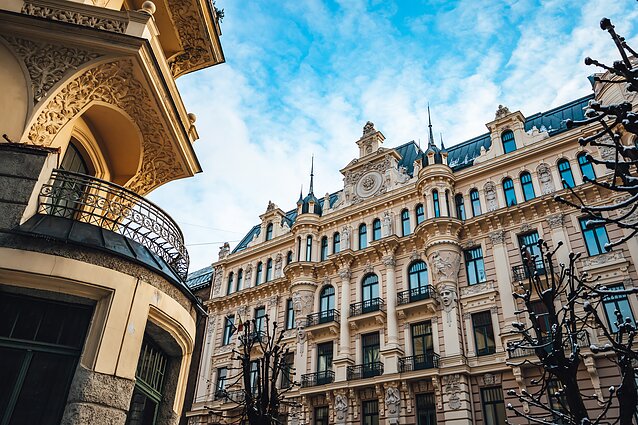
The 2008 crisis was purely due to reckless lending of banks in the Baltics that began after NATO and EU accession in May 2004. Essentially, banks came to view the Baltics as “safe” in 2004, so they opened the lending spigot on property markets there that were near debt free. It was something of an El Dorado moment for banks as there were lending opportunities everywhere: beautiful art nouveau properties with almost no debt. Really, a banker’s dream.
Bankers were not necessarily ill-intentioned, but there were just chances to make money. And, as often happens, when the regulatory infrastructure is weak, there is nothing to stop them from engaging in reckless practices. At the time, it did not seem reckless, but rather normal. A groupthink takes over. As one former president of a major Swedish bank in the Baltics was first hired, they were asked: “What’s your position on non-performing loans?” The person’s response was to run to the library to find out what a non-performing loan was. They had a basic accounting experience, so this person in the mid-1990s would do from the perspective of the Swedes.
Fast forward to 2006. As one director of real estate operations at one of the big Swedish banks told me when I queried as to why loans were being made without regard to ability to pay: “Look, no one is interested in that. It is much simpler. The Swedes know nothing about the local environment and so they put us in charge assuming we can handle it. But my only performance metric is how many loans I make. And, since the more loans I give the more money I make, I make as many loans as possible. It is the same for all the others (referencing the other local bankers in attendance at the event) here.”

I, along with Michael Hudson (a very innovative economist, but one I do have some differences with), warned Latvians in print (Diena and several other local publications starting in 2004). It was clear that incomes were too low to make the mortgages granted serviceable. We counseled using property taxes to slow the price appreciation down. Some listened, but it was clear too many were making money off the system to change it.
The current situation has significant differences in terms of causes, but nonetheless could be handled with tax policy changes.
There have been suggestions to introduce real estate taxes. However, whenever such proposals are made, leading economists – mostly from the major banks – say taxes would only make housing more expensive and less affordable.
First, I wish to assert we need banking, or at least its core functions. But we must recognise business is neither moral nor immoral by nature. Banks seek out money-making opportunities where they can. In certain instances, this works to the benefit of society by providing necessary services. In others, they will seek out, if not create, opportunities to make money by activities that add no value, or even destroy it.
The classical tradition of economics in the late 18th through to late 19th century essentially focused on this: freeing the market from those seeking to extract rents from it. The rise of the USSR and its decision to make a centrally planned permanent war economy changed the character of debate on economics.
The classical tradition – starting with Adam Smith, which had been focused on freeing the economy of rent-seeking by monopolists and special interests – took on a more simplistic character during the Cold War. The USSR selected centrally planned war economy, mostly out of necessity, but they post-facto branded this centrally planned model for political reasons as “superior”. […] In the “West” this led to equally simplistic and ideological understandings of economics in which if the Soviets argued centrally planned economies were superior (again, something top Soviet officials did not even always believe), then the opposite must be true, that unfettered markets must be the best means of organising economies.

In this way, we are still prisoners of the Cold War. Many still internalise these simple binaries about markets and the state regarding economies. Thus, we still are plagued by ideas about markets always being beneficial, when again, the classical economic tradition starting with Adam Smith said anything but. They in fact warned us about special interests extracting rents. And nowhere is this thinking about the purity of markets more prevalent than in the post-Soviet space, which is precisely what one would predict given the unpleasant experience most had with the Soviet occupation.
Now, back to banks and real estate. Any market has a somewhat fixed amount of money available for its purchase. Most people lack money to buy real estate outright. Thus, they must get credit from banks. Banks “sell” money (mortgages). The more money they sell, the more money banks make. Thus, it is in the interest of banks to crowd out any competing sectors in the real estate market.
The biggest competitor with banks for the buyer’s euro for property is taxes. Ideally, taxes pay for schools, libraries, medical services, playgrounds, kindergartens, pensions, roads, regulatory structures for clean air, food and water, etc. It is in the interest of banks to keep taxes as low as possible as it eats into the share of income people can pay for real estate, and thus, for bankers.
In short, bankers want the highest possible price for property. If people have, say, 1,000 euros available a month to pay for housing, bankers want as much of that 1,000 euros as possible. They don’t want, say, 100 euros going for taxes, which would then leave bankers with only 900 euros.

Now, arguably, the middle class is going to benefit a lot more if banks have to take a bit less profit because property prices are lower given a bit more in taxes are being collected for the services enumerated above, which add significant value to people’s lives and even make economies run more efficiently and promote economic growth.
Now, this does not mean we can have unlimited taxes. The proper balance must be found which maximises value and quality of life. Bankers, as all in society, should be part of that discussion, but for obvious reasons, banks must not disproportionately influence the debate, as their interest is to drive up property prices to their maximum level in order to make bigger mortgages (sell more money to make more money).
Again, at the risk of testing people’s patience with a history lesson, historically, the points in history where property price to income ratios have been highest, has been in economically sterile systems such as feudalism, which maximised rents and prices on property. This was precisely what the classical economic tradition wanted to reduce, if not eliminate, so that the potential of people and economies could be unleashed to resource innovation, efficiency and improved quality of life.
Now, that is the tax vs property price level debate. The other issue affecting property price is supply. Of course, people’s ability to pay for housing in part will drive supply.

For example, in much of the post-Soviet space, we had well-connected persons grab as much choice land as possible. In most developed countries, this land would be taxed at significant levels. This means that one would make money by adding value to this land by building apartments or homes on it, then selling it.
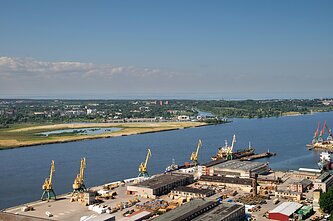
But, in the ultra-low level land tax environment of the post-Soviet space, you could simply grab big tracts of valuable land, say in the case of Riga, right along the Daugava River around the port authority near the city centre, and sit on it. Given near no taxes, there was near no penalty for holding the land undeveloped for years, or even decades, hoping for some massive future pay out as the land’s value continued to rise.
Instead, if a higher tax were put on larger land holdings (again, say around Riga’s port authority, as an example) we would see an increased supply of housing, as it would be cost-prohibitive to just hold the land undeveloped as you would have to pay taxes on it.
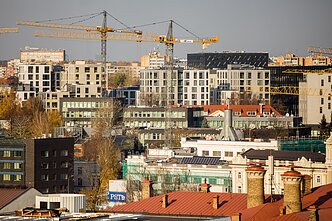
By using tax policy to incentivise building housing on land, this would decrease traffic congestion, as people could affordably live closer to the city centre. This, in turn, would reduce expenditures for roads (wear and tear) as you would have less wear from longer commutes. It would also raise new revenue from developed properties. Even bankers would benefit as it would create new building developments where they would be selling mortgages. Moreover, it would increase the supply of housing and thus eventually reduce its price.
All the above could be done to minimise tax burdens on working people. The tax rates could be progressive, and thus be structured to really only impact special interests that have been sitting on large, valuable tracts of land instead of allowing it to be developed for housing.

Newsletter
Every Friday morning.