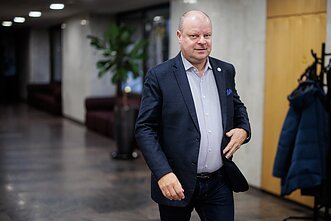













It would be irrational to continue to argue with EU partners over the Kaliningrad transit, Lithuanian Prime Minister Ingrida Šimonytė says, calling for further focus on supporting Ukraine and new sanctions for Moscow.
“It is not rational to have our time and attention distracted and used to discuss whether one kiloton of steel can be transported from one part of Russia to Kaliningrad by rail,” Šimonytė told reporters on Thursday.
Read more: Lithuania and Kaliningrad – updates
Her comment came in response to the European Commission’s Wednesday decision to allow the transit of sanctioned Russian goods to Kaliningrad via EU territory for the needs of the Russian exclave.
The transit was halted after some of the EU sanction on Moscow over its invasion of Ukraine came into force in mid-June.
Representatives of Lithuania and the European Commission have held consultations in recent weeks on the Kaliningrad transit following Russia’s outcry.
Although many in Lithuania have criticised the decision as succumbing to Moscow’s pressure, Šimonytė said that further disputes over the issue would be “a real victory for the Kremlin”.
“Therefore, the priority must be to continue to fully support Ukraine in its war with Russia and to reach an agreement as soon as possible on the 7th sanctions package we expect soon,” the prime minister said.

According to her, Lithuania is choosing to take the European Commission’s guidelines on transit into account “out of respect for the institution itself and its mandate”, and “out of respect for the unified approach, which is one of the main tasks of the guidelines”.
“We may not take them into account [...]. Then, our disagreement would end up in the Court of Justice of the European Union,” the prime minister said.
Šimonytė also pointed out that the European Commission is not obliged to coordinate its guidelines with the member states, adding that Lithuania is grateful for the consultations, comments, and suggestions.
“However, the responsibility for the European Commission’s opinion lies with the European Commission, and the institutions of the Republic of Lithuania should not and could not take responsibility for the European Commission’s opinion,” Šimonytė said.
‘We have all the data’
Under the updated guidelines, Lithuania and other EU member states will be required to check whether transit volumes to Kaliningrad remain within the historical averages of the last three years to make sure that sanctioned goods shipped to Kaliningrad are in line with real local demand and are not exported to EU countries.
Lithuania has all the data it needs to decide what transit volumes are needed to meet the needs of the region, the premier said.

“We have all the data on the historical movements of such goods over a number of years, and we can certainly more or less accurately assess what the volumes for the region’s needs look like, given that the volumes in transit have significantly dropped over the last few years,” the Lithuanian prime minister said.
“And we can probably make a reasonable assumption that most of those goods are for the internal use of the region,” she added.
In her words, since the adoption of sanctions on Russian exports to the EU, Lithuania has discussed the Kaliningrad transit issue “both with the European Commission and with strategic partners”, but has only discussed implementation details with the Commission.
“That opinion was coordinated not with officials, but with those directorates, those EC units that are responsible for this issue. Certainly, that approach, in my opinion, was discussed well in advance,” she said.
Šimonytė also said that blaming Lithuanian officials for the EC’s decision was incorrect, since “no national institution can prevent the European Commission from expressing its opinion”.
Currently, Russian steel, ferrous metals, cement, alcohol, and other goods are not shipped to Kaliningrad.

More clarity and less disinformation
Lithuanian President Gitanas Nausėda issued a statement on Thursday, welcoming the EC’s new guidelines on the transit of goods between mainland Russia and Kaliningrad via EU territory.
“The president believes that the Commission’s guidelines will bring clarity on the implementation of sanctions across the EU and will fend off the Kremlin’s further disinformation and unfounded accusations against Lithuania,” according to comments issued to the media by the president’s communication group.
“The country’s leader emphasises that effective implementation of EU sanctions is only possible when they are interpreted unanimously. The president states that it is particularly important to maintain transatlantic unity and strength at the EU level in the face of the Kremlin’s provocations,” the statement said.
According to Nausėda, it is necessary that the EU continue to pursue consistent policy of further tightening sanctions on Russia.
“In the president’s view, it is necessary to strive for the rapid adoption of the seventh package of sanctions for Russia, which would further strengthen the existing isolation of the aggressor country,” the statement said.

Newsletter
Every Friday morning.