






What and who is behind the recent proposal to revoke the recognition of Lithuania’s independence in the Russian Duma? Bradley Woodworth from the University of New Haven and Yale University looks into the recent headline-grabbing proposals.
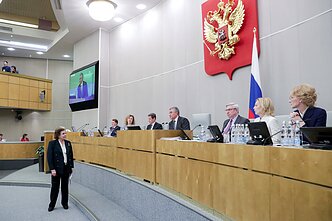
Last week draft legislation was introduced in the Russian parliament – the Duma – proposing that the Russian Federation revoke its recognition of the independence of Lithuania. The proposal comes from Duma deputy Yevgeny Fedorov, a leading figure in the majority party United Russia.
Read more: Russia’s Duma mulls revoking recognition of Lithuanian independence
On the one hand, this could be seen as a direct response to the decision by Lithuania’s Seimas last month to recognise Russia’s war in Ukraine as genocide. Lithuania joined Canada’s House of Commons in calling Russia’s actions in Ukraine genocide.
While that decision may have some influencing in timing the Russian draft legislation, something more profound is afoot – under President Vladimir Putin Russia is seeking to undermine the post-Second World War international order in which the sovereignty of states is recognised by the entire international community.
Yevgeny Fedorov is already known for his extreme views regarding Russia’s position as a state after the collapse of the USSR in 1991 in that he does not view the post-Soviet states as juridically legitimate. He heads a Russian organsation called the “National Liberation Movement,” the stated aim of which is to restore the “territorial integrity of Russia” and “the sovereignty lost in 1991.” Russia’s legal borders, Fedorov argues, are those that existed at the end of World War 2.
On February 24 of this year, the day Russia’s war against Ukraine began, Fedorov, in army fatigues, conducted an on-line interview in which he said: “Whatever words are used to cover up the removal of territories from our fatherland – self-determination, the independence of republics – though not one of them officially left the USSR, which says much – there is not one document about the exit of Ukraine from the USSR, for instance. […] It will end when, as Putin said, the security perimeter is established on the borders of the Soviet Union. I can say that inside this state, within this perimeter, there will be restored – of course voluntarily – a unified state with the borders of 1945.”

Read more: Should Lithuania be worried about Russia ‘cancelling’ its independence?
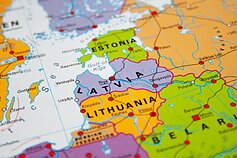
In other words, Russia’s true borders are those of the USSR. For Fedorov, a type of “war” has been going on since 1991, a continuation of the Second World War that will end only with a return to the borders of 1945. Such a course of events would mean the forced inclusion into Russia of all of the countries whose territory had been part of the USSR, including Lithuania, Latvia, and Estonia.
Speaking in Copenhagen on June 10, Lithuania’s Prime Minister Ingrida Šimonytė downplayed the proposed Russian legislation. “I think we should not over react to this, because it's a particular member of the Duma [behind it], very particular even for United Russia," she told Newsweek magazine. "Even legally, this is nonsense," said the Prime Minister, in the Danish capital to attend the Copenhagen Democracy Summit. "We have different sets of agreements that established the relations between the Lithuanian state and Russian Federation.”
In her remarks to the Democracy Summit, Šimonyte drew attention to the core issue: Russia under Vladimir Putin has turned to autocracy and is championing the notion that countries’ political system are not for their own people to determine.
“No surprise that democratic principles and the rule-based international order could be seen as a threat to autocrats. In their view, the world order is divided into spheres of influence [...]. They demand to not impose ‘Western values’ so as to disguise – and poorly so - an ambition of safeguarding and empowering autocracy,” she said.
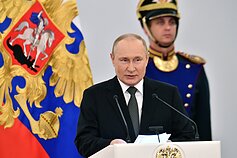
Putin made ever more clear his rejection of the post-Second World War international order while speaking to a group of young Russians readying to attend the St. Petersburg International Economic Forum held at the All-Russian Exhibition Center (VDNH) last week.
“Either a country is sovereign, or it is a colony, no matter what the colonies are called. I am not going to give any examples so as not to offend anyone, but if a country or a group of countries is not able to make sovereign decisions, then it is already a colony to a certain extent. But a colony has no historical prospects, no chance for survival in this tough geopolitical struggle,” he told them.

For Putin, many of the states that are members in the Western post-Second World War military alliance – the North Atlantic Treaty Organization (NATO) under US and British leadership – are actually colonies, not fully sovereign because of their reliance on NATO. The fear that Ukraine will become closely aligned with states in Western Europe and North America (“the West” in Putin’s neo-Soviet view) has been a major factor behind Russian aggression in Ukraine since 2014. In the now well-known article that he published in July 2021, “On the Historical Unity of Russians and Ukrainians” Putin wrote: “[W]e are witnessing not just complete dependence [of Ukraine on the West] but direct external control, including the supervision of the Ukrainian authorities, security services and armed forces by foreign advisers, military “development” of the territory of Ukraine and deployment of NATO infrastructure.”
It is not difficult to conclude that in Putin’s view, Lithuania, Latvia, and Estonia as NATO members are not in fact sovereign states but colonies, countries with “no chance for survival in this tough geopolitical struggle.”
Russia is currently mounting an existential threat to global security. Vladimir Putin is advocating that Russians abandon the idea that sovereignty for countries is determined by current international law but instead is simply the result of power. The arguments vary behind, on the one hand, Putin’s view of what constitutes a state or a colony, and on the other, Yevgeny Fedorov’s draft legislation n for Russia to revoke its recognition of Lithuania’s independence. Yet the outcome either way produces a justification for invading Ukraine and attempting to seize its territory, and an excuse for making threats against the Baltic countries.
On Friday in his comments at VDNH, Putin made his own threat against the Baltic countries. The exhibition center opened the previous day an exhibition titled “Peter I: Birth of an Empire,” timed to mark the 350-th anniversary of Peter’s birth. About the land in the far eastern corner of the Baltic Sea where St. Petersburg was founded, Putin said that though other states recognised it as the territory of Sweden, “from time immemorial, the Slavs lived there along with the Finno-Ugric peoples, and this territory was under the control of the Russian state”.

Read more: Hailing Peter the Great, Putin draws parallel with mission to ‘return’ Russian lands
“The same is true [when Peter turned in a] western direction, to Narva and his first campaigns. Why would he go there? He was returning and reinforcing [возвращал и укреплял] – that is what he was doing,” he said. “Clearly, it has fallen to our lot to return and reinforce as well. And if we operate on the premise that these basic values constitute the basis of our existence, we will certainly succeed in achieving our goals.”
With words like these not only is Putin justifying his war against Ukraine, he is also laying the foundation within Russian society to justify “return and reinforce” other areas as well that in the past have been under Moscow’s control. For the current Russian government, the successful “return” of the Pribaltika would be a prize indeed, a sure sign of a return to past imperial greatness as these lands were brought into the Russian Empire (in the case of Estonia and much of Latvia from 1710, and for Lithuania and the rest of Latvia in the partitions of Poland in 1772 and in 1793-1795). They were also in the Soviet Union in 1940-1941 and then 1945 to 1991. It also likely still sticks in the craw of some Russian imperialists that Lithuania was the to first to reach for independence, announcing the restoration of its independence in March 1990.
Though Duma deputy Fedorov may be dismissed as being on the fridge of Russian politics, it is not at all beyond the realm of possibility that the Baltic countries could be targeted after Russia is finished with its “special operation” – its war – in Ukraine. Whatever the outcome of this war, Putin will define it as “victory” and could conceivably move to initiate war elsewhere. The issue of independence for Lithuania, Latvia, and Estonia lies at the center of the question of “territorial integrity” of the state run from Moscow. It is certainly remembered in the Kremlin that throughout the final three years of the existence of the USSR, the Baltic republics were often at the center of attention.
This was the case in the final death throes of the Soviet Union. On August 20, 1991, day two of the unsuccessful coup in by Kremlin hardliners against Soviet President Mikhail Gorbachev, two figures close to Boris Yeltsin, President of the Russian RSFSR, told the BBC that immediate recognition of Baltic independence was crucial. Yeltsin’s foreign minister Andrei Kozyrev said this “will show the criminals that they are breaking the empire by their use of force.” Yeltsin advisor Galina Starovoitova agreed: “Recognise immediately the independence of the Baltic countries. It will be the sign that you will not recognise the legitimacy of state criminals.”

The era of state criminals is back. Putin, Fedorov, and any who are willing to violate international law and with violence restore Russia to some sort of imagined greatness clearly would like to “return and reinforce” Russia’s control over the Baltic countries.
But it is no longer 1945. Most of the rest of the world does not calibrate its strength based on asserting maximal territorial boundaries. Were that to happen, there would be no end to the angry claims and no end to war. After the immense destruction of World War 2, the international community set about establishing agreements and institutions to aid states in collaborating, even in managing relations between competitors. War has not always been avoided, notably in Korea, Vietnam, in Afghanistan, Iraq, and Syria. Only in the former Yugoslavia in the 1990s did large-scale war return to Europe.
The entire world should continue striving to secure the peace and security that until Russia’s current war in Ukraine has held in the West for over two decades and which still has the possibility of showing the world that war is not the way forward.
Bradley Woodworth is Associate Professor of History at the University of New Haven and Programme Manager of Baltic Studies at Yale University. In 1990 and 1991 he worked as a journalist for the newspapers The Estonian Independent and Baltic Independent, published in Tallinn.

Newsletter
Every Friday morning.