













The Karaim language is spoken fluently by around 30 people in the world. All of them live in Lithuania. The language is included in the UNESCO Atlas of the World’s Languages in Danger. For the Karaim community, it is a matter of pride not to let it go prematurely.
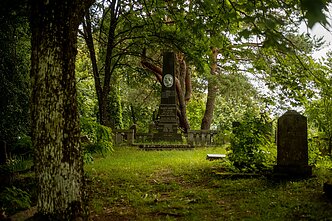
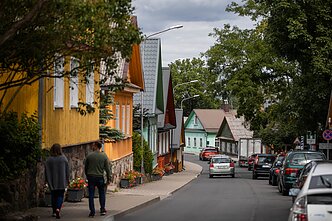
It is believed that the Karaims came to Lithuania in around 1397, when Grand Duke Vytautas of Lithuania brought several hundred families from the Crimea after a foray into the steppes of the Golden Horde. Vytautas recruited the Karaims as loyal guards and brave soldiers and settled them all in Trakai, his ducal seat. The street leading to Vytautas’ island castle is still called Karaim Street. The Karaims brought their own language and, six centuries later, are still using it.
That is partly because the Karaims have always been a close-knit, closed community, although one that did not ignore their Lithuanian environment and were known to get along with the locals exceptionally well.
This fact has been noted by travellers. The painter Wincenty Smokowski, who visited Trakai in 1822, noticed the dark-haired, unusual-looking people who spoke their own language among themselves. “Their calm and gentle communication, as well as their hospitality, and especially the fact that their strain has not committed any crime here, encourages everyone to get closer to them,” is how he described his impressions from the early 19th century in Trakai.
Seventeen cousins on one street
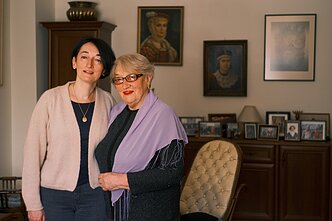
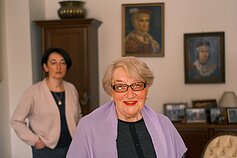
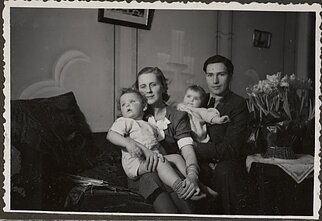
Scholars of endangered languages know that the starting point for study is finding the oldest people who still speak it. One such person is Halina Kobeckaitė, a journalist, diplomat, translator and former adviser to Lithuanian President Valdas Adamkus. Halina was born in 1939.
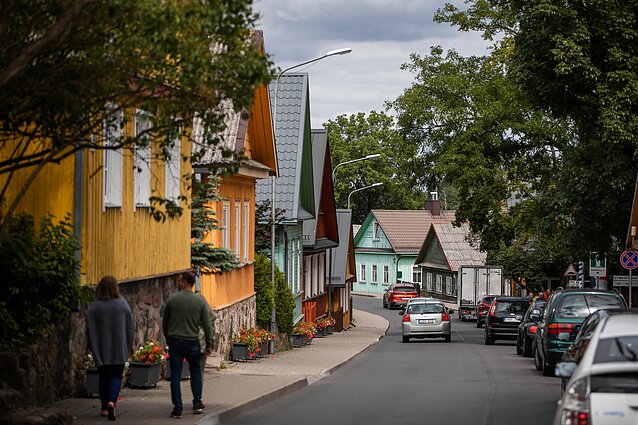
“My childhood was spent here in Trakai. I was born and grew up here. Almost all the houses on this Karaim Street were inhabited by Karaim families and all spoke the Karaim language. […] We spoke Karaim with our friends, with our parents, and with our neighbours,” says Kobeckaitė.
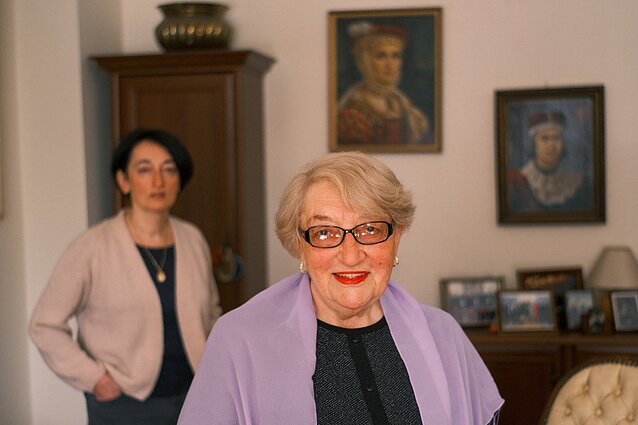
Although Halina had only one sister, she was surrounded by a very wide circle of Karaim relatives during her childhood: 17 cousins, all of whom spoke Karaim and lived in Trakai.
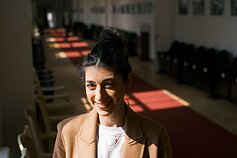
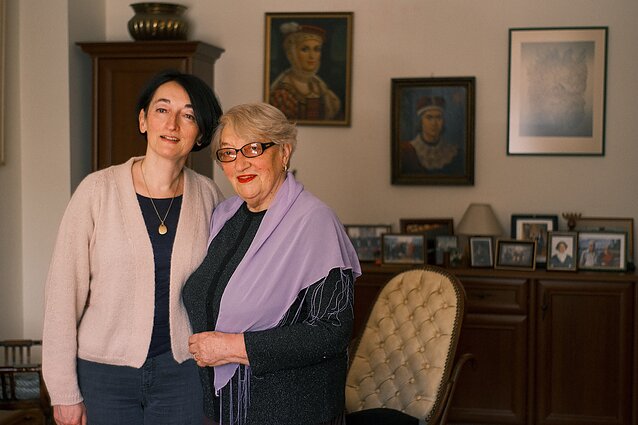
Today, Halina's daughter, the musicologist Karina Firkavičiūtė, lives in a beautiful wooden house on Karaim Street in Trakai. Born in 1971, she had a rather different childhood.
“Different times, different context, different political system. I was born in Vilnius, not in Trakai. Even in the physical sense, my neighbours were different people, not relatives. However, I had the privilege of having both my parents speak Karaim to me since I was born,” says Firkavičiūtė.
Thanks to the efforts of her parents, she picked up the language almost with no effort. Everyone else who wanted to learn Karaim had to study it. While the generation of her parents used the language widely, much fewer did in her own generation and hardly anyone younger than herself.
“Naturally, I had fewer cousins than my mother, and I am an only child and have no children of my own. So, of course, the numbers and generations change,” says Firkavičiūtė.
Translating dictionaries
The Karaim language belongs to the Kipchak group of the Turkic family. According to Kobeckaitė, it may have originated in the 9th-10th centuries. Since the Karaims lived in territories that were quite far apart (Ukraine, Poland, Lithuania), there is no one standard version of the language, but three dialects: Trakai, Halych-Lutsk and Crimean.
The Trakai dialect has been preserved in Lithuania until today. It is, Kobeckaitė says, quite special because it has preserved very old words from the Turkic languages. This makes the Karaim language of great interest to scholars of Turkic languages.
“That is why it is very important for us to preserve the language, if not in spoken, then at least written down,” says Kobeckaitė.
“The most precious legacy left to us by our ancestors is our mother tongue,” are the words of the preface to the Lithuanian-Karaim Dictionary published last year. Ana Špakovska, who compiled it, did not live long enough to see it hit the shelves, but the dictionary was published by her granddaughter Severina Špakovska.
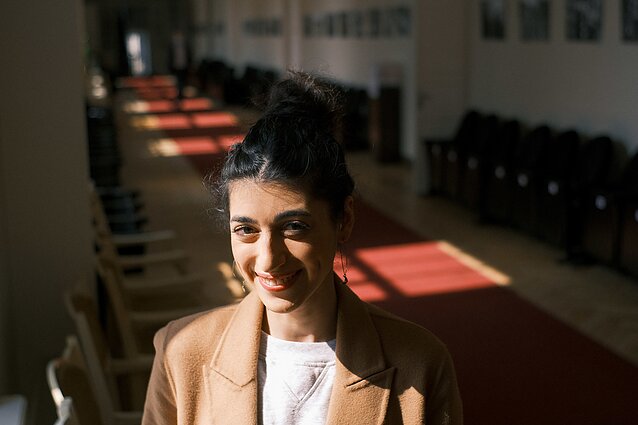
“My grandmother grew up in Trakai. Her family spoke Karaim at home, so she kept that language until old age. Not only did she know it herself, but she was also free to teach it to others. She was a mathematics teacher, so she had a pedagogical flair. My grandmother taught Karaim to my sister and me, as well as to other children in the community,” says Severina.
Severina’s grandmother Ana wanted to publish textbook for young people who could not read Russian. At the time, there were publications in Russian, but not many in Lithuanian.
“She would sometimes mention her idea and at one point just started translating other dictionaries. There were two: Russian-Karaim and Russian-Polish-Karaim. That translation took about 10 years. It was a constant work in the evenings, on days when she was already retired, when she had time and her health was still good. I am very happy that she managed to finish the dictionary,” recalls Špakovska.
Not so long ago, Halina, with help from her daughter Karina, also translated Antoine de Saint-Exupéry’s philosophical fable The Little Prince into Karaim. She was offered to do it by a German publishing house specialising in lesser-known languages. Although she does not speak French, Halina collected translations of The Little Prince in Lithuanian, Russian, Azeri, Turkish and Polish. Using these, she translated the story into Karaim and gave the manuscript to her daughter to check it against the French original. And so the book was translated.
Natural process
When Severina was a kid, Lithuanian was the language spoken in her home. She also started learning Karaim from an early age, from her grandmother Ana, but she does not speak it fluently.
“I like the idea that I am 100-percent Karaim and 100 percent Lithuanian. Still, Lithuania is home to me, always has been and always will be. Sometimes I feel sad and sorry that the Karaim language is disappearing, but at the same time it seems to me that this is a very natural process. There are not many members of the Karaim community left. So I think that, for some more years, our language will stay alive, we will try to preserve it, but I do not think that we need to fight against extinction. Even if there are more people who speak Karaim fluently now, where will you use that language? It may sound very desperate, but I don’t think this language will ever be alive again,” says Špakovska.
It would be worthwhile to preserve the Karaim language for tradition, as a relic and a legacy, she quips.
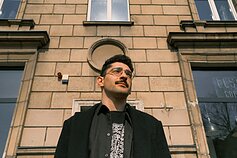
Aidar Lavrinovič, a 22-year-old psychology graduate and now works in advertising, is now probably the youngest Karaim speaker.
“For me, Karaim is a nostalgic language because I associate it with childhood, purity, sacredness. My grandparents spent quite a lot of time communicating with me in Karaim so that I could learn it,” he says.
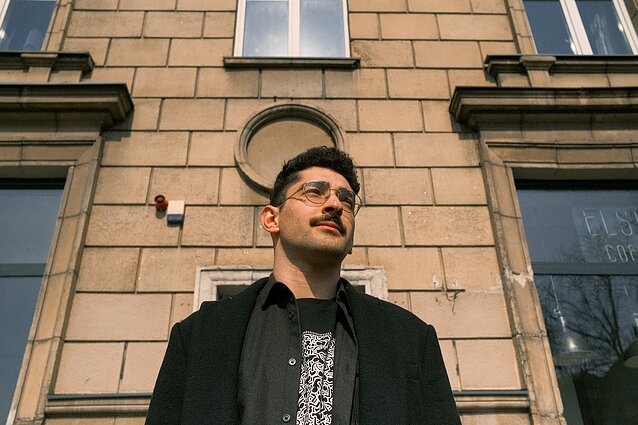
“I remember when I started going to school and started speaking more and more Lithuanian, I naturally started forgetting some Karaim words. My grandfather would then sit me down and remind how to say this and that in Karaim. And I used to love listening to bedtime stories and kept asking my dad for them. He would tell stories he had made up in Karaim about a family that had a monkey and the monkey was always getting into all sorts of adventures,” says Lavrinovič.
He picked up Karaim very organically from his relatives, he says. He grew up surrounded not only by Karaim and Lithuanian, but also Russian and Polish. Since Aidar was always known in the Karaim community as the youngest fluent speaker, he would always have to speak when reporters came to do a story about the Karaims.
Summer camps
There has been growing efforts to preserve the Karaim language in recent years, however. In addition to books and language courses, Karaims from around the world have been coming to Trakai each summer for camps.
Firkavičiūtė says that the meetings always revolve around the Karaim language. Even those who do not speak it or use it on a daily basis take away at least some new knowledge and have the opportunity to hear it spoken.

Špakovska started attending the camps at the age of six. She remembers that the best Karaim speakers in the community would take turns to teach her.
“The will is there, but because teaching is so fragmented, we used to study the same thing almost every summer. We learn something in the summer, then everybody returns to their lives, and when we meet again the following summer, we realise that we need to go over it again,” says Severina.
It is estimated that around 30 people can speak fluent Karaim today and almost all of them live in Lithuania. The figures were collected by Karaims in Poland, who set out to record the language and its sound. So a few years ago, they tracked down every surviving Karaim speaker.

Possible futures
What are the future prospects for the language, 625 years after its speakers came to Lithuania?
“If it survives at least in the family, that would be extremely good,” says Firkavičiūtė. “When I read Karaim periodicals from the yearly 20th century, I find exactly the same concerns: the language, the customs, the culture are disappearing, and we have to try, we have to do something. We can say exactly the same thing today. We are making as much effort as possible, and I hope that this curve of decline has the potential to turn upwards.”
Her mother Kobeckaitė looks to the past for guidance about the future.
“I have lived through all the phases: when there were many speakers, when there were fewer and fewer. Nevertheless, I remember my father, who many years ago said that this was a dying candle. So here I am very pleased to say that the candle has not yet gone out, and I hope that it will continue to burn. The candle is not so bright to illuminate entire worlds, but it can light up a part of the room, a part of the people,” Kobeckaitė says.
Lavrinovič takes the preservation of the Karaim language seriously.
“It will be a defeat and a loss for the people, unless they take charge of it themselves. Yes, we have people who write, publish books, do other things. But there aren’t that many people who feel they need to know the language. And because there is no great need, no one takes responsibility,” Aidar reflects.
He recalls meeting the last woman who still spoke the Halych dialect of Karaim.
“Her language was different – different stresses, sounds, accents. That woman is no longer with us, and nor is the dialect. I cannot point my finger and say – it’s because she didn’t teach anyone. Why didn’t we learn it?” says Lavrinovič.

Newsletter
Every Friday morning.