









As Ukrainian forces retook control of the region around Kyiv, Lithuania was among the first countries to send its ambassador back to the capital city.
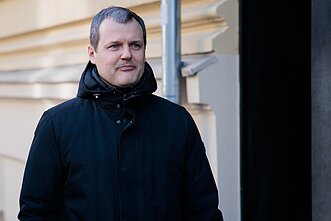
“Kyiv is already recovering,” Ambassador Valdemaras Sarapinas told LRT.lt during an interview he gave on his way from Lviv to Kyiv on Thursday.
The return of the Lithuanian ambassador to Kyiv was announced on Monday by the Ministry of Foreign Affairs.
Mr Ambassador, you are on your way from Lviv to Kyiv as we speak. What is the situation? What do you see around you?
Yes, we are passing through Ukrainian towns and villages. Lots of soldiers, lots of blockades. In fact, the country is living under war conditions. I think you can see this very well from all the images that the whole world, including the Lithuanian public, sees every day on their screens.

How has the last month been for you? What has your work been like?
Very intense. The specifics are different. This month, technically, our embassy was in Lviv with the ambassador at the forefront, but admittedly most of the time was spent in the capital Kyiv. This is only because of the regular visits of high-ranking officials, our ministers, members of parliament, the Speaker of the Seimas, and the visits of our ministers of defence and healthcare.
That is very good. Indeed, material, military and humanitarian aid is very important today, and Lithuania is providing it to the best of its abilities and in large quantities. But equally important is the moral, political, live support, support through live visits, which our leaders understand and do. As ambassador, I had to be there at their side, helping to organise those visits.
Therefore, a lot of my time was taken up by being physically in Kyiv and organising these visits and meetings.

The mayor of Kyiv, Vitali Klitschko, recently told Kyivans that they should not return to Kyiv just yet, but that is where you are going. How do you personally feel? Do you feel safe?
There is simply no time to think about the dangers. I feel really safe, protected, when I need to be, with a vest and a helmet, I’m outside. I have been to see the mayor of Kyiv several times this month.
In fact, the mayor has so far advised residents not to go back just because it would be logistically, administratively very difficult. Because there is a lot of destroyed infrastructure. If a large number of residents were to go back at once, it would be very difficult to manage the situation.
But Kyiv is already recovering. It is encouraging, of course, that the Russian army has been pushed back from the environs of Kyiv. When I was there a couple of weeks ago, Kyiv seemed completely empty, no cars, no people – and now life is slowly, very slowly getting back on track.

What information do you have about Lithuanian citizens currently in Ukraine?
Officially, we currently have 26 Lithuanians registered at the Embassy. Therefore, we feel obliged to maintain regular contact with them and provide them with all the necessary information. It is very difficult to say the true number. There is no obligation for them to register.
Your return to Kyiv was announced earlier by the foreign minister. Was it your initiative or the Foreign Ministry’s? Who decided that you should return?
I am very proud of the decision of my leaders, of the heads of state and government, and of the foreign minister to return the ambassador to Kyiv. We were the first to do so, and our Turkish colleagues have already followed suit, and I heard the Estonian foreign minister’s statement yesterday that he planned to send back his ambassador to Kyiv in the near future.
Believe me, this is very important politically, and it is important to demonstrate solidarity, unity with our Ukrainian sisters and brothers in this form.

Are all the embassy staff going back to Kyiv?
No, not all. Some of the embassy staff are returning, some are staying in Lviv for the time being, and we still have some embassy staff working from Poland, performing consular functions and other important day-to-day tasks.
You mentioned support. What else would the Ukrainians need from us, what kind of support?
The support continues to pour in, dare I use that word. Our embassy is involved in coordinating this process. Yes, we have helped as much as we can with arms, and I know that we are still helping. All our basic resources have been handed over.
What the Ukrainians need most is weapons. We should appeal to the conscience of the great Western powers, and they are doing so, but I would like to see even more of this. That is very important.

Humanitarian aid is also very important, including medicines. Lithuania is helping Ukraine in this area, I will not give the exact figures now, but the quantities are very large. Even things like, for example, 40 tonnes of chlorine from Lithuania for the treatment of Kyiv’s water pipelines.
There are many specific examples. The support continues.
Different information about Ukrainian casualties reaches Lithuania, ranging from a few thousand people killed in Mariupol to many more. What information do you have on this?
I can only refer to the information that is in the public domain. But in reality, I think the figures are much higher. What we have seen in recent days, the images from the liberated towns and cities near Kyiv, Buche, Irpin and others, it is extremely terrible. I think that those numbers will be higher.
The most important thing now is to document all this. I know that the prosecutor general of Ukraine has already set up a special group to investigate these crimes. However, the Ukrainians will not survive without the help of the West. It is imperative that Western countries get involved in this process as quickly and as actively as possible.
What do you know about Lithuanians who have come to Ukraine to fight?
The Embassy does not have their number. We know of individual cases, but I would not be able to answer how many there are in total.
What are your immediate plans after your return to Kyiv?
My working days will be intense. Keeping in constant contact with Ukrainian state institutions, which are working, and the Verkhovna Rada itself is also working intensively, meeting in plenary and committee sessions. The government is also working.
I am in constant contact with the heads of the Ministry of Foreign Affairs and the Ministry of Defence. I hope that the attention of our country’s leaders and officials and their live visits to Ukraine, which are very important today, will continue.

Newsletter
Every Friday morning.