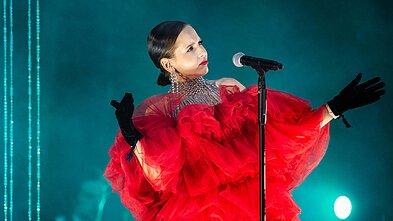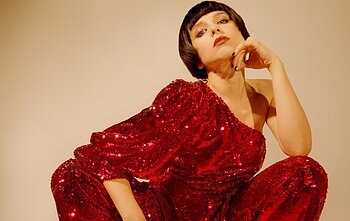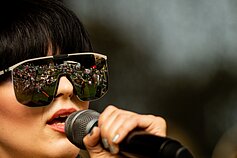














Monika Liu has won the national Eurovision selection and is going to represent Lithuania in Turin.
Thirty-four-year-old Monika Liubinaitė hails from Klaipėda, Lithuania's third city on the Baltic coast. She started playing the violin at the age of five, although it took ten more years to shift focus to singing.
Immediately, she won praise at Dainų Dainelė, one of Lithuania's oldest and biggest children's singing competitions.
Liubinaitė studied jazz and singing at Klaipėda University, before continuing her studies in Boston. She later moved to London, where she pursued a songwriting career.

According to one interview, her early works have been described as a “strongly electro-pop and less weird version of Björk”.
However, in her 2020 album Melodija, which was recorded in London and released as a vinyl, she turns to a slightly retro sound reminiscent of Lithuanian (and European) pop music of the 1960s and 70s. The title itself recalls the Soviet record label that dominated record collections of the last several generations.
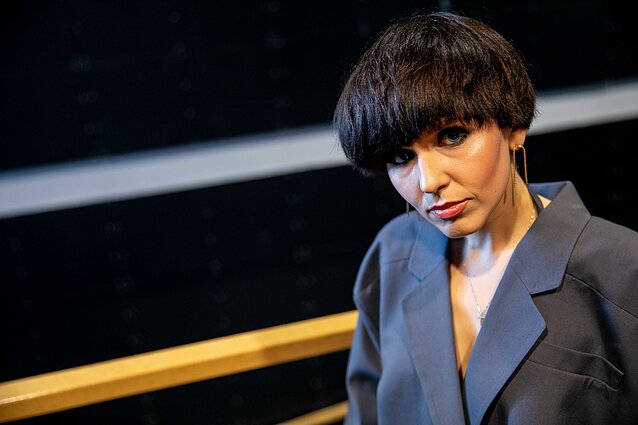
Monika Liu's Eurovision song Sentimentai (Sentiments) also follows in that direction. With a whiff of Mireille Mathieu (look at that hair!), the lyrics speak about seaside memories and nostalgia.

“Moments are making rounds in the head, running the same way as you. A million roses like sentiments are drowning in a sea of clouds,” runs the chorus.
Breaking with a two-decade tradition, Lithuania has picked a Eurovision song with lyrics in Lithuanian, something unseen since 1999 when Aistė Smilgevičiūtė performed Strazdas in Israel. It did not receive a high score back then, but is now considered a classic that, in the opinion of many a Lithuanian, was well ahead of its time.
“I believe very much in the Lithuanian language, and I have no doubt that it's time to show it again to Europe,” says Monika Liu.
In an interview with LRT.lt, she speaks of her expectations for Eurovision, making music during the pandemic and how she dealt with having to spend too much time with herself.

It's been a lucky year for you – your songs are hits, you are working in television, and after winning the national Eurovision selection you will get the opportunity to represent Lithuania in Europe.
They say, education has bitter roots but bears sweet fruits and I think this applies in my case. I've been working hard for years and now my hard work is bearing fruit. For ten years I've been studying, improving, experimenting, creating. Through all these years and searches, I have refined my own style, which is now authentic and unique.
The formula is simple enough – if you put in a lot of time and effort, you get a result. It all came naturally – I never had a goal to become famous, I didn't have a strategy, I didn't have a manager. I just wanted to grow and create, because music is sacred to me, I'm dedicated to it – it's my way of being.
You decided to compete in Eurovision with a song in Lithuanian. Why?
I have lived both in the US and in England, where I have realised – and have been told by professionals more than once – that nobody cares for a Lithuanian who tries to sound English or American. It's very noticeable and audible, and when you do that, you are just one of many.
So it's better to show where you come from. That's what made me release the album Melodija, which is in Lithuanian. And people liked it. So you don't have to try to be what you are not. No one is interested in copies. What's the point in trying to become another Adele or something? For a foreign listener, it's important to get a flavour of originality, authenticity. They can hear it.
I believe very much in the Lithuanian language, and I have no doubt that it's time to show it again to Europe. Maybe it takes courage to go with a Lithuanian song, some would perhaps prefer to play it safe. But I've always had courage and never been afraid to take risks - even if I come dead last in the competition, I will walk back into the airport like a queen, just because I sang in my own language. Besides, I have often heard songs in different languages that I didn't understand, but still loved.
When it comes to courage, I guess, you must take risks as a creator, otherwise you won't be able to create anything unique.
Of course! That's why I am brave on stage. And, by the way, it takes courage to go to Eurovision.
By the way, the Covid-19 pandemic has affected you directly.
In fact, I came down with a rather mild form. I got sick just when I had to decide whether to participate in Eurovision selection and submit the application. I realised that Sentimentai was suitable for Eurovision when we were working on it in a recording studio in London.

As it happens, it took a lot of work to be able to travel there and record the album. Since I wanted to go on working with the people who recorded my first album, I had to figure out how to get to England. We were recording in the first year of the pandemic, there were no vaccines, but a lot of fear of infection and anxiety.
I had to do a lot of paperwork to get there. I remember having to quarantine myself when I got to the UK and being put up in very poor conditions – cats from the street would come into the flat at night! When you think about it, all the audience sees today is a loud song and a sparkly dress, and how much I had to go through.
And anyway, the pandemic was a difficult time, and it left its consequences. The song I wrote for Eurovision is not just about a woman who lives in the memories and sentiments of the past because she was better off then. During the pandemic, I sometimes would not understand what was going on and what the reality was, I was living in memories. It was a challenging time to be with myself.
One's own company is that challenging?
It turns out it is. Fortunately, we have a lot of knowledge and practices to help us survive. However, humans are sensitive beings who react to their environment, so we need to try to make our situation healthier, more normal and brighter every day.
For me, making art helps – painting and music. As I said, it is what I live by and it is my way of being and living every day. Not all my work comes from my experiences, some songs are very personal, but there are some that I just make up.
Perhaps a “made up” song is easier to share with others than one that is deeply personal?
When you perform a song, you give it away to others and it becomes theirs. You have lived it by writing and recording it, but when you perform it, it is not you who has to cry, but the listener. People hear and accept that. That's why I love my audience so much.
By the way, they often write to me to say that a song affected them and thrilled their hearts. And some even write that they have tattooed or engraved my lyrics on a ring! That means that someone finds my work meaningful. That's what I'm trying to do, I don't want to put on a show for the sake of a show, because music is very important to me.
Paradoxically, an artist is someone sensitive and open to the environment, but also needs to have a thick skin in order not to be hurt by negative comments.
I get nice feedback more often, but inevitably there are negative comments. Especially since I started working in television. However, I have learnt not to read [comments on social media], I do not want to give my time and energy to those who are spiteful.

But when you choose to be a performer, you cannot avoid it. Of course, I would like to be completely sensitive and open, but you have to protect yourself and ration your attention. Especially since I am quite a harsh critic of myself – I'm a perfectionist, so I'm very harsh on my work.
Nowadays, many say that perfectionism is not a virtue and should be discarded.
I disagree! I don't like the “it will be fine” attitude. You have to strive for the best and generally raise standards in music or any other field. And that only happens when everyone does their job professionally and to the best of their ability. So how can we do without perfectionism?
How do your family feel about your work? Sometimes they can be the harshest critics.
I've seen everything, some people in my family used to look at me like I was crazy and didn't understand what I was doing. But my parents are very supportive and they love my music. So do my friends. It's important to me.
By the way, it's a pity that my grandmothers didn't get to hear my songs. I often get a lot of letters saying that my songs appeal to different ages – some people like the sentiments of the sound, others like the uniqueness. I smile when I read that some people listen to my songs with their grandmothers and dance together. And I would like to put my records on and dance with my grandmothers.

Newsletter
Every Friday morning.