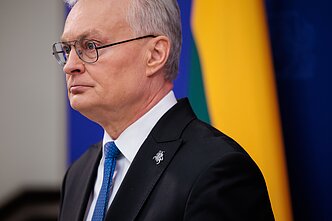
















This week, German Chancellor Angela Merkel talked on the phone with the Belarusian dictator Alexander Lukashenko. While the Lithuanian President’s Office knew about the upcoming call, it did not share this information with the Foreign Ministry. This suggests a serious disfunction in government institutions, observers say.
On Thursday, Lithuanian Foreign Minister Gabrielius Landsbergis told reporters that he learned about Merkel’s call to Lukashenko not from President Gitanas Nausėda’s team, but from “foreign partners”.
Asta Skaisgirytė, the president’s adviser on foreign policy, confirmed that Nausėda was informed about the call in advance. According to her, it was not a big deal that the information was not passed on to the Foreign Ministry.
“I don’t know if this sharing [of information] should be emphasised. [...] The most important thing is that the messages we wanted to convey have been conveyed,” Skaisgirytė said in an interview with with the radio station Žinių Radijas.
Abnormal situation
According to Ramūnas Vilpišauskas, a political science professor at Vilnius University, the fact that the President’s Office did not share important information with the Foreign Ministry is “abnormal”.
“[The migration crisis] is one of the most important foreign policy issues at the moment, and for this reason alone, it is extremely important that all Lithuanian institutions that are involved in making foreign policy coordinate their positions,” Vilpišauskas told LRT.lt.
Read more: Borrell, not Merkel, should be talking to Minsk, Lithuanian FM says

In his words, it seemed like governmental institutions were able to cooperate, when they were considering to impose a state of emergency on the Lithuanian border with Belarus.
“But this misunderstanding demonstrates that someone’s ambition or incompetence is becoming a serious obstacle for the Lithuanian institutions to speak in unison,” Vilpišaukas said.
Gerda Jakštaitė, a political science professor at Vytautas Magnus University in Kaunas, also said that not sharing information between institutions during a crisis was a bad thing.
“Sharing information, especially on such an issue, is a no-brainer. It is in the national interest,” Jakštaitė said.
In her words, institutions should also resolve issues resulting from miscommunication behind closed doors, instead of bringing them to the public.
“I think it is abnormal that the two institutions – the Foreign Ministry and the President’s Office – communicate in this way [via the media], especially in a crisis situation. They should resolve such issues behind closed doors,” Jakštaitė said.
“If such statements are coming from our institutions during a crisis, we are communicating that something is wrong in our country,” she added.
Read more: Lithuanian president says ‘possible to solve crisis’ by talking to Lukashenko

Newsletter
Every Friday morning.