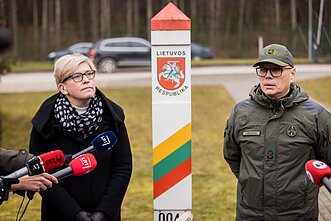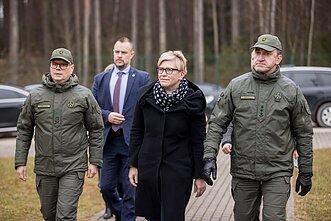











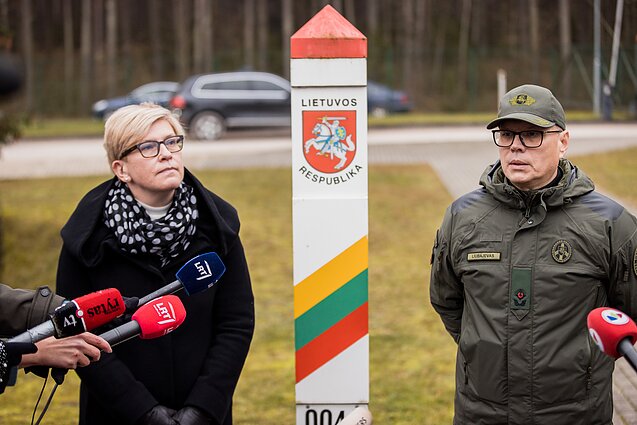
Lithuanian officers are watching the movement of migrants near Lithuania's border, as Belarusian authorities are possibly transporting them in trucks, said Rustamas Liubajevas, commander of the country's State Border Guard Service (VSAT).
According to him, Lithuanian officers are getting reports about groups of migrants near the country's borders and are monitoring social media for information.
Read more: Lithuania declares state of emergency on border with Belarus
“There is movement near the country's border. Even from here, our officers hear sounds of heavy machinery in the Belarusian territory, which might mean that trucks are possibly bringing in irregular migrants,” he told reporters at the Kapčiamiestis Frontier Station on Wednesday.
“The fact is that representatives of Belarusian law enforcement institutions are really taking irregular migrants and then pushing them into Lithuania's territory,” he said.
However, he said, there were no attempts by migrants to force their way into Lithuania over last night.
His comments came after Lithuania declared a state of emergency in its border regions in reaction to events on the Polish-Belarusian border where big groups of migrants have been attempting to force their way into Poland.
Read more: Migration crisis in Baltics and Poland
Act of desperation
The Belarusian government's actions show that it is feeling the pain of the EU's sanctions, Lithuanian Prime Minister Ingrida Šimonytė said.
“I think behaviour is always changed by those sanctions that hurt. So I think we already have introduced a number of sanctions that hurt, so what's happening now is a reaction to the sanctions,” the prime minister said during her visit to the Kapčiamiestis Frontier Station in the southern district of Lazdijai near the Belarusian border.
According to Šimonytė, Belarusian authorities are trying to pressure the EU into lifting sanctions, which “are fairly painfully hitting the economy”.
“In this specific case, the sanctions aimed at institutions and individuals involved in organising this migrant flow into Belarus are really a very important step, but I don’t think it will be the last one,” she added.
The EU is now considering a new package of sanctions for Belarus to put more pressure on the regime of Alexander Lukashenko.
Tensions rose further as of Monday when several thousands migrants marched to the Belarusian-Polish border. Lithuanian officials fear a similar situation might develop near the country's borders.
Read more: PM visiting Belarusian border as Lithuania introduces state of emergency over migrants
Doing ‘everything to ensure human rights’
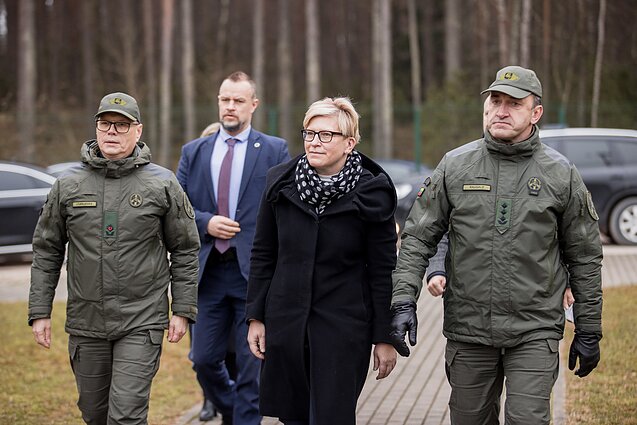
Prime Minister Šimonytė said that Lithuania's authorities would ensure that asylum seeker's human rights are respected, even while restricting their communication.
“Perhaps some might think that [restricting] the possibility to communicate on mobile phones and via messages on social media is a restriction of human rights, but this will definitely not limit the possibilities for migrants living in accommodation centres to communicate with state institutions,” Šimonytė said at Kapčiamiestis Frontier Station.
According to her, asylum seekers will be allowed to communicate with lawyers and NGOs when they visit migrant camps.
“I believe we are doing everything to ensure human rights, but we need to understand that this situation is very complicated because in this case, I would say, two international commitments [...] are at stake. One of them is to protect the state border, which is also the European Union's eastern border, and to implement the Schengen border code. On the other hand, we also need to ensure human rights,” she said.

Newsletter
Every Friday morning.