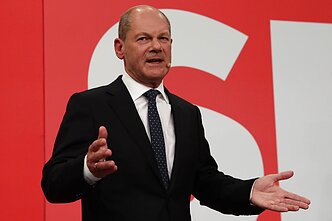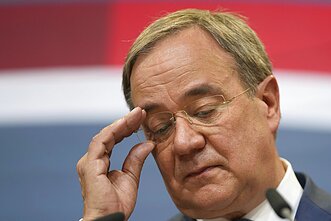
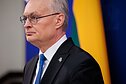







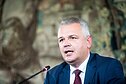



The social democrat vice chancellor Olaf Scholz and Armin Laschet of the conservative Christian Democratic Union are the leading figures in the German federal election. What foreign policy will the new Berlin government pursue and how will it affect Lithuania?
As the leader of NATO’s Enhanced Forward Presence battalion, Germany occupies an important position in Europe. Any political changes in Berlin can affect Lithuania as well.
Olaf Scholz, the candidate of the centre-left Social Democratic Party (SPD), as well as his main rival Armin Laschet from the conservative Christian Democratic Union (CDU) are both hoping to strike a three-way coalition with Germany’s Green Party and the business-friendly Free Democratic Party (FDP).
"In the search for a new government, we are seeking out common ground and bridges over our divisions. And we are even finding some of those things. Exciting times," FDP leader Christian Lindner posted on Instagram.
Scholz and Laschet will need to showcase all of their charisma and experience to persuade the smaller parties to join them in a coalition.

Veteran politicians with robust experience
Olaf Scholz, whose party is leading in the polls, is a notable political figure in Germany.
The 63-year-old has been the finance minister in Merkel's Cabinet since 2018 and is also the vice chancellor in the current governing coalition. Scholz was elected to the federal parliament in 1998, then served as a mayor of Hamburg from 2011 to 2018.
Olaf Scholz was born in 1958 in northern Germany. He studied labor law, and began his career as a vice president of the International Union of Socialist Youth. However, he went through a change in political views while serving as Hamburg’s mayor, and is currently among the more conservative members of the SPD.
His handling of the Covid crisis won him much praise and high approval ratings. Moreover, Scholz oversaw the emergency 750 billion euro funding package put together by the federal government to help German businesses and workers survive the pandemic.
"This is the bazooka that's needed to get the job done," Scholz said last year.
For many years, the current vice chancellor has been known by the name "Scholzomat," a play on the words "Scholz" and "Automat" or machine. Scholz earned the nickname for his pragmatism and restraint.
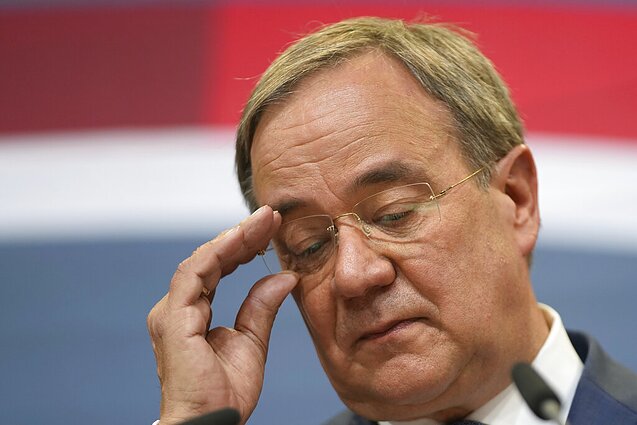
CDU candidate’s Armin Laschet’s run in the elections has not been as successful due to a series of missteps.
The 60-year-old governor of North Rhine-Westphalia state had outmanoeuvred a more popular rival to secure the nomination of Merkel’s Union bloc. However, the politician faced criticism for poor handling of Covid-19 crisis in the state.
In July, the CDU candidate was caught laughing in a conversation with someone else while the German President Frank-Walter Steinmeier delivered a statement on the devastating floods in western Germany. The incident tarnished his image further.
Considering that his father was a coal miner, it is no surprise that Laschet is a supporter of the coal industry. He has firmly stood by the compromise that Germany should phase out coal no sooner than 2038.
Born in Aachen, West Germany, he is known for his liberal politics and passion for the EU. Moreover, he has good ties with the Turkish community and immigrant groups in the country, as he served as the integration minister of North Rhine-Westphalia in 2005–2010.
Laschet has also defended Chancellor Merkel's open-door migration policies during the European migrant crisis of 2015.
Clash over foreign policy and security
Judging by election tendencies, most German voters do not prioritise foreign affairs and security. However, the six parties currently competing for seats in the parliament have dedicated a fairly large portion of their election manifestos to these very topics.
“Broadly speaking, the parties appear to share an assessment of global challenges,” said Ulrike Franke, senior policy fellow at the European Council on Foreign Relations (ECFR).
The conservative CDU brought up that “we are in the middle of a worldwide, epochal change” and that democracies and authoritarian states “are struggling with each other to shape the future in the 21st century”. The SPD also spoke of a “global competition”, Franke added.
Both the Greens’ and the liberal FDP’s manifestos focus on countering autocratic powers.
“Most other parties want Germany and the European Union to take on a stronger role in foreign policy,” Franke said, pointing out that “the Christian democratic parties envision the strongest role for Germany, which they view as an anchor of stability in a global world”.
CDU’s manifesto highlights the wish for Europe to be an “equal partner of the US, a country with which it can stand for freedom, peace, and democracy in the world”.
“FDP argues for ‘open strategic sovereignty’,” said Franke. “It supports the creation of a European defence union as a step towards the European army.”
The European army is also brought up in the manifesto of the centre-left SPD, which envisions it “as part of the Peace Force Europe”. Moreover, the party looks towards developing the EU that is more capable in terms of military strength.

The Greens are motivated to build up European capabilities “instead of putting ever more money into parallel national military structures”, according to Franke. The party also wants to adopt a “post-colonial”, “anti-racist” feminist foreign policy.
Read more: Baltics and German Greens: unexpected allies on Russia? – opinion
“The Greens note that the goal is a world order in which conflicts are resolved not through the law of the strongest, but at the negotiating table,” said Franke.
The far-right Alternative for Germany (AfD), as well as the democratic socialist Die Linke party are most vocal about developing a new relationship with Russia.
“The AfD argues for an end to EU sanctions on Russia and wants to integrate the country into a comprehensive security structure,” Franke added.
Baltic countries left to rely on US
Only the CDU explicitly supported the NATO goal of spending 2 percent of GDP on defence, according to Franke. Moreover, the party seeks to “increase the number of active German soldiers from 185,000 to 203,000”.
The SPD, meanwhile, focuses on ensuring optimal equipment for Bundeswehr soldiers, since “only a well-equipped and modern Bundeswehr can fulfil its tasks”.
In their manifesto, the Greens criticise attempts to fulfill the NATO goal of spending on defence, however, they do not disclose how much they would be willing to spend.
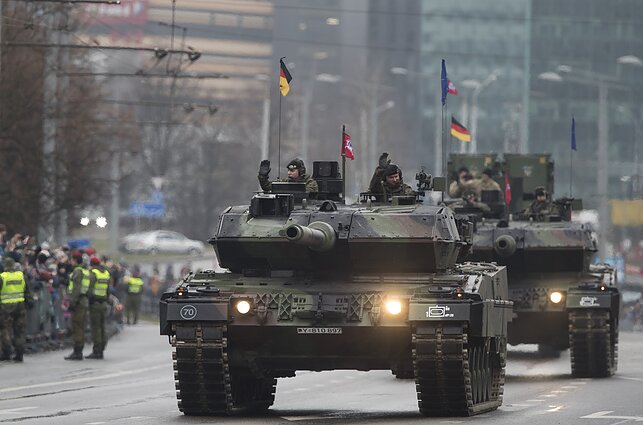
The new German parliament “should not be the parliament that completely agrees with the European vision, and its objectives of creating instruments of hard power in the EU should not be fulfilled,” according to Steven Blockmans, a director of research at the Centre for European Policy Studies (CEPS).
"CDU/CSU accentuates the handlungsfähig strategy, and supports the PESCO (Permanent Structured Cooperation) policy, which is based on support for defence troops, strengthening of EU military bases,” he said. “They also support the idea of joint military force in the long run.”
Considering the “current geopolitical environment” there is little hope that the currently leading SPD can make any real progress towards establishing the European army, Blockmans added.
“EU-Russia relations are based on structural factors which will not disappear once the parliament changes in Berlin,” according to Zachary Paikin, a researcher in the EU Foreign Policy unit at CEPS. “It is clear that Merkel’s and French President Emmanuel Macron’s attempts to get closer to Russia back in June were unsuccessful, indicating that there is no restart of relations happening anytime soon.”
Blockmans, meanwhile, is convinced that both CDU and SPD will seek to renew their relationship with Russia.
“This is in relation to the ideas expressed by Macron, and it leaves Baltic states dependent on the US [...]. If we’re talking about Belarus and the situation there, the new parliament should maintain the current EU line,” he said.
“An interesting period of stagnation awaits. EU countries will continue to put forth the need for strategic autonomy (from the US as well), and will probably fail at developing stable relationships with countries such as Russia,” said Paikin.

Newsletter
Every Friday morning.