














Roma are among the most marginalised groups in Lithuania, facing discrimination in employment and education, with the media having contributed significantly to the negative image.
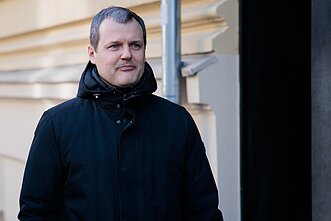
May 21 marked the Day of Ethnic Communities in Lithuania, and World Day for Cultural Diversity for Dialogue and Development. Ištvan Kvik, the chairman of the Roma community in Lithuania, spoke to LRT.lt about the challenges the Roma face while seeking to integrate into the society.
Tell me about the situation of Roma in Lithuania. I remember someone saying that they are often seen as more of a social group than an ethnic community. Do you agree?
To put it nicely, a lot is untrue with what is being said about the Roma in Lithuania and worldwide. Mass media has contributed a lot to this. People initially see the Roma as some fairytale, that there is a certain bubble surrounding the entire Roma community. No one wants to look deeper into the history of this nation, they are only scratching the surface.
I don’t even want to remember the stereotypes. Sometimes we can laugh at them, but they don’t make the lives of Roma youth, as well as the entire community, any easier. People need to find work, to provide for their families, to receive an education. When there are such stereotypes, a person will live in this closed circle that they cannot escape.

When a Roma applies for a job, the employer immediately changes their opinion, after merely seeing the candidate. For this reason, people don’t want to go through the same the second or third time, they feel hurt, because they aren’t evaluated based on their skills in the field, or whether they want to work. Instead, they are immediately seen as delinquents. This is horrible.
I’ve heard that landlords refuse to let apartments to Roma tenants, and that employers reject their job applications. What kind of discrimination is the Roma community facing in Lithuania? Is the situation changing?
Some women have told me how they were applying for jobs. Their phone conversations go well, and they get invited for an interview. However, as soon as they arrive, the employer sees their long skirts, their different appearance, and says that they've already hired someone else, that these women are no longer needed. This is the thinly veiled discrimination they face.
There are cases when employers see that your appearance is not exactly ‘traditional’ and immediately say “sorry, but we have no job positions available for you”. Sometimes they explain why, sometimes they don't.
Some say that they “don’t want Roma in their team”, others say that they would hire you, but that “the other members of the team will not want to work with you or be around you”.

Sometimes I assist Roma people in getting a job. In these cases, employers are often very grateful, admitting that they’ve befriended the Roma, and that they are some of the best employees. This happens very often, I’m not trying to promote the Roma, it’s just how it is.
If a Roma person is welcomed into the team, they truly become part of that team, they always keep in touch with their managers and colleagues. The Roma are communicative, it is a very rare occasion that a Roma person would leave someone hanging or be unfriendly.
People who come to our restaurant, too, say that even though the staff are not very good at English, Lithuanian or Russian, their honesty and communicativeness makes up for anything that is lacking.
But it is very difficult to find a job [for a Roma]. We are working on reducing discrimination, and we want to create a sort of employment incubators for the community, so that they can work for their fellow Roma, then enter the labour market and build their own businesses.
Speaking of employment, you said that potential employers react to the way people are dressed. Perhaps it is because when it comes to integration, many assume that it means giving up one’s traditions, language, and culture? But integration should not be about giving something up, it is about feeling like a member of the society.
Very well said. I would travel a lot, and in my travels I saw, for example, a woman in traditional dress working at a bank. It left no negative impact on the customers, and did not affect her either. This was in a capital city, a huge city, where people of different ethnicities and religious background live, but we need to respect that.
I like to live in a city where, for example, there are Karaite restaurants. In a city where I can listen to Armenian or Georgian music, where I can visit Roma or Latvians in their restaurants. I like it when people are tolerant. Sadly, there is little tolerance in Lithuania.

Integration often means giving up one’s traditions to become some standard person as understood by the majority. I cannot agree with this, as that is not integration, that is assimilation.
I speak my native language, I know my traditions, so I cannot just ignore everything and say that here, I will now become a Russian, a Pole, or a Lithuanian, so that I can work and forget who I am. I will not do that.
But the fact that I am a Roma, a Jew, a Tatar, or a Lithuanian should not get in the way of graduating from a school, receiving vocational training, or being an expert in some field. We really need to separate these things.
My wife can come to a job interview wearing a long skirt and a shawl over her head, but if she has to wear the same clothes as everyone else in that team while at work, she will do it. Once at work, a person must change their clothes, and behave like everyone else. But if you come to a job interview only to hear that you’re not a suitable candidate because of what you’re wearing, that is an insult.
Those are examples of intolerance people learn at home. For example, I’ve heard children being told that “gypsies will come and kidnap you”.

Do you and the Roma community feel like you're part of the society here? Do Lithuanians want to learn about a different culture, meet people of different ethnicities?
I think so, yes. However, what is very interesting is that the Roma have this inner charisma. I really enjoy the fact that other people like the Roma, since they, as a people, are very charismatic, sensitive, and very communicative, not angry at all. That is what I like most.
It is said that this is why the Roma do not have their own land, it’s that they cannot battle, they cannot stand for themselves and fight. People often come to our performances and say that had been afraid of the Roma, but really wanted to meet them. You can hang out and talk with a Roma person for a little and they’re already your friends.
Think about it: why are Roma mentioned so often in songs and tales? Why do Lithuanian and foreign artists use “Roma”, “gypsy” in their song lyrics? No other ethnicity is mentioned this often. Is it a Polish or a Lithuanian woman standing somewhere in songs? No, it is the gypsy woman. Or “I saw a woman with the eyes of a gypsy”. Interesting, isn’t it?
Why is that so?
The Roma attract people, they do very much. People remember meeting them, their eyes, their way of communicating. When someone speaks of the Roma, they speak of magic, spellcasting... You shouldn’t say this, since not everyone in the community can cast spells, but the Roma get along well with magic. They can feel a person's energy, they can understand another person well.

They are very empathetic towards others?
Yes, if you befriend a Roma, they will give everything to this friendship. Roma are very welcoming, very open. But how can they create bonds, when many people wouldn’t let Roma in, they don’t want to befriend them, or want to, but are too afraid.
Mass media should not only cover crimes committed by Roma people, but also show examples of good deeds. There will always be criminals, it’s not limited to the Roma community. Of course, I wish there weren’t, but that’s not how it is. There was a story about a car crash, and one of the drivers was mentioned to be a Roma. Did he drive differently? Did he crash his car on purpose? Why was only his ethnicity mentioned? Is one of them a human, and the other one a gypsy?
It’s a sensitive subject. I never tell children that there are Lithuanians and Poles nearby, so don’t go there. If I said that, I would be humiliating myself. We, the Roma, say that there are our people, and then there are the others. The others are those who do not know our law, don’t speak our language, and don’t wear our clothes. They are not better or worse than us, they are just others.
When I talk to people, I ask them why they can enjoy Romani songs, or products made in Africa, but can’t at the same time enjoy the people. Not the products, the people themselves. These songs were written by the Roma, this toothpaste was manufactured by Indians or the French... It all begins with values instilled by the family. But the younger generation already thinks differently.
Is the view changing?
The youth want to learn more, they travel a lot, they want to meet other people. But there shouldn't be prejudice instilled by the family, or violence against others. It is horrible.

I don’t want to generalise, the situation varies, but it is often brought up that many Roma children don’t go to school. The Roma themselves say that they are being bullied at school and therefore skip classes. How widespread is this problem? Is it being tackled, does the government help?
I can certainly say that we are trying to look into this. Of course, during the quarantine many families are reluctant to let their children go to school, and they stay at home. But I see people studying remotely. This change makes me very happy, as the Roma are attending school.
What I don’t find as joyful is the attitude of teachers that even if a Roma student does not understand something, they can be forgiven for it and still allowed to pass. Sadly, that still happens. I have met a few seventh graders who couldn’t properly read or write. That is a shame.
I did talk to the students and their parents about this. They explained that a child had asked the teacher a question once, and the teacher said that he wouldn’t be able to understand anyway, but then the child still passed. These are some very bad examples.
The problem also lies in the fact that the Roma speak in their native language. Sometimes children only speak their own language until their three or four, so it can be difficult to communicate with teachers once they start going to school, they might find it hard to understand. But everything can be solved.
I have noticed that Roma children mostly want to go to school and learn. There are more of those who do than those who don’t.
Still, they face discrimination from their peers, who say that “you are a gypsy, I will not sit with you or talk to you”. But that is part of the culture now, you cannot escape it, people will always talk about you.
I told children that they will be immune to it, or that they should try and do something ten times better than the others, just don’t start conflicts. We wish to publish textbooks with something on the Roma history, textbooks that would cover the holocaust of the Roma.

Indeed, the majority of the Roma in Lithuania were touched by a genocide. It would be difficult to find a family unaffected by this tragedy. However, we don't speak about it much, it seems to be a forgotten part of history. Is the Lithuanian public aware of this tragedy?
The elites who are interested in history know about it, but regular people don’t. There are few people left [who survived the genocide], but we do have some witnesses. That is why it is important to have textbooks writing about all the nationalities that lived in Lithuania. You can’t fit everything in a textbook, but it would be nice to have something on the most affected groups, such as the Roma and the Jews.
It is important to speak about the history and the culture [of Roma]. It would be very useful for primary school pupils to learn about this, learn about their fellow Roma students, sitting beside them in the classroom. To learn about this from a textbook, not from a crime report.
Speaking of the holocaust, there is not much information about it because the majority of the people were murdered, taken to concentration camps. Others ask us why we are talking about the holocaust, why we are remembering these dates, such horrible stories.
It is actually a very good question, you could say that what’s done is done. But what if it happens again? Who will be responsible? We cannot forget, we need to know our history. If you know history, you are less bound to repeat it.