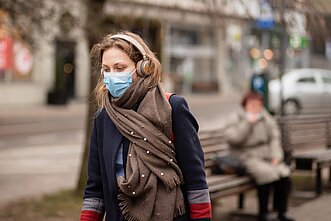















A council of experts advising the Lithuanian government have proposed four scenarios for imposing and easing coronavirus restrictions. Allowing “social support bubbles” to help people who live alone is among the proposals.
A social support bubble means that a single-person household can have close contact with one other household “to provide emotional and practical help to people experiencing greater isolation stress”, according to the council's proposal made public by the government on Tuesday.
The four lockdown scenarios are based on the number of new coronavirus cases per 100,000 people over the preceding 14 days.
The experts propose to keep the most stringent measures, which are in place now, in the worst-case scenario where the number exceeds 500.
Lithuania's 14-day rate currently stands at 1,199.1, according to the country's statistics office.
When the number falls below 500 but is still higher than 100, the lockdown rules could be relaxed to allow close contacts between two households and permit schoolchildren to return to classrooms. Non-essential shops would be allowed to open, provided that they manage shopper flows.
If the number falls to between 25 and 100, local measures would be put in place instead of nationwide restrictions. Close contacts between three households would be allowed and restrictions on health and other services would be lifted. Events with up to 100 attendees would be permitted, and cafes, bars and restaurants, as well as museums, theaters and other venues would be allowed to open.
Most restrictions would be lifted if the number of new infections is below 25 per 100,000 people, the rate of positive test results does not exceed 4 percent and an effective testing and contact tracing system is in place.
The experts propose that even in the worst-case scenario, a person who lives alone should be allowed to form a social bubble with any other household, regardless of its size, if members of both households commit to not having any close contacts outside their bubble.
The council, which advises the government on the management of the Covid-19 crisis, is made up of medical professionals, representatives of healthcare institutions, and scientists.

Newsletter
Every Friday morning.