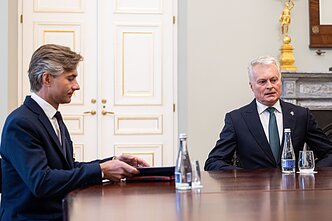




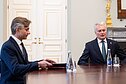



EU leaders appealed to Russian President Vladimir Putin to not use force in Belarus, Lithuanian President Gitanas Nausėda said in an interview with LRT TV.
Nausėda said mediation with the Russian president was necessary because the authoritarian leader of Belarus, Alexander Lukashenko, turned to Putin for support.
“[EU leaders] predicted that this could happen, so we appealed to Putin to not use force and military means to resolve the situation in Belarus,” the Lithuanian president said.
Read more: Baltic ministers aim to meet Belarusian officials in Minsk – Lithuanian PM
Nausėda also said Lukashenko refuses to talk to European leaders, while Russian President Vladimir Putin serves as a mediator in discussions.
“Lukashenko is not ready to talk. He communicates mainly via the media,” Nausėda said. “None of the members of the European Council have spoken to Lukashenko recently.”
According to the Lithuanian president, European leaders have been trying to get in touch with Lukashenko since the August 9 presidential election, which saw nationwide protests errupt in Belarus.

But German Chancellor Angela Merkel and French President Emmanuel Macron were only granted calls to the Russian president, according to Nausėda.
On Wednesday, European Union leaders said they would not recognise the results of the recent election in Belarus. The European Council also promised to shortly impose sanctions on those responsible for violence and election fraud in Belarus.
“[European leaders] unanimously accepted the logical conclusion that Lukashenko cannot be recognised as a winner of the rigged election,” the Lithuanian president said. “Another resolution was that a new election, where candidates could freely participate and Belarusians could elect their favourite, was necessary.”
But Nausėda also recognised the unique geographical position of Belarus and its deep-seated relations with Russia, saying that the country should not only look to the West.
“Those leaders that can find a balance between East and West and that see Belarus as a bridge could win elections if this was what the Belarusian people wanted,” the president said. “But nobody, including Russia and the EU, has a right to impose their preferred leaders on the Belarusian society.”
On Wednesday, Lukashenko also ordered the Belarusian Interior Ministry to quell protests in Minsk and to tighten border control to prevent an influx of “fighters and arms”. Nausėda said that these moves were in part influenced by Russia and were meant to distract from the internal situation in Belarus.

“I see inconsistency in the regime’s actions. In the first week [after the election], they listened carefully to our messages about possible dialogue and de-escalation,” the president said. “But the situation changed radically after [Lukashenko’s] contact with Putin.”
“They then turned to military rhetoric about supposed NATO forces near the Belarusian border […]. I think they are trying to divert people’s attention from the real problem inside Belarus to the alleged external threats,” Nausėda commented.
The Lithuanian president said that the recent Belarusian military drills close to the border of Lithuania were merely a provocation.
“We will not give in to these provocations. Same for Poland,” he said.

Newsletter
Every Friday morning.