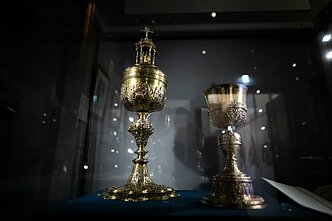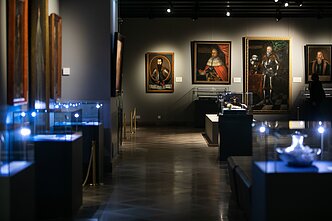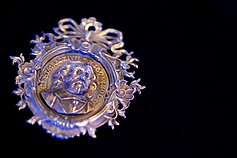
















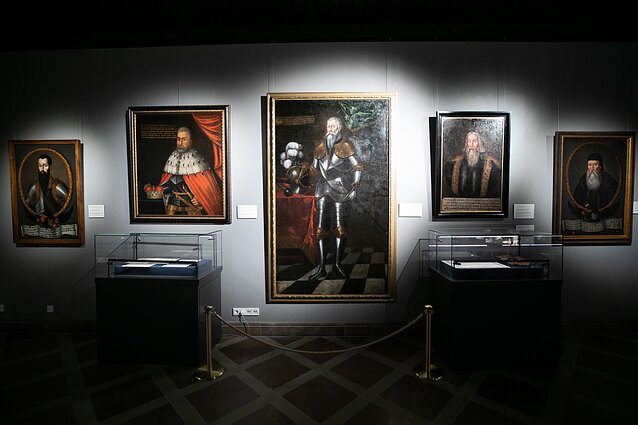
The Radziwills, or Radvilos, the most illustrious noble Lithuanian family, played a central role in the history of the Grand Duchy of Lithuania. An exhibition in Vilnius celebrates the legacy of the Radziwills, about whom, paradoxically, most Lithuanians know quite little, a historian says.
Eimantas Gudas is a historian at the Palace of the Grand Dukes museum and a consultant for ‘The Radziwills. History and Legacy of the Princes’ exhibition. He says that few Lithuanians are aware that the Radziwill line survives to this day and most concentrate on the so-called golden generation.
The Radziwills entered the peak of their power in the 16th century when the cousins Mikolaj ‘the Red’ Radziwill and Mikolaj ‘the Black’ Radziwill formed a powerful alliance to secure wealth, power and predominance among Lithuanian noble houses.
Their ambitions were greatly helped by Barbara Radziwill's romance with Sigismund II Augustus of Poland. Their marriage made Barbara the queen of Poland and gave rise to one of the most enduring love stories in the history of the Grand Duchy, spawning numerous novels, theatre plays and operas.
Read more: Walk through UNESCO love trail in Vilnius – top things to see and do
Eimantas Gudas talks to LRT.lt about the legacy of the Radziwills, their place in the history and the collective memory of Lithuania.
How well do we know the Radziwills?
I am surprised that the Poles and even Western Europeans often know more about the Radziwills than the Lithuanians. Our fellow Lithuanians usually know about the [16th century] ‘golden generation’ of the Radziwills: Mikolaj ‘the Black’ Radziwill, Mikolaj ‘the Red’ Radziwill, Mikolaj Krzysztof ‘the Orphan’ Radziwill, or Barbara Radziwill. The Lithuanians know very little about the Radziwills in the 18-20th centuries, some even think that the family has long died out.
How many Radziwills are there in the world today?
About 100. The family is not extinct, only some of its lines have died out. After 1990, most of the Radziwills settled in Poland, Warsaw. But they are also scattered in the US, France, Italy.

How did this family succeed in preserving power and wealth for so long?
The Radziwills came from the nobility, even though pinning down their ancestry is difficult. They kept their power and influence through calculated marriages, by marrying Barbara Radziwill to [the King of Poland] Sigismund II Augustus, by managing enviably well their money and lands.
Compared to other noble families, the Radziwills were very wise, far-sighted and successful. Sure, there were tiny downfalls, too, over the 500-year history, but wherever the Radziwills found themselves, they'd generally had their way. The motto on their coat of arms says “God advises us”. Looking at their history, it was probably true.
Was the ‘golden generation’ the pinnacle of the Radziwill power?
Lithuanian and Polish historians differ on when the Radziwills peaked. In Lithuania, they were at their most powerful in the 16th century, the ‘golden generation’ were unequalled among their peers. It was the time when the Radziwills intermarried with the royal family, which is a big honour. But they held high offices in other periods, too. One can say that the Radziwill golden age lasted for the best part of 300 years, from the 16th to the 18th century.

Polish historians say that the Radziwills reached the pinnacle of their power in the 18th century, the family was well-known in Europe and had amassed titles and wealth. The Radziwills then owned about one million hectares of land, a figure that is hard to grasp.
But success is not enough to keep that kind of wealth. What did the Radziwills do to maintain their position?
They developed the Radziwill ordinance system that is complicated even for today's legal experts. It's wealth ownership is not by individuals, but by a family. The ordinance contained a list of properties and said that they could not be sold or pledged, nor bestowed or given away. The properties could only be passed on to a male heir.
Usually, the estates would be inherited by the owner's son, and if not, a nephew, a cousin or a cousin's son. This system existed virtually throughout Europe.
Sure, sometimes losses were unavoidable. In the 20th century, when the Soviets and the Germans divided up Poland, most of the territories that included Radziwill estates went to the Soviets. They later ended up in socialist Poland and haven't been returned to the family.
Radziwill residences in Poland are now used as embassies, stately offices etc. The government would not return them, offering financial compensation instead. I do not know why the Radziwills have not claimed their property in Lithuania.
The marriage of Barbara Radziwill and Sigismund II Augustus is one of the best-known love stories. How much love was there actually?
Sigismund Augustus was clearly very much in love with Barbara Radziwill, otherwise he would not have agreed to the marriage. For a king to marry a daughter of a simple nobleman, it was quite unusual at the time, however powerful were the Radziwills. Did Barbara herself love Sigismund? Who knows, but I believe that she did.

But as a historian, I suspect – and archives confirm it – that [Barbara's cousin] Radziwill ‘the Black’ and [her brother] ‘Radziwill the Red’ were particularly encouraging about the wedding and Barbara becoming the queen. They did all they could for the marriage to happen and be recognised and for the children from this marriage to be legitimate heirs to the throne. Unfortunately, Barbara Radziwill did not bear any children.
How would the Radziwills normally arrange marriages?
For Radziwill men, marriage was a transaction the point of which was to bring wealth. Sometimes, if the wife were very intelligent, she would push her husband to the background.
There have been successful marriages, both romantically and financially. But, during the height of the Radziwill power, a successful marriage was not about love. It was about happiness, but not the way we imagine it now. Happiness derived from building solid material wellbeing, accumulating wealth, bearing offspring that had a future.

Speaking of offspring, the Radziwills took care of their education. Every boy would be sent to European universities for several years: six months in France, to learn French, six months in Italy, to learn Italian. Boys would also go to [European courts to] learn refinement so they could later introduce what they learned at home. Girls, obviously, would be educated at home or sent to monasteries.
What was life like in a Radziwill household? Was it a life of luxury?
Life wasn't as comfortable as we often imagine when we think about the Radziwills and other nobles. One thing is clear, though, no one lived better than the Radziwills in those days.
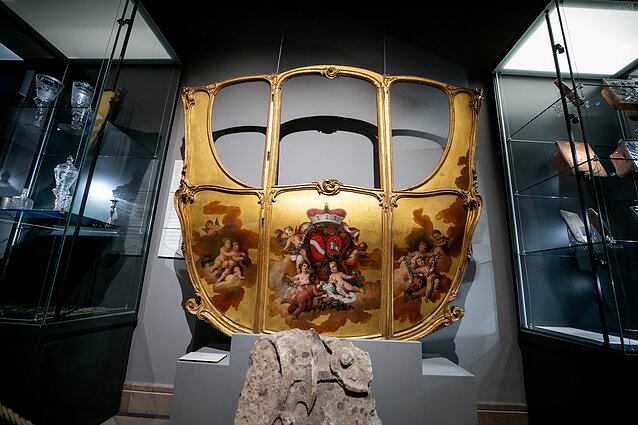
In the 16th century, the Radziwills mostly lived in coaches. They would often be on the move, traveling between their estates and cities. That was their lifestyle, never to stay too long in one residence. They'd go see the lord in Vilnius, to a Sejm in Warsaw, to a diplomatic mission in Rome. All the while managing their estates.
How big were the convoys during such trips?
About 12 coaches or more, depending on the trip. One of them were for the cooks to make food during stops. In longer journeys, everyone would sleep and eat in the coaches or tents. But there was also a saying that, while traveling across Lithuania, the Radziwills would only sleep in their own homes, because they had so many.
How many of their properties survive?
In Vilnius, the Radziwills had about 15 houses, some of them have survived. The best known is the Radziwill Palace on Vilniaus Street and the palace that now houses the Theatre, Music and Film Museum.
The Radziwills also had a palace in Vingio Park which they owned and later donated to the Jesuits. They used this territory to breed wild animals and hunt. It is where the Žvėrynas district is today, hence the name [Žverynas means menagerie in Lithuanian].
The Radziwill legacy also includes castles in Biržai and Dubingiai, the Taujėnai manor near Ukmergė, the Leonpolis manor.

Why should present-day Lithuanians take pride in the Radziwills?
I'd mention three points. First, it is a world-renowned family, the only one that we've got. Second, this family contributed as much as it could to keeping Lithuania autonomous, protecting it from Moscow's plans many times. If it weren't for the Radziwills, the terms of the Lublin Union with Poland would have been much less favourable to Lithuania.
Third, when Sigismund II Augustus died, that was the end of the Jagiellonian dynasty; the Polish-Lithuanian rulers were elected from then on. But it was the Radziwill family that provided unity. We do not have a dynasty of monarchs, but the Radziwills come closest, they still represent Lithuania and its history. There was not a single important event between the 15th and 18th centuries that didn't involve the Radziwills. They loved Lithuania, though for them it meant different things than for us today.