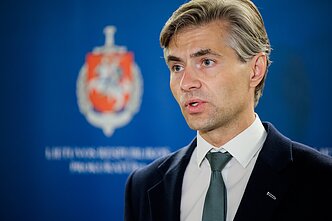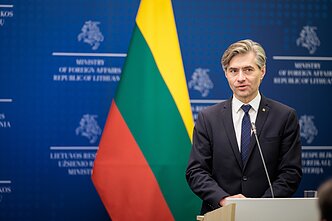











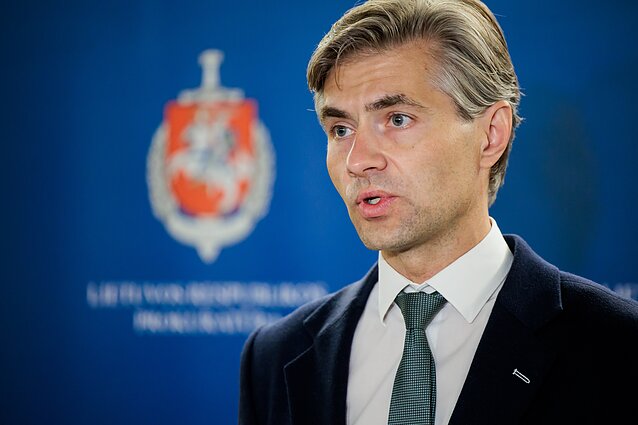
Lithuanian Foreign Minister Kęstutis Budrys said that NATO possesses the means to destroy air defence capabilities in Kaliningrad, the Russian exclave on the Baltic coast.
"We must show the Russians that we are capable of breaking through their little fortress in Kaliningrad. If necessary, NATO has all the means to level the Russian air defence and missile bases there," the minister said in an interview with the Swiss Neue Zürcher Zeitung newspaper published this week.
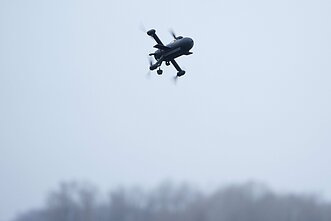
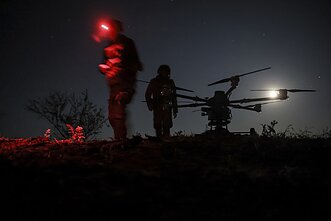
Separately, on the social media platform X, the foreign minister claimed that Russia is deliberately directing Ukrainian drones toward the Baltic states while conducting a smear campaign against them.
PM urges restraint
Lithuanian Prime Minister Inga Ruginiene on Thursday urged restraint following Budrys’ comments.
"I have heard various statements, including those regarding redirected drones, and I believe that today we should refrain from sharper rhetoric," Ruginienė said.
The prime minister made the comments during a government question hour in parliament on Thursday, after Liberal Movement leader Viktorija Čmilytė-Nielsen asked for an assessment of the foreign minister's statements.
His comments followed a claim by Russia's Foreign Intelligence Service on Tuesday that Ukraine was allegedly preparing strikes against Russia from Baltic territory and that Ukrainian troops were already deployed in Latvia.
"Regarding reports that drones are being directed at Lithuania, there is no such data. Today it is important to remain calm, follow instructions clearly, and not create unnecessary waves where there are none," Ruginienė added.
The prime minister said she viewed Budrys' remarks as an attempt to use deterrent rhetoric.
"I would very much like us to use the rhetoric of deterrence rather than escalation," Ruginienė said.
Lithuanian president criticises foreign minister’s statements
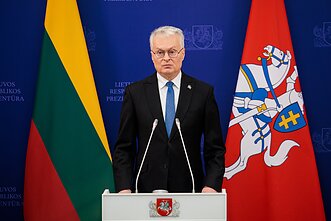
President Gitanas Nausėda on Friday criticised the comments made by Budrys.
"This was not the most successful statement by Kęstutis Budrys, and perhaps Mr Budrys the security expert defeated Mr Budrys the minister. He began to speculate on hypothetical scenarios that might be appropriate for a security expert, but are not entirely suitable for a foreign minister," the head of state told LNK News on Friday.
However, the president emphasised that there was no need for a "lynch mob" against the minister, noting that Russia is currently in a highly sensitive state and prone to provocations.
On the social media platform X, the Lithuanian diplomatic chief also said this week that Russia is deliberately directing Ukrainian drones toward the Baltic states while conducting a smear campaign against them.
His comments followed a statement by Russia's Foreign Intelligence Service on Tuesday, which alleged that Ukraine was preparing strikes against Russia from Baltic territory and that Ukrainian troops were already deployed in Latvia.
Nausėda said it is currently impossible to say with 100 percent certainty that Russian drones entering Lithuania are being deliberately directed there.
"Evidence is required. The probability of those drones entering the Baltic states, Poland, or Finland is naturally high because if you look at the trajectories they follow within Russian territory, some move east, some move north, and some follow a path not geographically far from Belarus and the Baltic states," Nausėda said.
"A significant number of them enter Belarus; one could say the majority of drones reaching us cross Belarusian territory. Belarus is far from being able to shoot down those drones in all cases," he added.
The president said the violation of regional airspace by drones marks a period of increased risk.
"We should certainly not assume we are living in a context of total peace or 'business as usual'. This is indeed a stage of increased risk that we must properly face, endure, and take measures to ensure threats are not only removed but risks are minimised," Nausėda said.
According to him, airspace violations will be discussed at next week's meeting of the State Defence Council.

Newsletter
Every Friday morning.