









It took just thirty roubles and a provocative name to set off alarm bells across half of Europe. The rest was done by the very institutions meant to prevent such scenarios.
On March 11, 2026, Propastop – a blog run by volunteers from the Estonian Defence League and widely cited by NATO and Baltic mainstream media – published a warning about a niche Telegram channel. At that moment, the channel had only a few dozen subscribers, amateur graphics, and tongue-in-cheek slogans about the “autonomy of Narva”. One warning was enough for the channel to reach 50,000 daily views within days.
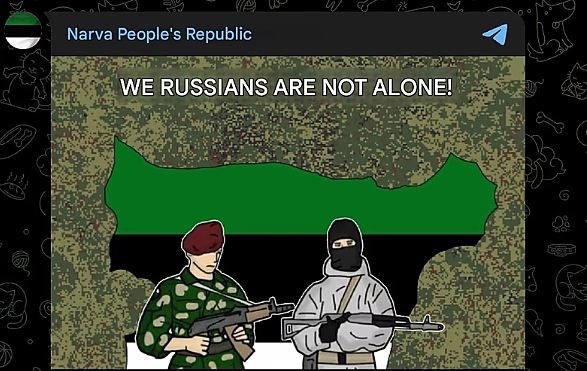
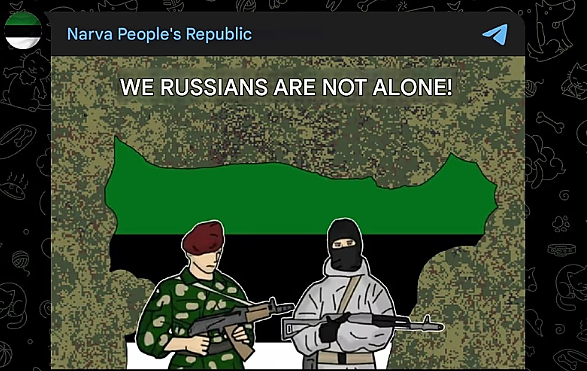
In March 2026, Estonia’s information space caught fire. It all began with the emergence of the “Narva People’s Republic” (NRL) on Telegram. The profile used a distinctive green-black-white flag, and its name was a direct reference to the separatist entities in eastern Ukraine.
Initially, the channel remained almost completely obscure. The posts – mainly memes, low-quality graphics, and sharp slogans – circulated only in the darker corners of the internet. The administrators invoked the right to self-determination, cited Kosovo as a precedent, and built a narrative of discrimination against Russian-speaking residents of Estonia.
Some of the slogans were intentionally clumsy. “Narvinians – that sounds proud,” they wrote. This phrase used the grammatically incorrect term Narvinians instead of the proper term Narvans, which immediately revealed the authors’ distance from the local community. Other messages included “Russian land stretches from Narva to Püssi” and “We are not alone!”, hinting at a larger force supposedly standing behind the project.
Doctored maps also circulated online, showing the Narva region cut off from the rest of Estonia. There were images of the removed Soviet tank monument with captions like: “It will return – but not as a monument.” The amateurish aesthetic was deliberate. The channel was meant to look like the work of “ordinary, rebellious citizens”.
Within days, the channel exploded. The authors later thanked Estonian officials for the “free advertising”. The uncomfortable truth is that without the institutional overreaction, almost no one would have heard of the project.
A project for thirty roubles
A journalistic investigation by Narva Gazette quickly exposed the reality behind the channel. NRL was not a social movement; it had no structures in Narva and no Kremlin funding. It was a meme project created by amateurs – the graphics and flags were produced almost for free.
The key piece of evidence was a Telegram sticker pack commissioned from a graphic designer in Cheboksary for exactly thirty roubles – roughly 35 euro cents. The designer confirmed the order from an anonymous user named “@narvasepar”. The group behind the project consisted of around twenty people scattered across Estonia, Russia, Turkey and Serbia.
In interviews, the administrators were surprisingly candid. They admitted the idea came after the removal of the Soviet tank monument in Narva in August 2022. They wanted to mock what they saw as an obsession with monuments, choosing a frightening name simply to get attention. They were fully aware that pretending to be a separatist movement would irritate the authorities like a red rag to a bull.
The legacy of the hot summer of 1993
Why did Estonia react so nervously? The answer lies in history – specifically in July 1993. At the time, Estonia was a nascent state, still forging its institutions, currency and borders. Narva, a predominantly Russian-speaking city, felt adrift and uncertain of its place in the new republic.
In July 1993, Narva’s city council organised a referendum on autonomy. Over 97 percent of voters supported it, with turnout above 54 percent. While Estonia’s Supreme Court declared the vote illegal, the psychological scar remained. Narva became a symbol of a potential “fifth column”, a place where unrest could erupt at any moment.
The NRL project deliberately tapped into this old wound. The authors knew that for Tallinn, the phrase “autonomy of Narva” acts as a trigger that sets off alarm bells. The joke did not need to be sophisticated – it only needed to hit the most sensitive point of Estonia’s security culture.
The trap of overreaction
The NRL case is a case study of what scholars of information warfare call the “amplification paradox”: when the institutions tasked with neutralizing a threat end up becoming its main vector of distribution. Propastop, intending to warn the public, became the channel’s most effective promoter.
Estonia’s interior minister, Igor Taro, commented calmly that this was an example of “something big growing out of absolutely nothing”. As a former journalist, he understands the media’s hunger for sensation; as a politician, he sees the cost. Excessive media attention creates a false reality that exists only in headlines.
When asked about the episode, a Propastop editor defended the decision to publish, arguing that even small signals need to be flagged in the current security environment. “We’d rather warn once too many than miss something real,” the editor said. The position is understandable – but it sidesteps the question of whether a warning aimed at security professionals should have been framed as a public alarm.
International media contributed as well. Germany’s Bild and the Belarusian Belsat picked up the story, presenting the amateur meme project as a “threat to NATO security”. Military analysts drew arrows on maps and compared Narva to Donetsk. An information loop formed – and it could no longer be stopped.
The doctrine behind the memes
Russia has long refined a strategic concept it calls miatiezhevoyna – literally “rebellious warfare”. The term dates back to Yevgeny Messner, a White Russian emigre military theorist writing in the 1960s. This figure argued that future wars would not be won on battlefields but through the destabilization of societies from within: by fuelling ethnic tensions, sponsoring fringe movements, and creating the appearance of popular unrest where none exists. The concept was revived and updated by Russian military thinkers in the 2010s, particularly after the annexation of Crimea, and has since been integrated into broader discussions of so-called “hybrid warfare”.
Under this doctrine, the goal is not to create a real separatist movement – it is to create the impression of one. A Telegram channel with a flag and a few slogans is enough, as long as external actors – media, analysts, politicians – treat it as evidence of genuine sentiment. The amplification does the work that no agent or operative could.
New legislation adopted in Russia in early 2026, reportedly expanding the president’s authority to deploy troops for the “protection of compatriots abroad”, provides a potential quasi-legal framework for such narratives. Although the precise scope of the law remains debated among legal analysts, its signalling function is clear: it creates a doctrinal pretext in which even a meme channel could be cited as evidence of a persecuted Russian-speaking population. Whether Moscow would ever act on such a pretext in an EU and NATO member state is a separate question – but the existence of the framework itself shapes threat perception in the Baltics.

Narva as a screen for other people’s fears
The biggest loser in this story is Narva itself. The city once again became a hostage to someone else’s symbolism. Residents feel unfairly judged.
Aleksei Yefimov, a Narva city councillor, put it bluntly in an interview with Estonian Public Broadcasting: “No one in the city takes the NRL seriously, and most people learned of its existence only from the media panic.” He added: “We have real problems — jobs, infrastructure, schools. And instead, the whole country is discussing a Telegram sticker.” His frustration echoes a broader sentiment in the city. Narva’s residents are tired of being treated as a security problem rather than as citizens with the same concerns as people in Tallinn or Tartu.
Local surveys are unequivocal: no one wants a “people’s republic”. People want stability and security within Estonia. Narva has become a projection screen for fears shaped by the war in Ukraine. Every Russian-speaking voice is scrutinized for loyalty; every minor incident is interpreted as the beginning of a larger conflict. This mindset builds a wall between Narva and the rest of Estonia, deepening the divisions the security system was meant to heal.
Narva is not a new Luhansk. It is a city that wants to remain part of a free Europe – and one that has once again paid the price for someone else’s joke with yet another wave of suspicion. It is hard to think of a cheaper way to expose how easily a continent’s security anxieties can be turned against its own citizens.
Grażyna Myślińska is a Polish journalist, reporter, and photojournalist. A long‑standing contributor to the Catholic weekly Gość Niedzielny, she has published dozens of reportages from across Europe – including France, Italy, Romania, Ukraine, Moldova, Estonia, and Serbia – focusing on historical memory, Polish traces abroad, and social change in Central and Eastern Europe. She also works in documentary photography, with her images represented by the Forum Photo Agency.
This story was originally published by the New Eastern Europe magazine, partners of LRT English.

Newsletter
Every Friday morning.