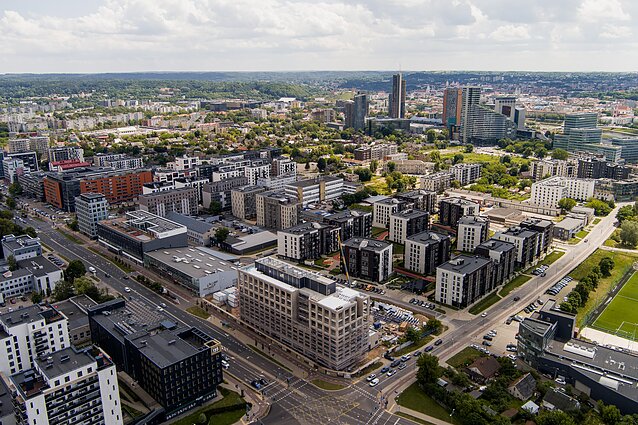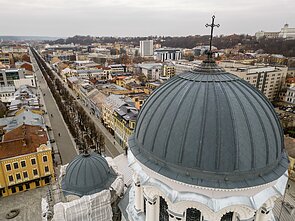













“If other cities don’t mind, Kaunavilnis is the heart of Lithuania,” proclaimed a 2022 exhibition organised by the Kaunas City Museum and the MO Museum, inviting visitors to reflect on the country’s two largest cities – Vilnius and Kaunas – as a single cultural and economic axis.
Whether that slogan rings true is open to debate. What is less disputed is that the regions anchored by Vilnius and Kaunas form Lithuania’s strongest economic corridor. The question now resurfacing is whether that axis could formally evolve into a regional metropolis – a twin city.
Some observers are sceptical. Others say the Kaunas–Vilnius two city already exists in practice.
“Although it has not been formally declared, de facto we already have a Kaunas–Vilnius two-city. It exists at least in part,” Algirdas Bartkus, an associate professor at Vilnius University’s Faculty of Economics and Business Administration, told LRT.lt.
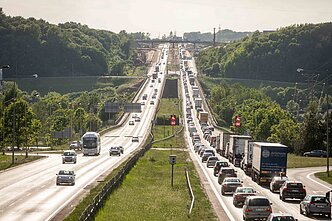
He points to heavy traffic along the A1 highway, where cars can travel up to 130 kph, increasingly frequent train connections and a growing number of people commuting between the two cities merely 100 kilometres apart.
According to LTG Link, the passenger arm of Lithuanian Railways, trains run between Vilnius and Kaunas nearly every hour – sometimes every half hour – with 15 to 20 daily departures in each direction.
At first glance, the changes may seem subtle, said urbanist Martynas Marozas. But over the past two decades, territorial cohesion between the cities has become more visible.
“If Lithuania’s major cities integrate quietly, we may simply have to acknowledge that the twin city has already formed. Then, most likely, a politician will appear who takes credit for this natural evolution,” Marozas said, half-joking.

Not everyone is convinced that formalising the arrangement makes sense.
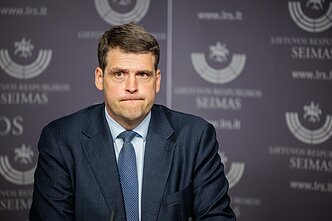
Saulius Bucevičius, chairman of the parliamentary Committee on Economy, said widening disparities between major cities and smaller regions argue against further strengthening the Kaunas–Vilnius axis.
“Neither the ruling coalition nor the Committee on Economy is currently considering or planning to consider the Kaunas–Vilnius twin city issue,” Bucevičius said in a comment to LRT.lt.

An old idea, revisited
The concept of a twin city refers to an urban and economic cluster of two or more cities linked by efficient transport infrastructure and strong functional ties.
Such models are common abroad. In the Netherlands, the Randstad region connects Amsterdam, Rotterdam, The Hague and Utrecht. In Poland, the Tri-City links Gdansk, Gdynia and Sopot. In Germany, the Rhine-Ruhr metropolitan area encompasses dozens of closely connected towns.
“Twin cities typically succeed when three conditions are met: significantly reduced travel times and improved convenience, strong economic interdependence – including labour markets and services – and clear governance capable of resolving regional issues without constant institutional conflict,” said Evaldas Stankevičius, an associate professor at Kaunas University of Technology’s Faculty of Economics and Business.

Lithuania is no stranger to the idea. In 2002, the Kaunas–Vilnius twin city was included in the national master plan as a possible model for regional development.
One of its conceptual authors, architect Jurgis Vanagas, argued at the time that Vilnius alone would struggle to compete with Warsaw – and potentially, in the future, Minsk. A combined Kaunas–Vilnius agglomeration would have a combined population of more than 1 million, strengthening Lithuania’s competitive edge.
More than 20 years ago, then-mayors Artūras Zuokas of Vilnius and Erikas Tamašauskas of Kaunas signed a project valued at over 1.45 billion euros. But in 2013, the initiative was halted amid funding shortages and institutional disagreements.
Political will and practical limits
The proposal resurfaced in 2020, when four members of the Liberal faction in parliament registered a draft resolution calling on the government to implement the project and recognise it as being of special national importance.
“Separately, no Lithuanian city reaches the critical mass to become a strong European metropolis. Together, this would be a region of more than 1 million people,” said lawmaker Ričardas Juška, one of the initiators.
Yet the project was not included in the government’s program and stalled once again. Juška argues that Lithuania missed an opportunity a decade or two ago, when European Union funding could have supported the plan.

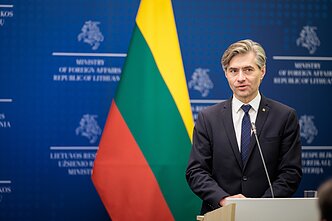
Vilnius city officials say the issue is not currently under consideration. Gabrielė Grubinskaitė, a representative of the municipality, cited a lack of financial, legal and governance instruments. She also expressed concern that the Rail Baltica branch between Vilnius and Kaunas is not expected before 2030.
Kaunas city representatives declined to comment unless Vilnius Mayor Valdas Benkunskas first shared his position.
Vision vs. reality
Experts say the twin city idea remains both relevant and questionable.
Stankevičius criticised the 2020 draft resolution for lacking clear implementation measures, indicators or phased financing. “It creates an illusion of results without concrete commitments,” he said.
Economically, he added, a twin city only makes sense if integration delivers tangible benefits to residents and businesses that outweigh the costs.
Marozas argues that politicising the idea has hampered objective debate. In his view, the project should be treated not as a municipal initiative but as a strategic government-level endeavour.

He envisions development focused on settlements between the cities – such as Vievis, Elektrėnai, Kaišiadorys and Lentvaris – transforming them into functional suburbs.
“If housing with developed infrastructure emerged around stations and along the highway, daily mobility would increase. You don’t have to live in Vilnius to work there. Trains can transport very large numbers of people,” he said.
Bartkus agrees that improved connectivity would naturally strengthen the twin city. But for it to succeed, he said, coordination at the national level and further infrastructure investment would be essential.
“The twin city will be successful when public transport, not private cars, becomes the main mode of travel. People are already naturally commuting to jobs in Vilnius, Kaunas and the region between them. That makes the twin city’s development a realistic prospect,” he said.

Newsletter
Every Friday morning.