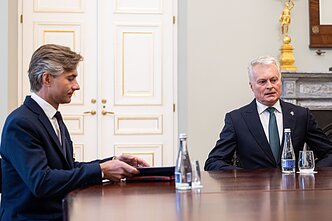









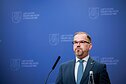
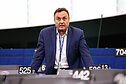
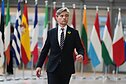

Lithuania’s Foreign Minister Kęstutis Budrys has said the transatlantic partnership must be founded on equality rather than reliance, ahead of his attendance at the Munich Security Conference on Friday.
In a pre-event Letter to Europe published on X, Budrys wrote: “Transatlantic partnership must mean equality, not reliance. Respect is not granted to those who depend indefinitely on others for their own defence. If you want influence, you must carry weight – military, financial, strategic. You cannot shape the world if you are afraid to project power within it.”
The Munich Security Conference, an annual high-level forum, brings together defence leaders to discuss pressing security and foreign policy challenges.
Budrys said that a geopolitical Europe must be able to project power and extend its membership, with Ukraine’s integration seen as far preferable to the alternative of Russian influence.
“A geopolitical Europe understands that having Ukraine as its part is a thousand times better than having Ukraine as part of Russia,” he said.
He also stressed the importance of economic resilience, saying Europe must protect strategic sectors, secure supply chains, and invest at scale in defence industries, AI, energy independence, and advanced manufacturing.
“Set the standards. Defend your industries. Use market access as power. If you do not define the rules of the game, you will live by rules written elsewhere,” he added.
Budrys touched on Europe’s nuclear deterrence, saying: “In a world where nuclear weapons still shape strategic reality, credible nuclear deterrence must also be part of the equation. This does not mean duplicating NATO or weakening the Alliance. It means reinforcing the European pillar within NATO, ensuring that deterrence on the continent remains robust and unquestionable.”
The issue of European nuclear capabilities has gained attention after French President Emmanuel Macron proposed extending France’s deterrent to European partners. While Vilnius welcomed the discussion, Lithuanian officials emphasised that it should not undermine NATO’s US-based nuclear deterrence.
Juozas Olekas, speaker of the Lithuanian parliament, said the matter should be revisited, while Bundestag Defence Committee Chairman Thomas Röwekamp said Europe could prepare for nuclear deterrence without confronting the United States.
More than 60 heads of state and government, alongside around 100 foreign and defence ministers, are expected to attend the conference, running February 13–15.

Newsletter
Every Friday morning.