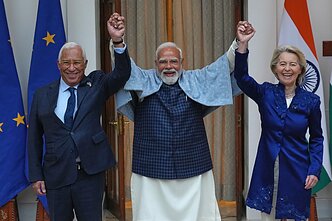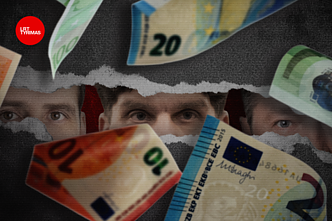












European Commission President Ursula von der Leyen has hailed the new EU-India free trade agreement as the “mother of all deals”, but economists say its immediate impact on Lithuania is likely to be gradual, reflecting the country’s still-limited trade ties with India.
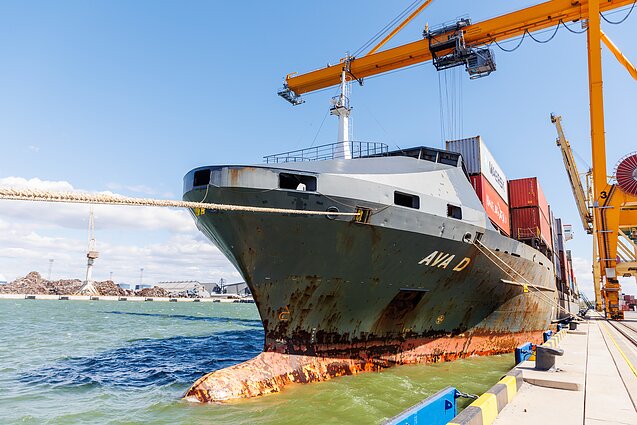
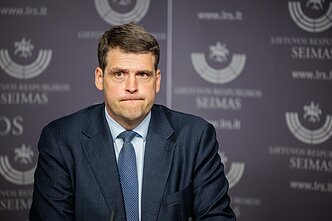
SEB Bank economist Tadas Povilauskas said the agreement is clearly beneficial for Lithuanian exporters, though trade volumes to date have been small. In 2024, a significant share of Lithuania’s exports of domestic origin to India consisted of a “single shipload of beans”, he noted.
Chief economist at the national development bank ILTE, Jonė Kalendienė, said Lithuania’s trade with India so far has focused largely on vegetables. She expects the greatest benefits from the agreement to accrue to companies already active in the Indian market.
“For those companies that already export there, things will become easier,” Kalendienė told LRT.lt. “Prices will fall, and they will be able to export more because Indian buyers will be able to purchase more. That scenario is more realistic than assuming companies with no prior presence will suddenly enter the market.”
According to the Foreign Ministry, India ranked as Lithuania’s 32nd-biggest trading partner in 2024.
Lithuania imported €210.12 million worth of goods from India last year. Data from the State Data Agency show that more than a quarter of that total consisted of engines and power equipment, with significant imports also including tires, electrical appliances, and metal products.
Exports to India totalled €115.79 million, of which €85.24 million were goods of Lithuanian origin. About one-fifth of that amount was the bean shipments cited by Povilauskas. Other exports included chemical reagents, semiconductors, and wood products.
Tariffs to fall sharply
The free trade agreement signed by EU and Indian leaders in late January envisages the elimination of some tariffs altogether.
One of the most significant changes affects European-made cars, which currently face tariffs of up to 110%. Under the agreement, duties would fall to 10% within an annual quota of 250,000 vehicles.
While Lithuania does not export cars directly, Povilauskas said its manufacturers are integrated into automotive supply chains.
“We are part of those supply chains, so this is clearly beneficial for our exporters,” he said.
The agreement also calls for eliminating tariffs on nearly all machinery and electrical equipment, currently subject to duties of up to 44%; aircraft, up to 11%; most optical, medical and surgical equipment, up to 27.5%; plastics, up to 16.5%; and pearls, precious stones and metals, up to 22.5%.
Chemical products, metals and steel – currently subject to tariffs of up to 22% – are also expected to see duties fall to zero. Pharmaceutical tariffs are set to drop from 11% to zero.
Tariffs on some food products and alcoholic beverages would decline sharply. Wine duties are to be reduced gradually from 150% to 20–30%, spirits from 150% to 40%, and beer from 110% to 50%. A 45% tariff on olive oil would be eliminated entirely, as would duties on juices, bread, baked goods, pasta, chocolate, and pet food.
Key agricultural products such as beef, poultry, rice, and sugar are excluded from liberalisation.
“God willing, everything will move smoothly through to ratification,” Povilauskas said.

Although the agreement has been signed, it must still be approved by India’s cabinet and ratified by the European Parliament. Another EU trade deal reached this year with the Mercosur bloc has stalled after the Parliament requested a review by the EU’s top court, a process that could take up to two years.
An underdeveloped market
EU-India trade talks began in 2007, were suspended in 2013 and resumed in 2022. The EU and India currently trade more than €180 billion worth of goods and services annually.
The European Commission estimates the agreement could double EU goods exports to India by 2032 and save about €4 billion annually.
Povilauskas described India as an “undiscovered market” for Lithuania.

“The tariffs on what we export or could export there are still high,” he said. “This agreement offers hope. The volumes are small now, but the potential is there.”
He suggested Lithuania’s Foreign Ministry and Economy Ministry could play a role in helping businesses enter the Indian market, noting that India’s share of global trade is expected to grow over the coming decades.
Kalendienė said that compared with the Mercosur deal, the agreement with India is more significant due to the market’s size and uniform regulatory framework.
“India’s market potential is far greater,” she said. “One country means one government and one regulatory system, which is simpler than dealing with multiple countries.”
She cautioned, however, that large, direct export contracts from Lithuania to India are unlikely to emerge quickly.
“Much of our industrial output reaches other markets through Europe,” she said. “So while the tariff reductions are substantial, the impact will likely be indirect rather than immediate.”

Newsletter
Every Friday morning.