









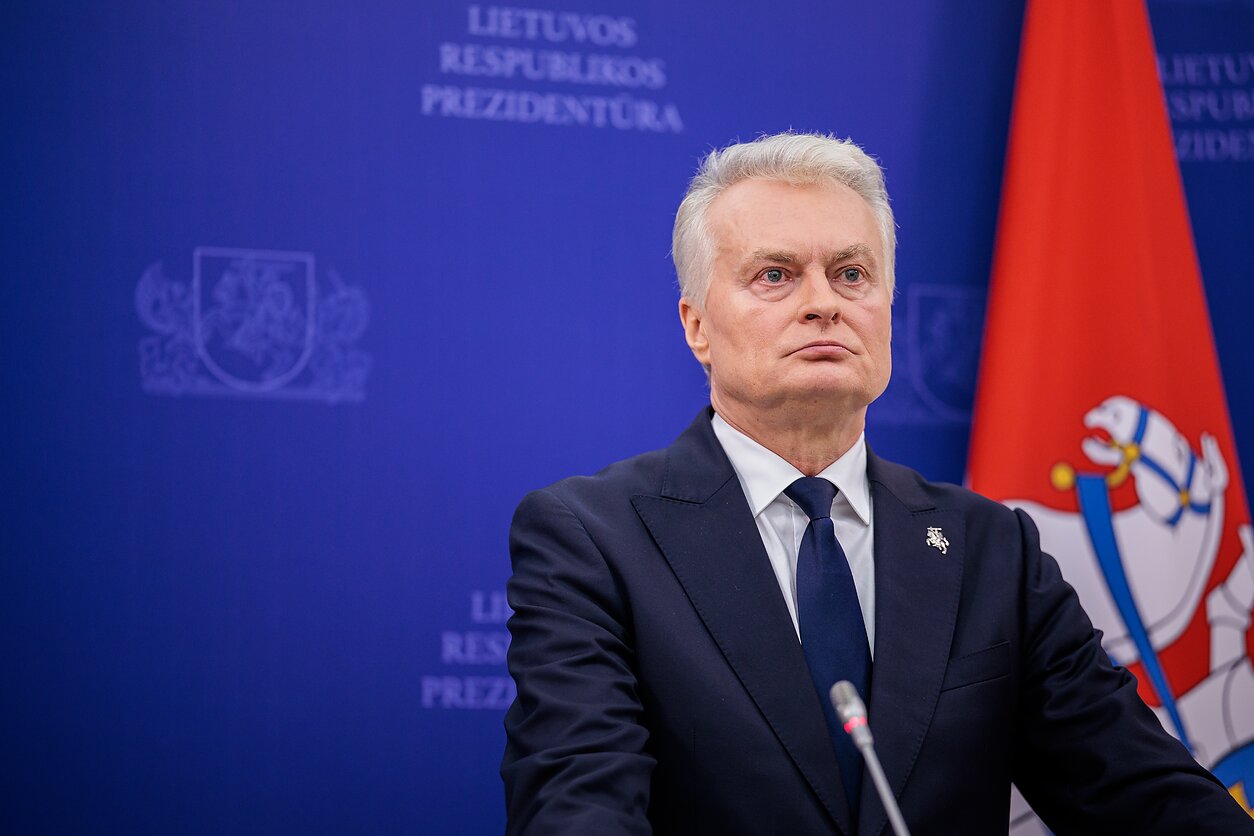
More people view the president negatively than positively, which has not happened for more than two decades, according to a Vilmorus survey commissioned by the Lietuvos Rytas newspaper and published on Friday.
According to the poll, Gitanas Nausėda’s rating continues to fall and remains at its lowest level since he took office in 2019. In December, 38.2 percent of Lithuanians viewed the head of state favourably, while 42.6 percent viewed him unfavourably.
In a survey conducted in November, 45.2 percent of respondents viewed the politician favourably and 32.3 percent unfavourably. As a result, the president fell from first to fourth place in the ranking of the most popular politicians.
Vilmorus head Vladas Gaidys compared these changes to the presidency of Rolandas Paksas, who was impeached.
“Presidents usually have positive ratings and are in first place. The last time a Lithuanian president had a negative rating was in 2004, and that was Rolandas Paksas. But in his case there were very clear reasons – treason,” the sociologist told BNS.
Paksas was removed from office after the court found he breached the Constitution for his dealings with a Russian businessman.
There is no single reason why Nausėda’s rating has been falling sharply for several consecutive months.
“The decline began in the summer and is linked to the formation of the government, which lasted until October. Then there were protests, bonfires outside parliament. There is no single event – it is a process,” Gaidys said.

The sociologist said the president is viewed most negatively by voters of the Homeland Union–Lithuanian Christian Democrats (TS-LKD) and Nemunas Dawn, the populist party in the coalition government.
Nausėda is viewed most favourably by the electorate of the Lithuanian Social Democratic Party.
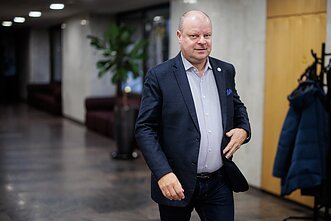
The leader of the opposition Democratic Union “For Lithuania”, Saulius Skvernelis, rose from second to first place in popularity among Lithuanian politicians.
He is viewed favourably by 47 percent and unfavourably by 33 percent of respondents, an improvement from 44.2 and 30.5 percent in the previous poll.
Aurelijus Veryga, leader of the Farmers and Greens Union, moved up to second place. The share of respondents who view the MEP favourably remains unchanged from November at 39.6 percent, while unfavourable views stand at 36.7 percent, up from 35.2 percent.
The chair of the Liberal Movement, Viktorija Čmilytė-Nielsen, is third in the rankings. She is viewed favourably by 39.1 percent of respondents (37.4 percent in November) and unfavourably by 38.9 percent (35.3 percent).
Fifth place is held by TS-LKD leader Laurynas Kasčiūnas. He is viewed favourably by 36.5 percent of respondents (34.6 percent in November) and unfavourably by 42 percent (40 percent).
Next in the table is the leader of the Lithuanian Social Democratic Party and mayor of Jonava, Mindaugas Sinkevičius. He is viewed favourably by 35.5 percent of respondents (35.8 percent in November) and unfavourably by 34.4 percent (28.4 percent).
Foreign Minister Kęstutis Budrys fell from fifth to seventh place in December. The head of Lithuanian diplomacy was viewed favourably by 34.2 percent of respondents and unfavourably by 26.2 percent (down from 36.4 and 22.3 percent respectively in November).
The most disliked politician in Lithuania remains Remigijus Žemaitaitis, the populist leader of Nemunas Dawn. According to the survey, 56.1 percent of Lithuanians view him unfavourably (50.4 percent in November), while 26.1 percent view him favourably (25.3 percent).
Second on the list of negatively rated politicians is Prime Minister Inga Ruginienė of the Social Democrats. She is viewed unfavourably by 49.1 percent of respondents (41 percent previously) and favourably by 30.3 percent (down from 35.4 percent).

Conservatives retain first place in party ratings
The opposition Conservatives (TS-LKD) narrowly retained first place in the party popularity rankings.
If parliamentary elections were held next Sunday, 12.9 percent would vote for the Conservatives in December, compared with 13.7 percent in November.
The ruling Lithuanian Social Democratic Party would be supported by 11.4 percent of respondents (12 percent in November).
Nemunas Dawn remains third in the rankings, with 10 percent of Lithuanians saying they would support the party, unchanged from a month earlier.
The opposition Democratic Union “For Lithuania” stands at 8.2 percent (9.3 percent in November), while the ruling Lithuanian Farmers and Greens Union is at 7.2 percent (7.4 percent).
The opposition Liberal Movement would receive the support of 6.6 percent of respondents, up from 5.3 percent in November.
The Vilmorus survey also shows that 3.4 percent would support another party, while 12.2 percent would not vote. A further 28.1 percent of respondents said they did not know who they would vote for.
Gaidys noted an increase in the number of people choosing to vote for another party.
“Among the other parties, the [far-right] National Alliance dominates. If their name were included and respondents could choose it, I think they would pass the electoral threshold,” the Vilmorus head said.
According to the survey, public trust in the government is also at its lowest level in 14 years.
The data show that 11.9 percent of respondents trust the government, while 46.5 percent do not. When Vilmorus conducted the survey in November, the figures stood at 16.8 and 41.8 percent, respectively.
“The last time trust was this low was in January 2012. At that time there was an economic crisis, Andrius Kubilius was prime minister, and the lack of trust was linked to the crisis and taxes,” Gaidys said.
The Vilmorus public opinion and market research centre conducted the representative survey on behalf of Lietuvos Rytas between December 12 and 30. A total of 1,000 adult residents were surveyed, with a maximum margin of error of 3.1 percentage points.

Newsletter
Every Friday morning.