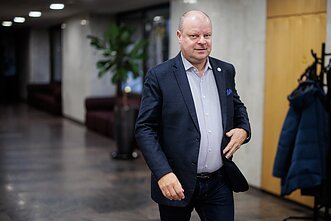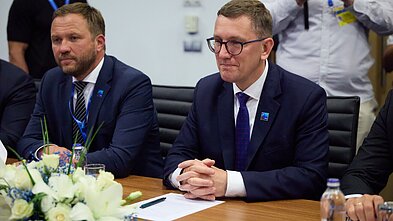












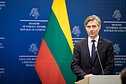

Lithuanian Foreign Minister Kęstutis Budrys has urged EU leaders to set a date for Ukraine to join the bloc, stressing that it should happen before 2030.
“On EU membership, we must make progress by the end of this year. If we cannot open the six chapters already screened by the European Commission, a political decision must be taken within the European Council to set a date for Ukraine’s EU accession,” Budrys said.
“It needs to be sooner than 2030. Otherwise, we are not giving Ukraine credible cards in the ongoing negotiations. Europe can and must offer two cards: membership and finances, including the reparation loan.”
Lithuania has previously suggested that Ukraine’s accession date should be January 1, 2030.
Brussels wants Ukraine and Moldova to receive approval for official negotiations this year, but Hungary is delaying consideration of Kyiv’s candidacy.
Marta Kos, European Commissioner for EU enlargement, told BNS earlier this month that a 2030 accession is possible, while talks with Budapest continue to ease Hungary’s opposition.
Hungary is also sceptical about using frozen Russian assets to support Ukraine. Budrys said progress in this area is expected by 2026.
“We need to move forward with Ukraine’s financing. The reparation loan is not ideal, but it is the only feasible way to mobilise funds for Ukraine’s needs. Billions are required for defence and macro-financial stability,” he said.
Earlier this month, leaders from seven EU states, including Lithuania, sent a letter to European Council President António Costa and European Commission President Ursula von der Leyen urging the bloc to act swiftly on a proposal to use frozen Russian assets to provide a loan to Ukraine.
The letter, signed by Lithuania, Poland, Estonia, Finland, Ireland, Latvia and Sweden, describes the loan as the most financially sustainable and politically realistic option, while reaffirming Ukraine’s right to compensation for damages caused by Russian aggression.
In early December, the European Commission proposed providing Ukraine with €90 billion over two years, financed either through EU borrowing or frozen Russian assets. Kyiv would repay the funds once Moscow pays reparations; if Russia refuses, the assets would remain frozen. Belgium has strongly opposed using the frozen assets for this purpose.

Newsletter
Every Friday morning.