











Lithuania has been updating its shelter network since Russia’s February 2022 invasion of Ukraine. Two incidents involving Russian drones entering Lithuania in July prompted the public to question – where to hide in case of danger?
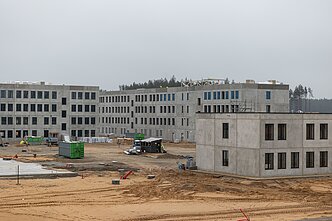
Almost all shelters are located in schools or other public buildings. For example, Vilnius is currently renovating 32 shelters, mostly in schools and kindergartens that have suitable basements. In peacetime, these premises serve their usual purpose and are inaccessible to the general public.
“If a threat arises at the national level, a decision may be taken to activate the shelter network. In such a case, a shelter must be prepared within 12 hours,” Vilnius City Council told LRT.lt.
At present, there are different levels of protection. Shelters (Priedangos, marked in yellow) are designed to protect from danger for just a few hours. Collective protection buildings (Kolektyvinės Apsaugos Pastatai, a blue triangle on an orange background) can accommodate people for at least several days, distribute aid, and serve as evacuation centres.
Meanwhile, bunkers (slėptuvės) are secret and are reserved for those keeping the state functioning during a crisis.
Some shelters are always accessible, like underpasses and garages. However, critics say they are usually not properly suited to survive bombings, and staying there for more than a few hours can be difficult without prepared chairs, bunks, or heating and electricity supply.
All shelters and collective protection facilities in the country can be found on the website LT72.lt, which also contains official guidance on how to prepare for 72 hours of emergencies – not only war, but also natural or man-made disasters.
“The website was set up in 2015. For a time, it wasn’t very popular, but now we can see the situation in our country and beyond, and interest is growing,” said Loreta Naraskevičienė, a Fire and Rescue Department (PAGD) specialist responsible for the LT72 platform.
According to her, people were mostly concerned about nuclear dangers after the construction of the Astravyets nuclear power plant in Belarus, some 50 kilometres from Vilnius. “Now it’s more about military threats, air raids, evacuation, shelters, and go-bags,” Naraskevičienė added.

Who can build a shelter, and how?
Since last year, every residential building with more than five storeys must have a shelter, and the same applies to larger non-residential buildings.
Residents can also set up what is known as an Enhanced Safety Room (Padidintos Saugos Patalpa). Based on Ukraine’s example, such places are typically bathrooms or stairwells, as they should be separated from the outside by at least two walls.
The Lithuanian Chamber of Architects has published recommendations on how to set up or prepare such rooms – available here.
The Interior Ministry is allocating tens of millions of euros in support for municipalities to set up shelters. However, this funding cannot yet be distributed to private individuals or community groups – though this may change as early as this autumn, when another round of funding will take place.
“Most municipalities are modernising or purchasing equipment – for example, stationary generators, or adapting stairways to ensure access for people with disabilities,” said Vytautas Kaminskas, who is responsible for civil protection at the Association of Local Authorities (LSA).
Meanwhile, there are active communities across the country that choose to build shelters in the basements of apartment blocks or other spaces at their own expense. Some municipalities, such as Kaunas, are already offering financial support, while others say it will be available soon.

Why talk of war?
Officials are looking for ways to discuss preparing for war without dividing society or provoking criticism for alleged fear-mongering.
“There could be a storm, or a fire like the one at the block of flats in Viršuliškės – the scenarios and preparations in peacetime are very similar to wartime situations,” said Donatas Gurevičius, a Fire and Rescue Department (PAGD) representative and civil protection expert.
“In peacetime, to say that border municipalities are unsafe, when we have commitments to NATO and EU member states, would be madness – and to provoke people by talking about it would be irresponsible,” he added.
But Lithuania now finds itself in this reality – the country is just hundreds of kilometres away from the war in Ukraine.
“Each of us must find our way of approaching this very complex subject of war, because that is the reality. Families need to check where the nearest shelter is and pack a go-bag,” said Gurevičius.

This is difficult to do, he added: “Naturally, people postpone thinking about the worst-case scenario until the very last moment. It’s hard to imagine that a catastrophe could happen.”
“The state is working to create this shelter network precisely in peacetime. But each of us should look at this reality ourselves: is there a shelter near me, near my workplace, do I have the LT72 mobile app?” he said, adding that every individual must make the decision to prepare without waiting for the state to intervene.
People’s concern for their safety peaked just months after the start of Russia’s full-scale invasion of Ukraine, Gurevičius said.
“But then the front stabilised, territory was recaptured, and the threat felt more distant, so you put the shelter issue on the back burner,” he said. “When the situation [at the frontline] deteriorates, people become interested again.”
The Red Cross is also trying to familiarise people with the basics. It organises tours (registration available here) showing shelter markings, and explains evacuation and what to put in an emergency bag.

“A go-bag is meant to help you take care of yourself for at least 72 hours, because in an emergency, the fire service or ambulance will be busy,” said Rokas Dvarvytis, a Red Cross volunteer who leads the tours.
He added that such a situation could be not only a military crisis, but also riots, unrest or natural disasters.
Is Lithuania late in preparing?
“At present, Lithuania has 6,453 shelters, which could accommodate about 1.5 million people – around 54% of the country’s population. Twenty-eight municipalities already have a sufficient number of shelters, but 32 are still facing shortages,” the Interior Ministry said in a June press release.
But critics say that many shelters exist only on paper, and only a few are properly prepared to protect people in a crisis. These problems were confirmed by a State Audit Office review earlier this year.
“We are not able to deliver in a couple of years what other countries have done over decades – such as Finland or Switzerland,” said PAGD representative Gurevičius.

Newsletter
Every Friday morning.