







Lithuanian-American Svaja Worthington was born in interwar Lithuania but has spent the last 50 years in the harsh climate of Alaska. She has immortalised both her family’s and Lithuania’s history in what may be the world’s most remote Lithuanian museum in the world.
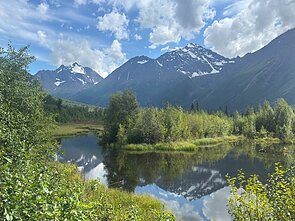
While winters can be harsh with temperatures dropping as low as minus 40 degrees Celsius, on a bright summer’s day, Alaska’s pristine landscapes make it the most beloved place in America for Worthington. She chose to make Alaska her home more than half a century ago.
Alaska remains unrivalled as the most sparsely populated US state: it is more than twice the size of Texas and four times the size of Germany, yet its population is similar to that of Vilnius.
Just outside of Anchorage – Alaska’s largest city, with a population roughly the size of Kaunas and home to almost a third of the state's residents – one is surrounded by forests and mountains that have stood unchanged for thousands of years.

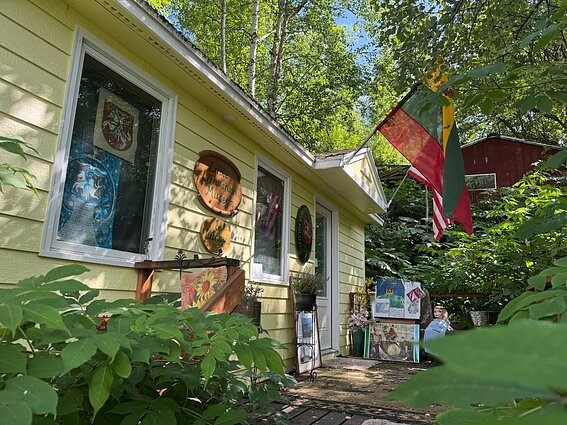
Along a secluded road, a few Dozen kilometres outside of Anchorage, a bright Lithuanian tricolour flag stands out against the lush Alaskan summer greenery. It flies over a small cottage painted a striking yellow, a colour somewhat unusual for the region.
“We painted it yellow because there are many yellow houses in Lithuania; they look very beautiful,” says Worthington, opening the door.
A tragic family history from the Šakiai district
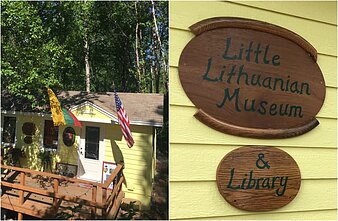
“Little Lithuanian Museum,” reads a sign on the yellow cottage. Worthington has filled it with Lithuanian artefacts and memories. She has spent 50 years in Alaska but was born in interwar Lithuania.

“This is my grandfather, Šilingas,” she says, pointing to a black-and-white photo, depicting Stasys Šilingas, Lithuania’s interwar Minister of Justice.
In 1941, he was arrested by the Soviets and deported to Siberia. A few years later, as the Red Army approached again, Worthington and the rest of her family fled Lithuania. “On August 1, 1944, we left our manor in the Šakiai district, fleeing as the Russians approached,” she shares her childhood memories.
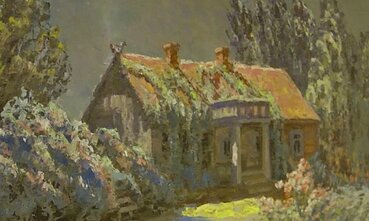
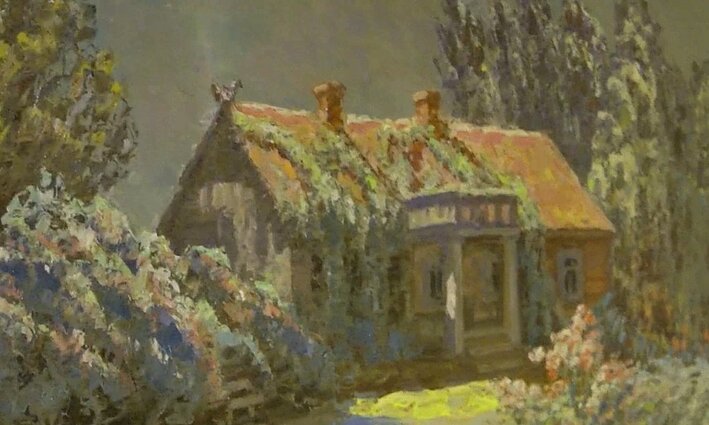
Among the exhibits is her mother’s suitcase, the one she carried into America. Her abandoned family home in the Šakiai district is remembered in a painting on the wall. “They were so beautiful, the homes. Lithuanians lived such a gentle, beautiful life, and then the war came and so many were taken to the cruellest of places – Siberia,” Worthington says.
She also reveals the museum’s vision: “Americans and those who know nothing about Lithuania must find out about it.”
What is the biggest gap in American knowledge? “They don't know the tragic history of Lithuania after the war,” she explains.
Worthington’s family is one of many witnesses to that history. Stasys Šilingas died after returning to occupied Lithuania after 20 years of exile and imprisonment. Worthington and her parents travelled through post-war refugee camps in Germany before reaching America, where they settled in New Jersey and Illinois.

Worthington herself only moved to Alaska much later; her American husband had worked summers in one of Alaska’s national parks. Falling in love with the landscape, they decided to move permanently.
Now, the wheel of history seems to have come full circle: the military tensions felt here during the Cold War have returned: Alaska is the only part of the US directly bordering Russia. A nearby wooden Orthodox church is a relic of the days when Alaska was purchased from Russia. Near Worthington’s home, the US military is expanding a base, and the news echoes the Cold War again.
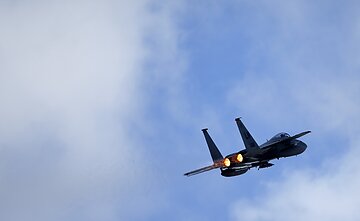
“Sometimes planes from Russia fly across the Bering Sea,” says Worthington.
Still, the wheel of history has also shifted in another direction. While visitors from Lithuania were unimaginable during the Cold War, now, every summer, the museum’s guest book fills with new Lithuanian names.
Translated to English by Smiltė Titovaitė.

Newsletter
Every Friday morning.