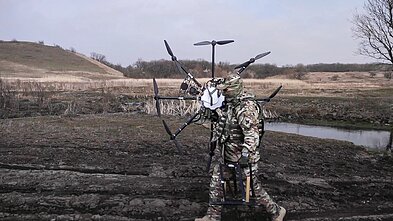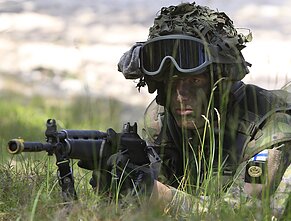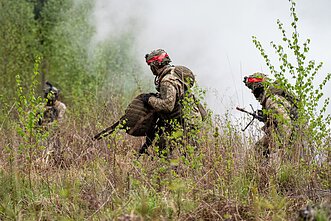














Lithuania is launching the systematic integration of drones into its armed forces, with every unit to be equipped with unmanned aerial systems, Chief of Defence Raimundas Vaikšnoras, who is marking his first year in the post, said on Thursday.
“We are starting the systematic integration of unmanned aerial vehicles from the squad level up to the division level,” Vaikšnoras posted on Facebook.
“Every infantry squad will have a reconnaissance drone. Higher-level units will be equipped with appropriate reconnaissance and combat drone systems. We are also working to develop long-range combat drones so we can strike deep behind enemy lines if needed,” he wrote.
The general added that a UAV systems training centre has been established at the Lithuanian Armed Forces School.
“Enthusiasts have been brought in and are already training operators for reconnaissance and strike drones. We have included specialists with combat experience in Ukraine in our initial programmes,” he said.

Vaikšnoras also noted that the military needs additional capabilities to counter aerial targets.
“To be able to effectively destroy all potential air targets and respond swiftly and reliably when necessary, we need additional sensors and broader neutralisation capabilities,” he wrote.
The general added that the Armed Forces, together with the Defence Ministry, are planning measures to strengthen this area.
In addition to the air defence battalion being established within the division structure, Lithuania plans to set up a separate medium-range air defence battalion equipped with NASAMS batteries. It will also form short-range air defence batteries with MSHORAD systems, according to the chief of defence.
“At the same time, we are looking for cost-effective solutions to neutralise aerial targets using simpler but effective means. In this area, we are actively adopting Ukraine’s experience, which shows that inexpensive and less technologically advanced systems can sometimes be very effective at neutralising air threats,” he wrote.
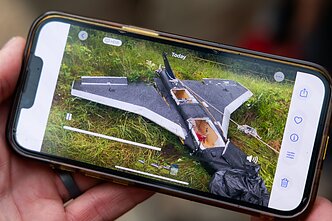
Lithuanian border guards detected an object flying in from Belarus on July 10. According to the military, it remained in Lithuanian airspace for about three minutes before crashing.

Officials initially suspected that the object was an Iranian-made Shahed drone, like those used by Russia in Ukraine, but it was later identified as a Russian-made Gerbera.
The UAV crashed on its own near the closed Šumskas border checkpoint, roughly one kilometre from the Belarusian border.
The incident was later reviewed by the parliamentary Committee on National Security and Defence. Its chairman, Giedrimas Jeglinskas, said there were “numerous critical gaps” in Lithuania’s airspace protection, including in detecting incoming drones, issuing alerts and having the capacity to eliminate such threats.
Earlier this week, Vaikšnoras said Lithuania would review part of its planned air defence procurements, but rejected criticism that the country’s air defence was “full of holes”.
President Gitanas Nausėda said he saw a need to improve coordination between institutions in responding to violations of Lithuanian airspace.

Newsletter
Every Friday morning.