






When Siarhei Tsikhanouski first took to the streets with a camera, it did not seem he was seeking a revolution. His YouTube channel Strana dlia zhizni – translated as A Country to Live In – began as a chronicle of discontent, a platform where ordinary people could speak freely.
But Tsikhanouski soon became a voice of protest – and ultimately one of the Belarusian regime’s most prominent enemies.
This article is also available in Russian.
“I have three questions. Today, I consider your channel the only place where I can ask them—because I don’t know of any other such platform,” a woman from Navapolatsk said in one of the videos.
The recording is dated 30 April 2020. At that time, Belarus, like the rest of the world, was facing the COVID-19 pandemic.
Unlike its neighbours, however, Belarus imposed no lockdown. President Alexander Lukashenko instead recommended drinking 50 grams of vodka daily “to kill the virus”, continued playing ice hockey, and joked that “you can’t see disease on the ice”.
In the absence of state measures, Belarusians themselves organised grassroots efforts to supply doctors with respirators and masks.
Yet the wave of civic mobilisation ahead of the 2020 presidential elections was fuelled by more than just the pandemic. COVID-19 merely catalysed a rising tide of dissatisfaction – one that Tsikhanouski’s channel amplified.
Arbitrariness and criminal negligence
“Entrepreneur and videoblogger” – that’s how Tsikhanouski introduced himself in his videos.
The 46-year-old opposition figure was born in Khorki, in the Mogilev region, and grew up in Gomel. Since the late 1990s, he had been engaged in a range of business ventures – from running nightclubs (one of which is where, in 2003, he met his future wife, Sviatlana Pilipchuk, later Tsikhanouskaya) to organising events and later transitioning into video production. He founded a company called Kompass, which operated across Belarus, Ukraine and Russia.
Those business links to Russia later became a subject of public discussion.

Strana dlia zhizni was, in many ways, a product of his entrepreneurial instincts.
“In 2019, after facing officials’ arbitrariness and criminal negligence, I was forced to become a video blogger,” he stated when announcing his intention to stand in the 2020 presidential election.
Two years earlier, Tsikhanouski had purchased a 19th-century merchant’s house in the village of Aharodnia-Homelskaya, near the Russian border. He planned to convert it into a tourist complex – with a café on the ground floor and a guesthouse or hostel above.
Instead, he found himself entangled in a two-year battle with Belarusian bureaucracy.
“The land lies fallow, and I’m not allowed to do anything with it. My dreams of building something beautiful—gazebos, picnic spots, barbecue areas—are already behind me,” he said in an interview with Onliner.
He stressed that the project was “not for business, but for the people”. It was intended to host not only religious pilgrims visiting relics of Saint John of Korma, but also tourists from neighbouring Russia – “just five minutes away”.
According to Onliner, local residents were supportive. “It’s like someone’s started playing the accordion in a cemetery! Maybe you’ll spark a revival in the village,” one local commented.
But the accordion was soon silenced. The project stalled amid local officials’ unwillingness to support it.
As the building had been classified as a historical and cultural monument, any reconstruction was prohibited. Tsikhanouski was forced to visit a multitude of state institutions in search of the necessary permits. He later claimed he had been to the Ministry of Culture “more often than I breathed”.
Out of frustration and perhaps naivety, Strana dlia zhizni was born. The channel rapidly became a chronicle of bureaucratic apathy, rural decline, and growing public anger.
That anger soon found its target in the regime itself. In Strana dlia zhizni videos, Lukashenko was frequently referred to as “the cockroach”.

Courage or naivety?
In 2020, Tsikhanouski continued to document examples of negligence and mismanagement across Belarus. He interviewed farmers, laid-off factory workers, and villagers. Some lamented that their roads hadn’t been paved in over two decades; others criticised the high tolls on Belarusian highways.
Within a year, Strana dlia zhizni had over 200,000 subscribers and had become one of the country’s most popular channels.
Tsikhanouski embodied the image of the ordinary Belarusian. For the first time in Lukashenko’s decades-long rule, his opponent wasn’t a nationalist intellectual from the traditional opposition, but a man of the people – the very persona Lukashenko himself had long claimed.
Tall, broad-shouldered, and always smiling beneath his leather jacket, Tsikhanouski had the air of a 1990s-era folk hero – blunt, bold, and outspoken. His language could be coarse, but his principles – justice, free choice, and a dignified life – resonated widely.
Yet there was also a sense of naivety. Despite Belarus’s long record of political repression, Tsikhanouski seemed genuinely taken aback by the pressure from authorities – publicly questioning why he was being detained without explanation or proper documentation.
Many of those he interviewed expressed similar fears. Some, wary of state reprisals, would only admit that their friends or acquaintances followed the channel.
Their fears were justified. The outspoken, at times provocative, blogger soon attracted the attention of Belarusian law enforcement.

The Road to the ballot – and prison
By May 2020, Strana dlia zhizni began publishing videos documenting efforts to detain its contributors and subscribers. Tsikhanouski responded with calm defiance, as though convinced he was untouchable.
In one such video, filmed in the rural town of Prudok, he confronted plainclothes KGB officers who were allegedly shadowing his team.
“Ah, it’s you again?” Tsikhanouski asks assertively in the video. “Do you also want to live in a country fit for life?”
“We already do,” one man replies.
“Already? I thought so,” he smiles, turning to another. “And you? Living or just hoping to?”
“Living,” the second answers.
Grinning, Tsikhanouski declares he captured “the best footage yet”. The security officers, confronted so directly, seem unsettled and avert their eyes.
Around this time, Tsikhanouski announced his presidential candidacy. But the day after submitting his documents, on May 6, 2020, he was forcibly pulled from his car and detained by riot police on administrative charges.
As a result, he was unable to finalise his election registration. His wife, Sviatlana Tsikhanouskaya, submitted the documents on his behalf, but they were rejected on the grounds that he had not signed a power of attorney. So she decided to run in his place.
Upon his release, Tsikhanouski threw his full support behind her campaign – helping to organise rallies and speaking publicly.
On May 29, President Lukashenko referenced the Tsikhanouski publicly for the first time, during a speech at the Minsk Tractor Works. Though not naming them directly, he described them as “a scumbag and his wife”, adding that “our Constitution isn’t made for a woman”, and as a result, “no one in this country will vote for her.”
That same day, Tsikhanouski was arrested again – this time at a campaign event in Hrodna.
In 2021, he was sentenced to 18 years in prison – a term later extended by a further 18 months.

Political vision vs. populism
Unlike fellow opposition figure Viktar Babaryka, a former banker who ran on a clear platform of reform, Tikhanovsky entered politics without a defined campaign. When Sviatlana Tsikhanouskaya took his place, her platform was clear: free and fair elections, and the release of political prisoners.
Before his arrest, Tsikhanouski mostly relied on emotional appeals. He urged supporters to bring slippers to rallies – to “squash the cockroach”, as he put it. He fiercely criticised the regime’s “incompetence and negligence”, advocating for everything good and opposing everything bad.
Compared to the traditional opposition – often comprised of veteran dissidents from long-banned parties – Tsikhanouski was a clear outsider. He later admitted he saw little value in “empty talk”, explaining that as a businessman, he was used to action, not debate.
It is hard to find concrete statements from that time outlining his vision for Belarus. In a recent interview with ru.DELFI.lt, Tsikhanouski stated that the 2020 protests were “not for Europe or for Russia”, but “for a country without Lukashenko”.
Still, some continue to label him as a pro-Russian politician. After his release, such claims resurfaced – most notably from opposition veteran Zianon Pazniak, who commented: “The regime doesn’t release recognised Belarusian politicians – only Russians and pro-Russian figures.” Although Pazniak later moderated his tone, he reminded readers that in 2020 Tsikhanouski had been “Moscow’s man with a special mission in Belarus”.
Pazniak is known for making sweeping accusations – including against Tsikhanouskaya herself, whom he has called “a Kremlin agent”.
These accusations stem partly from Tsikhanouski's 2017 trip to Crimea, which was annexed by Russia in 2014. During his first press conference after release, a Lithuanian journalist directly asked about the visit. Tsikhanouski replied it had been a brief pilgrimage – “just a day or two” – and said that at the time, he had not thought in terms of “yours” or “ours”.
“I never thought it would be interpreted that way,” he said. “But I was never a pro-Russian politician.”
He also stated clearly that Crimea belongs to Ukraine, and described Ukrainian President Volodymyr Zelenskyy as “a hero”.
Later, he said it was his dream to one day shake Zelenskyy’s hand – to express his admiration in person.
Solitary confinement, torture, and special treatment
Little was known about the conditions Siarhei Tsikhanouski endured between his arrest and release in June 2025. Only scattered fragments and incidental details have surfaced in the media.
The first insights came in October 2020, following a highly publicised meeting between President Alexander Lukashenko and imprisoned opposition leaders, held in a KGB detention centre. Pro-government media released footage in which Tsikhanouski was allegedly seen threatening Lukashenko’s youngest son, Nikolai. “There will be questions for Kolya after you... They will come to him,” said Tsikhanouski , seated at a round table alongside 12 other prisoners. He later explained that his words were taken out of context and deliberately twisted to mislead the public.
After this meeting, Tsikhanouski was permitted to call his wife for the first time in four months. In a leaked snippet of the call, he urged Sviatlana to “be tougher”.
His next appearance came in December 2021, during court proceedings in the so-called “Tsikhanouski's case”. Six defendants were handed a total of 94 years in prison. In footage released to the press, Tsikhanouski , handcuffed, is shown being led into a cage. His appearance was much the same as before his arrest, save for a freshly shaven head.
He vanished from public view again until December 2023, when Sviatlana Tsikhanouskaya received message suggesting that her husband died in prison. Belarusian authorities swiftly denied the rumours and released a video of Tsikhanouski in solitary confinement, exercising.
He was visibly gaunt, nearly unrecognisable. He would later reveal that he had lost over half his body weight in prison, dropping from 135kg to 79kg. In the final weeks before his release, he said prison officials attempted to “fatten him up”, offering him cottage cheese, juice, butter, and double meat portions.
Speaking later with former political prisoners in Lithuania, Tsikhanouski said he realised he had been shielded – at least partially –thanks to international media coverage and pressure from political figures. Still, he described his imprisonment as “torture”: he spent the entire duration in solitary confinement, and in the later years, received no letters and had no communication with anyone.

“Not a single kind word from anyone; just constant negativity, insults and threats from the guards,” he told Deutsche Welle in an interview shortly after his release.
Most high-profile political prisoners in Belarus are kept in total isolation. Tsikhanouski was held under the strictest regime. At his first post-release press conference, he described the gruelling routine:
“Scrubbing four times a day. Two sessions of an hour each, two of half an hour. If you're not scrubbing something the whole time, you’re sent to the punishment cell.”
He wept as he recounted this. His tears surprised both the journalists and his wife. Sviatlana would later say that before prison, she had only seen her husband cry once in their entire life together.
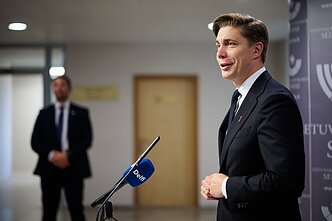
In his first public appearance since being freed, Tsikhanouski did not hide his emotions. He cried as he spoke of reuniting with his children, how his daughter did not recognise him, and about the people who had supported him throughout his incarceration.
Despite retaining the same fervour and leadership energy he showed prior to arrest, Tsikhanouski is not the same man.
The difference is not only visible in his appearance or manner of speaking, but also in the substance of what he says. Books, he said, kept him alive in prison. Today, he quotes Niccolò Machiavelli, Alexander Solzhenitsyn and Erich Maria Remarque, recites poems he composed in his head while in solitary confinement.
The world he has returned to is different as well. His wife is now a globally recognised leader of the Belarusian opposition – something the country had not seen in over 30 years. The YouTube project he launched, Strana dlia zhizni, has evolved over five years into a fully fledged media outlet run by people he mostly does not know. The opposition now has structures, offices, foundations, press secretaries, deputies and more – Tsikhanouski must now find his place among them.
What's next?
One of the earliest theories floated by Belarusian media following his release was that Lukashenko freed Tsikhanouski in a bid to sow discord within the opposition movement, seeking Belarussian democracy.

According to this line of reasoning, the regime could exploit Tsikhanouski's return to divide the opposition leadership, which has spent recent years building stable political structures, teams, and strategic agendas. Among those figures are Sviatlana Tsikhanouskaya – who led the protests following her husband’s arrest – her close advisers, Pavel Latushka, head of the People’s Anti-Crisis Management, and members of the Coordination Council, the body often regarded as Belarus’ alternative parliament.
Tsikhanouski himself declared upon release that the opposition’s leader remains his wife, and that he “does not intend to claim anything”. He describes himself as “the first gentleman of Belarus” and says he will focus on developing his YouTube channel.
“Many people are asking how they can join my team and help achieve our main goal – democracy in Belarus,” he said in the first video he posted on the channel following his release.
In that address, he urged everyone to unite for a common cause – democracy.
He said he aimed to “motivate Belarusians at home and abroad to strike a blow against Lukashism over the next three weeks”. He also announced a crowdfunding campaign, aiming to raise €200,000 to fund his initiative, including travel to meet with the Belarusian diaspora abroad.
Is this a political comeback or a continuation of his visual storytelling project? For now, it remains unclear. The question appears to be on the minds of those who have led Strana dlia zhizni in his absence.
Just days ago, one of the YouTube channel hosts released a video suggesting that, for someone like Tsikhanouski, accustomed to action, it may be difficult to remain on the sidelines while democratic structures in Belarus remain sluggish and ineffective. Eventually, the host speculated, he may feel compelled to re-enter politics.
“Tsikhanouski may have to compete for assets and resources,” the host noted. In the same video, Pavel Latushka is criticised – accused of being “frightened” by Tsikhanouski's return and relegating him to “a media role”.
At a rally in Warsaw – the first attended by Tsikhanouski – Latushka compared him to an F-35 fighter jet, calling him a weapon in the information war against the regime.
The Strana dlia zhizni presenter also claimed that among the opposition, Tsikhanouski is “candidate No. 1”.
All this unfolded in the first weeks after Tsikhanouski's release, but the political jockeying appears only to have deepened the trust, influence and transparency crisis afflicting the pro-democracy movement.
It is possible that other high-profile political prisoners – such as Viktar Babaryka, Maryia Kalesnikava, Mikalai Statkevich, and Nobel laureate Ales Bialiatski – could also be released. Tsikhanouski himself has alluded to this on multiple occasions, claiming he was informed in prison of their potential release by both KGB officers and another Belarussian blogger and activist Roman Protasevich.
How their return might reshape the Belarusian opposition remains a matter of speculation.

Newsletter
Every Friday morning.