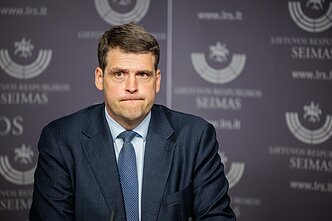












Lithuania’s environment minister voiced scepticism Wednesday over the European Union’s newly announced goal to reduce greenhouse gas emissions by 90% by 2040, compared to 1990 levels, saying the ambition is unrealistic without clear financial backing.
“The increase in ambition, from my perspective as a minister, was met with scepticism – at least in the sense that we cannot support it until there are financial instruments to accompany the goal,” Environment Minister Povilas Poderskis said in an interview with LRT TV.
“If we’re saying we must achieve this, someone has to pay for it. Someone has to modernise industry, transport, agriculture, and everything else,” he added.
Still, Poderskis acknowledged that reaching the target might not be especially difficult for Lithuania.
He also criticised what he described as the EU’s strategy of presenting climate goals as economic advantages.

“The Green Deal is hidden under the mask of competitiveness,” he said. “We modernise industry, it remains competitive, and becomes sustainable. Less pollution and waste means greater efficiency – and that means global competitiveness. But not all of it is logical or well-measured.”
Asked about cooperation with Agriculture Minister Ignas Hofmanas, Poderskis said the two find common ground despite sharp debates.
“Our discussions can be intense, but we always find compromise. So far, the prime minister hasn’t had to step in to moderate any conflict,” he said.
On Wednesday, after months of difficult negotiations with member states, the European Commission confirmed it would pursue the 2040 climate target as outlined last year. The announcement comes amid Europe’s first heat waves of the summer – a phenomenon scientists say is growing more frequent and severe due to human-driven climate change.

The 2040 target, which still requires approval from member states and the European Parliament, is considered a milestone toward the EU’s broader aim of achieving carbon neutrality by 2050.
To ease opposition from some capitals, the Commission proposed that beginning in 2036, member states be allowed to count up to 3% of their emissions reductions through carbon credits acquired from non-EU projects.
Climate groups oppose this measure, warning that offsetting schemes – such as tree planting or renewable energy projects outside the EU – could undermine the bloc’s efforts to phase out fossil fuels. They cite scientific studies and the Commission’s own climate science advisory panel.
EU environment ministers are expected to discuss the proposal in mid-July, ahead of a vote on the package scheduled for September 18. The Commission aims to have the target formally approved before the United Nations COP30 climate conference in November in Belém, Brazil.

Newsletter
Every Friday morning.