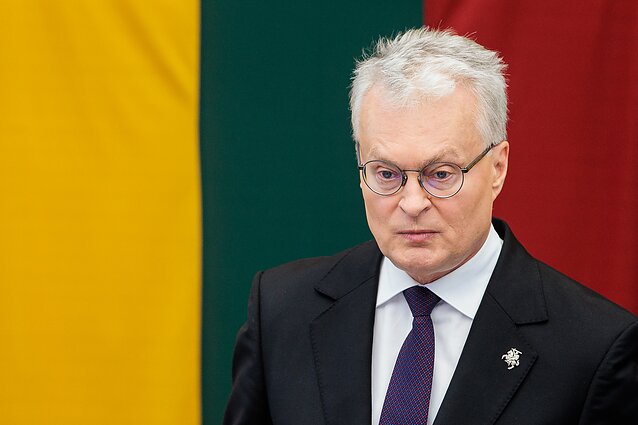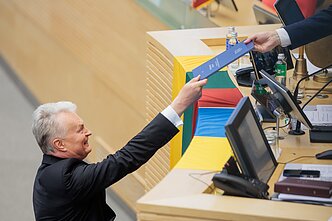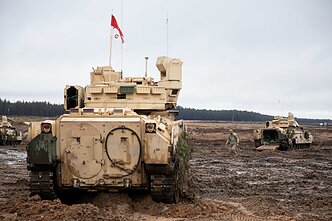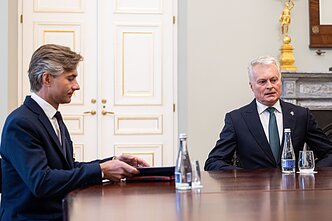



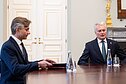




In his annual State of the Nation Address to the parliament on Thursday, President Gitanas Nausėda focused on defence, praising what he called Lithuania’s “finally proper” investment in its military.
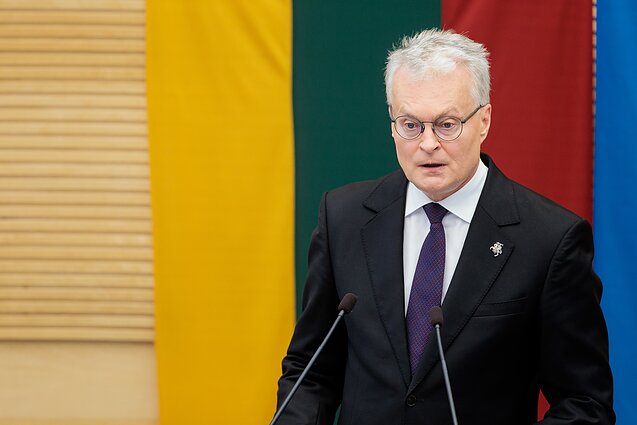
“We have finally begun to invest properly in national defence. Not just through words, but through actions, we have demonstrated that the security of our state and its people is a top priority today,” Nausėda told the parliament.
“I know very well – the people of Lithuania do not want war. We want peace, stability and security. That is precisely why we must strengthen our national defence and contribute to the effectiveness of NATO’s collective defence,” he added.
Ukraine’s victory and EU membership
Lithuania will support Ukraine until victory, Nausėda insisted, meaning until Kyiv controls all territory within its pre-2014 borders.
“Ukrainian soldiers, including Lithuanian volunteers, are fighting for the freedom we all share. The will of the Ukrainians to resist protects us here in Lithuania. Russia seeks to break that will at any cost,” the Lithuanian president said.
“Brutal attacks on civilians, the killing of women and children are not accidents. Russia did this yesterday, is doing it today and will do it tomorrow. If not stopped, it will spread death beyond Ukraine’s borders. That is why one of Lithuania’s most important foreign policy priorities is comprehensive aid for Ukraine. We will support Ukraine for as long as it takes – until victory, which includes the return of all occupied territories.”
“Lithuania stands for a just and sustainable peace agreement that ensures Ukraine’s long-term security. Ukraine’s sovereignty, territorial integrity and the freedom of its people cannot be subjects of negotiation,” Nausėda insisted, adding that Lithuania is interested in “the earliest possible start of negotiations on the membership of Ukraine and Moldova in the European Union”.
“Given Kyiv’s success in implementing reforms under wartime conditions, I have proposed setting a clear goal for Ukraine to become a member of the European Union by 2030,” Nausėda said.
He believes that significant progress on this path can be achieved as early as 2027 when Lithuania assumes the rotating presidency of the EU Council.
Discussions on small nuclear reactors
President Nausėda also called for a “well-informed” discussion on the need for small nuclear reactors in Lithuania.
“Looking further ahead, we must begin a well-informed discussion about small nuclear reactors, which could help ensure greater stability in electricity generation,” the president said.
The updated National Energy Independence Strategy 2050, approved by the Seimas last year, foresees the possibility to develop low-power nuclear reactors in Lithuania beyond 2030. However, Energy Minister Zygimantas Vaičiūnas has urged caution and said Lithuania should not be among the first countries to adopt it.
Nausėda believes that energy is the area where Lithuania has achieved the most over the past decade.
“I am pleased to note that we have truly achieved a great deal in making Lithuania’s energy system resilient. In this field, we serve as an example for all of Europe, which is gradually breaking free from Russian blackmail,” the Lithuanian leader said.
“Today, having severed the last energy ties with Russia, we are free to further strengthen our energy sector. We must rapidly develop renewable energy sources, ensure full domestic electricity production by 2028, and move forward with the Harmony Link project together with Poland,” Nausėda said.
Replacing butter with cannons won’t bring security
Nausėda said in his address that the tax reform being debated in the parliament should not only help boost defence spending but also reduce income inequality.
“While implementing the tax reform, it is essential to maintain a balance between social and economic policy needs. We will certainly not become more secure by replacing butter with cannons – only increasing poverty and social exclusion,” Nausėda said.
“Therefore, the tax changes prepared by the government and approved by the Seimas must also help to reduce income inequality,” he added.
If approved by the parliament, the government's proposed package of tax changes is expected to raise an additional 278.8 million euros for the state budget in 2026 and 551.9 million euros in 2027.
Most of the money is expected to go toward defence. Lithuania plans to spend between 5 to 6 percent of its GDP on defence between 2026–2030.
Nausėda noted that the most vulnerable groups in society have recently raised “legitimate concerns” about the rising risk of poverty, while soaring living costs, especially housing expenses, are putting increasing pressure on lower-income earners.
The president reiterated his call for reducing the personal income tax burden for employed and self-employed parents as part of the tax overhaul.
“It would provide meaningful support to Lithuanian families – the backbone of our society,” he said.
He also proposes earmarking at least 20 percent of the planned surplus in the budget of the state social insurance fund, Sodra, for indexing the individual component of pensions.
Nausėda said the tax reform should help secure funding for public services, but whether it succeeds depends on several factors.
The president called on public institutions to spend taxpayer money more carefully.
“When the state turns to the people, it should also take a critical look at itself. How much money is simply going up in smoke? How much do we overpay for goods and services in public procurement? How much is wasted on so-called qualification upgrades that end up as banal parties or idle retreats?” he asked rhetorically.
He also stressed that the changes should not significantly affect consumption and investment.
The full address is available here.

Newsletter
Every Friday morning.