












From the survival of the state to reclaiming Crimea and Donbas – the concept of victory for Ukraine has changed repeatedly over the past three years of full-scale war. Now, more voices both at home and abroad are talking about a necessary ceasefire. But what do Ukrainians actually think?
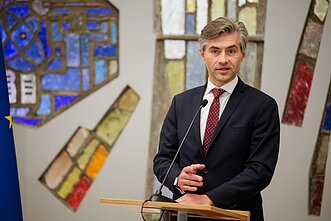
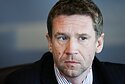
A prominent Ukrainian sociologist and rector of the Kyiv School of Economics (KSE) Tymofii Brik sat down with LRT.lt in an attempt to answer this seemingly impossible question.
How has the perception of victory changed over time?
There is an optimistic expectation about whether Ukraine is going to win. Consistently, we see that 80 to 90 percent of people believe that Ukraine is going to win this war. This does not correlate with positive or negative situations on the battleground, so this optimism is very stable.
However, everything else is very sensitive to the specific situation. There are questions about potential negotiations with Russia and we see in various polls that more and more people are willing to negotiate. We also see that it correlates with the Russian military advancements and with the attack on energy infrastructure.
So when people do not feel any quick wins or people are concerned with their security and they're overwhelmed with the news, then people are quite pessimistic and say that they're ready for negotiations.
We also see that the mood and stress of people correlate quite a lot with the consumption of media.
But your question was also about the shape, the form of the potential victory and here we see some changes over time. Back in 2022–2023, most people would agree that victory meant getting back Ukrainian territory. [...] People received various options in the survey and were asked – would you accept this form of victory? For instance, borders before the invasion, or borders before 2014.
In 2023, there was more optimism and most people would say that victory was associated with getting back the territory from before 2014, including Crimea and Donbas. But now it seems that people are not so optimistic anymore.

Newsletter
Every Friday morning.
Still, more than half, a very significant number of people, believe that Ukraine should get back the territory it had before the invasion, but the share of people who accept a ceasefire along the current lines has increased.
To me as a citizen, this is quite a dramatic change. It seems that with time, Ukrainians are more open-minded to some negotiations and a ceasefire because the war has affected the country so much.
Two years ago there was a huge rally-around-the-flag effect and there was much optimism by inertia. Now, it seems, people are tired.
[...] It’s very difficult to measure immediate reaction, but overall we see that physiological pulse, national-level pulse, and its volatility correlate with big events [like the counteroffensive, Kursk operation, etc.].
We also know that these debates are often shaped by social media. There is this theory called agenda setting, meaning that there are different actors – journalists, activists, NGOs, politicians – who propose some agenda on social media. They advocate it and discuss it quite a lot, and then the hype begins, and that's how it cascades into mainstream media, because mainstream media then copy it and deliver it to the population.
In my own opinion, I see a lot of this in Ukraine. Whenever we have a military victory or Donald Trump or Kursk, first it appears on social media, on Facebook and Twitter, with some opinion leaders or politicians shaping the perception of the event. Then mainstream media catch up, and then people follow.
So in that sense, how was President Volodymyr Zelensky's victory plan seen in Ukraine?
It seems that it was met with scepticism. [...] My own interpretation is that people in Ukraine are always sceptical of formal power and institutions like the president and parliament. There was a huge increase in trust in Zelensky during the first year of the invasion. It was kind of a rally-around-the-flag effect, but now things are returning to normal, meaning that on average Ukrainians are usually sceptical toward proposals by big formal institutions like the president, parliament, or the cabinet of ministers.
The victory plan was proposed, but I think people just shrugged, like, “Well, we'll see.” There wasn’t a lot of negativity, but it also wasn’t met with praise and optimism. I would even say that people didn’t notice it at all. The international media paid quite little attention to it as well, perhaps overshadowed by different things.

There was a Gallup Global Centre study that said more than half of Ukrainians would be in favour of territorial concessions to Russia. In contrast, there was the Kyiv International Institute of Sociology (KIIS) poll that showed 63 percent of people were prepared to endure as long as it took to achieve victory. So from a sociology background, can you explain why there are such different results when asking essentially the same question?
Yeah, it’s always an issue with sociology. That’s why polls are often criticised; so much depends not just on the question itself, but also on the composition of questions, how they follow each other, and which alternatives are proposed. My interpretation would be that everyone will understand the question differently if you ask: “Are you ready to give up some land?”
If we’re talking about a piece of land somewhere in eastern Ukraine, an old village that was completely destroyed and occupied, with no inhabitants, people might think, “Who cares about that?” But if you’re talking about the possibility of Russians attacking Kharkiv tomorrow and capturing it, no one would agree to that.
The perception depends on the framing – it’s not just about territory; it’s about people. If Ukrainian territories are occupied, it means losing access to people there, losing the ability to enforce laws, and leaving people vulnerable to being kidnapped, tortured, or re-educated into Russian culture. That’s a hard line for Ukrainians. When a question is framed as, “Will you accept losing the opportunity to protect other Ukrainians?” the answer will be no. But if the question is, “You’ve already lost some territories – would you accept giving them up for a deal?” people might say yes.
It really depends on the formulation of the question. I’ve seen polls where the scale matters too. For example, one question might ask, “Do you agree to give up territories?” as a binary choice. Another might provide a list of options, like: “We will never give up,” “We will give up some territories,” or “We will attack Russia.” When people are given clearer options, they give more precise answers.
If I were you, I’d look at the survey question wording and composition to understand the clarity provided to respondents. Sometimes, even when survey results differ, you can reconcile them. For example, people believe in victory, but they understand that it must come through both military and diplomatic means. People don’t want to give up territories, but they don’t mind giving up an uninhabited old village. Understanding the meaning behind the answers helps reconcile apparent mismatches.

Is there a case of some polls being politicised?
Absolutely. Polling can often be politicised or weaponised – there are two ways this happens. First, a poll might be conducted to raise awareness or push an agenda. Second, even the most neutral survey can be interpreted by someone with an agenda. For example, a reputable Ukrainian media outlet hired a sociological firm to survey opinions on mobilisation and the war. The survey’s results criticised Ukrainian society for not being mature – people wanted victory but also tried to avoid mobilisation. The media used this to attack the government for not leading the nation in a proper way.
Another example involved a Wall Street Journal article referring to a survey conducted by American political scholars and a Ukrainian firm. The report was thorough, but the media cherry-picked data to claim there was growing polarisation between veterans and other Ukrainians. I read this report, it was such a minor and marginal thing and it was not the main point of the report. It seems to me that politicians, activists and media can, either on purpose or accidentally, politicise an agenda.
But what are the differences in perceptions of victory among the different parts of Ukrainian society?
It depends on how the question is framed, but what we see in the continuous surveys from the Academy of Science or other sources, surprisingly – or even cynically – one of the key variables that works is age.
Older people tend to believe that Ukraine should fight until the end. There seems to be a generational ladder, where every next older generation holds stronger views that Ukraine should fight and endure longer, emphasizing the need to return to the pre-2014 borders.
There are two possible arguments for this. The cynical argument is that older people won’t have to fight themselves or sacrifice their lives, so it could just be wishful thinking, leaving others to fulfil their dreams. On the other hand, a more optimistic interpretation is that these are people who lived through the Soviet Union, experienced the post-Soviet transition, and witnessed oligarchs. Having seen what life under dictators or oligarchs was like, they might be more willing to risk everything and fight until the end to avoid returning to those times.
These are two opposing interpretations – one cynical, the other romantic. Unfortunately, we don’t have enough data to determine which is correct. It could be an optimist-versus-pessimist perspective, and the truth is likely a mix of both.
The interesting thing is that age seems to matter more than military experience, socioeconomic status, or even regional divides like western versus eastern Ukraine. Age appears to be a significant factor in Ukraine, which, honestly, I didn’t expect.

Lastly, regarding victory – what do you think Ukrainian society is ready to accept as victory?
That’s the most difficult question. It seems like the society’s mood is becoming more pessimistic. You can’t rely on the rally-around-the-flag effect for too long – two or three years is too much. Now, people seem more willing to consider negotiations. It’s very difficult to be a scholar and a citizen at the same time, but I think many would accept any ceasefire, even if it meant the current frontline becoming the border. People are tired.
Analytically, I know ceasefires are bad – Russia could regroup, rest, and attack again. We could lose occupied territories permanently and lose contact with Ukrainians there. But despite this, I believe more Ukrainians would accept a ceasefire. I think what the president and the government are doing is meant to raise the spirits of the people, the mobilisation of patriotism and the feeling of solidarity [to fight against the war fatigue]. Zelensky also seems to be trying to raise stakes internationally, trying to convince everyone from Macron to Trump that we need to push Russia now or never. I think it's because he also understands that maybe the window is very short and we need to take as much territory back as we can, because then there will be a ceasefire.
But if a ceasefire happens, will people see it as victory? In February 2022, just the survival of Ukraine as a state would have been seen as such.
You are right. I think it will depend on the framing. Initially, no one would see a ceasefire as victory, but I think that politicians will try to sell it as one. Over time, public opinion might shift with enough framing. There will be a lot of public debates and presentations to convince people that this is a victory.
People will also come back after fighting and they will raise questions like, “We were fighting, our friends died, for what, for this compromise?” But I also have a hypothesis that people in the military are not united on this. There are people who will accept anything just to go home, to see their family. So there will be some polarisation within the military. But will people accept it as victory? That’s 50/50.
Newsletter
Every Friday morning.