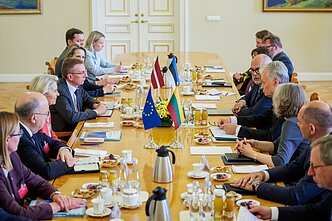











Tucked away in a small, fifty-seat conference room of a central Vilnius hotel, Lithuanian lawyers, prosecutors and the Belarusian opposition addressed a tough question – has Belarus been forgotten?
The grip of the regime had not loosened. After forcing hundreds of thousands of people to flee, Alexander Lukashenko helped Moscow invade its neighbour Ukraine. The subsequent Russian war crimes overshadowed the tortures and mass repressions in Minsk following the elections in August 2020.
Lithuania sought to help fight back by opening a probe in December 2020 into potential crimes against humanity under universal jurisdiction, which allows national courts to prosecute individuals for serious crimes included genocide committed in other countries.
But almost four years later, there is little to show for it.
Some victims of regime violence said they were running into Minsk officials shopping and sightseeing in Vilnius, while investigative journalists published pictures of so-called regime purses – the people tasked with maintaining the regime’s financial buoyancy – having drinks in the Lithuanian capital.
Despite gathering evidence from 60 victims and identifying dozens of perpetrators, Vilnius has not issued a single arrest warrant.
Thus, those who were responsible for mass repressions and torture have nothing to fear – they are able to get EU visas, travel abroad and continue on with their lives. No one is searching for them.
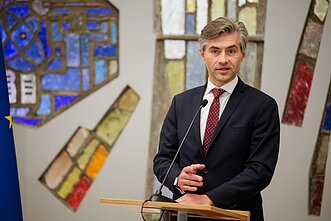
Lithuania’s Deputy Prosecutor General Saulius Verseckas fought off criticism of the investigation hitting a brick wall. “We can try a low-ranking police officer in absentia but I don't think it will be conducive to a proper trial, to charging the top officials and commanders,” he said.
The key was to gather evidence properly so the defence cannot pick at its credibility in court. “We don’t need to hurry, we need to measure twice and cut once,” Verseckas said.

But the measuring took two decades in a similar case when Vilnius probed Soviet war crimes of January 1991, which followed Moscow’s attempt to take back control of the country months after Lithuania had declared independence.
In the case of Belarus, the prosecutor hinted, it would be best if the country “became democratic and would will itself administer justice”.
For some Lithuanian lawyers and members of the Belarusian opposition, this was a sign that the country’s prosecutors were dragging their feet and waiting for political winds to change.
Subsequently, the prosecutor opened his cards – Lithuania was looking at international courts.
“We don't want to risk it by charging people domestically, so as to not become an obstacle to a case at the International Criminal Court (ICC),” Verseckas said. However, Andrea Huber, head of the International Accountability Platform for Belarus taking part in the conference, contested this assessment, saying there would be little risk of an overlap.
Belarus also does not recognise the ICC, international law experts told LRT.lt. Although Moscow doesn‘t either, Russian war crimes were probed by the Hague because they took place in Ukraine, a country which does recognise the court.
Despite pleas for European partners to get involved, Vilnius is now alone in its push to bring Lukashenko to justice – the idea to form a joint tribunal has been put on ice, while no other countries have joined Lithuania’s probe. A similar, parallel investigation in Poland was silently shelved.
“The process that might ultimately result in a court hearing has only been happening in Lithuania,” Verseckas said. “Others are holding back in contrast with what they're doing in Ukraine – they [Western countries] all rallied around Ukraine.”
“Belarus has been dwarfed and sidelined,” he added.
Without help, “I don’t think anyone will support Lithuania if it starts prosecuting Lukashenko and it might even be to our detriment”, Verseckas said.
According to a lawyer representing several of the victims, who spoke under condition of anonymity to avoid affecting the case, this shows that the country’s law enforcement is waiting for political will – in Lithuania, or in the European Union as a whole – to take the next steps.
Dainius Žalimas, a Lithuanian MEP and a former constitution court judge, also said “we are encouraging impunity by not doing anything.”
“In some cases everything is clear – for example, judges. Anyone who signed the judgments could be wanted by us,” he added. “In Lukashenko’s place, I would laugh at such investigations.”
But Žalimas was wrong.
The tense discussions inside a small conference room were enough to send shockwaves in Minsk.
Just days after the September conference, Lukashenko complained to Russian state-media – Vilnius was trying to take him to the Hague. “They are eager to remove the president of Belarus,” the authoritarian ruler said.
Was the loose threat of the ICC, or prosecution in Lithuania alone, enough to make Lukashenko afraid?

Secrecy prevails
Vitaly Aleynik, an established finance professional, was among the hundreds of thousands of people that flooded the streets during the 2020 uprising. The momentum was in their favour – the opposition was united, Lukashenko’s regime had shown weakness during the Covid pandemic and Russia was sending mixed-signals to its long-term yet problematic ally.
“I’ve never been indifferent to what has been going on in my country. The protests of 2006 and 2010 already gave an understanding of what the Belarusian system was based on. But the brutalities of 2020 just turned the world upside down,” Aleynik told LRT.lt in Vilnius.
The first people dragged off the streets were thrown piece-meal into police trucks and ferried off to prisons. There, the tortures would persist for days, but the protests continued nevertheless.
On September 23, Aleynik was attacked with truncheons by marked men before being dragged to prison. There, they were kneeled in front of a wall, beaten, abused and later tortured.
Thousands were tortured and injured by the time Lukashenko would stamp out any public sign of dissent the following year,
The resistance moved underground and many of the people that had packed the streets were forced to flee abroad. Tens of thousands of Belarusians ended up in Vilnius, a mere 20 kilometres from the border with Belarus. Here, people including Aleynik were offered a so-called humanitarian corridor easing their escape and promises to help bring Lukashenko to justice.
Aleynik was one of the first victims to step forward.
Before leaving Belarus, Aleynik had gathered evidence to help his case, like medical reports documenting his physical abuse in prison. At first, he wanted to test the Belarusian legal system by submitting formal complaints against the prison guards and police officers.
“The requests from people were at the time accepted. It was a trick from the system to show the public that the legal framework was working,” Aleynik said.
Predictably, Belarusian courts took no action.
“I got to the Supreme Court, I went through the whole chain,” Aleynik said. “If someone asks me why I didn’t try to find justice in Belarus, I can say I did – I went all the way to the Supreme Court.”
The case in Belarus was eventually frozen.

Once safely in Lithuania, Aleynik turned to the criminal police to file his complaint in March 2021. But a year passed with little new information. Aleynik’s attempt to get information about the case kicked off a cat-and-mouse game with the prosecutor’s office.
“I submitted several requests to let me know details of what is going on. I immediately was rejected. I contested this response in late 2021, or early 2022. They again rejected it,” said Aleynik.
Not only was the investigation largely out of public discourse, the victims were also not allowed to get acquainted with the process
Two lawyers involved in the case criticised the prosecutors’ unwillingness to cooperate more closely with the victims and keeping them in the dark. However, they did acknowledge it might be part of an effort to prevent the identities of witnesses and victims from being leaked.
By March 2022, Aleynik felt stuck. At that point, Lithuania had joined the war crimes investigation in Ukraine, while an overstretched prosecutor’s office was complaining of having just one investigator to handle 80 cases.
The office did not reply to LRT’s question whether the high workload was preventing the case from moving forward. In a written comment, it said “planned procedural steps are being taken in a pre-trial investigation”.
“The victims and witnesses were interviewed, the material they provided was analysed and translated into Lithuanian, ie court judgments, photographs, medical documents confirming their injuries were submitted, and the extent of the impairment was assessed in accordance with the Criminal Code. Other documents are also analysed and other investigative actions are carried out,” the office said.
Finally, Aleynik was given access to his part of the case in June last year.
“I visited the investigator’s office and was given a big pile of papers, but 95 percent of it was what I had provided,” claimed Aleynik.
“The only piece of new information was the medical part. They managed to get a local medical expert to confirm the physical exposure that was made to me there. This is important, but probably the only piece of information that would count as progress.”
This confirmed his fear – the investigation had seemingly ground to a halt.

Political interference?
Aleynik started thinking whether this reluctance by the investigators was the result of the lack of political will. The same theory was allegedly thrown at him by legal experts.
Until there is a push from the top, Aleynik was allegedly told, there will be reluctance to kick the case into gear. The most he could do was to keep the pressure on. Two sources involved in the legal process confirmed the same assumptions to LRT.lt.
“There is unquestionable political influence,” said the lawyer involved in the case. The same way there was an impulse at the beginning to launch the case, he said, similar enthusiasm is now lacking to take further action. However, he did not provide further evidence to back up his statements.
The deputy prosecutor general challenged these claims during the September conference.
“Statements by politicians had nothing to do with launching the case nor its completion,” Verseckas said during the conference. “It’s easy to start [such a case] – you put out a statement that you have opened the case and that's it, it only takes a few minutes.”
“The fact is that we have collected all this evidence and we keep moving forward, but other issues have to be addressed, including international criminal liability. All these processes need to be coordinated and aligned,” Verseckas added.
LRT.lt reached out to Justice Minister Ewelina Dobrowolska, but the minister declined to comment. Her spokesperson said her interview might be used by the accused to argue the case had been politicised and they were thus being persecuted unjustly.

Turning to the Hague
On September 6, Poland announced it would be charging three Belarusian individuals responsible for forcibly diverting a Ryanair flight from Athens to Vilnius in 2021. During the operation, the regime detained a Belarusian activist Roman Protasevich and his partner, Sofia Sapega.
The people sought by Poland are former director of the Belarusian air navigation agency, head of the air traffic control shift in Minsk at the time and the head of the KGB.
To some of the victims and lawyers, this was a sign that similar steps could be taken by Lithuania in its own case.
“It seems to me that the process in Lithuania is at a standstill,” said Žalimas, the MEP. “I do not see any obstacles to issuing European arrest warrants against suspects.”
Meanwhile, Lukashenko’s words showed that rhetoric alone has an effect on the regime.
“Even a tiny conference has shown Lukashenko is anxious and this is trickling down in the regime,” Rytis Satkauskas, a lawyer representing Aleynik, told LRT. “One can predict what the reaction will be if Lithuania closes the probe.”
But the investigation can only be effective if those responsible know they can be brought to justice. This way this would serve as a deterrent against further crimes.

“The complete classification of any procedural information creates the conditions for the [prosecutor’s office] institution to do nothing and creates the impression for the victims that nothing is being done and that the risk they took in lodging their complaint was pointless,” Satkauskas added.
On September 30, the ICC in Hague acknowledged in a press release it had received a referral from Lithuania to investigate crimes against humanity committed in Belarus.
Some of the crimes were allegedly committed in Lithuania, which recognises the court thus allowing the ICC to investigate. According to the Lithuanian Justice Ministry, the regime forced some 300,000 people to flee Belarus, and one in 13 Belarusians is now living in exile.
“I can confirm that my Office will conduct a preliminary examination to examine the request within the limits of the ICC jurisdiction, and to determine, based on statutory requirements, if there is a reasonable basis to proceed with the opening of an investigation,” ICC Prosecutor Karim Khan said in the press release.
Aleynik told LRT that “we still still believe the law in Lithuania should work” without transferring the case fully to The Hague.
“We are planning to take legal actions for the Prosecutor’s Office to finally move the case to court,” he added.

Newsletter
Every Friday morning.