














Only three of Lithuania’s elected MEPs have decided to move to Brussels, the other eight say they are only coming for the sittings while keeping permanent residence in Lithuania.
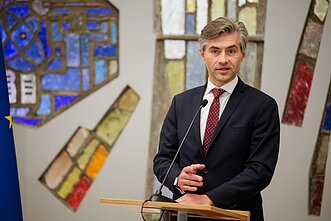
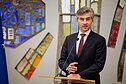
Paulius Saudargas, a newly elected conservative member of the European Parliament, says he is already familiar with the corridors of the Brussels building, although he still occasionally gets lost.
He was eager to move to Brussels as soon as he took up his seat in the EP, but has so far been travelling only for the meetings.
“The intention has not gone away, and we do have plans [to move], but from next autumn. My children are small, the twins are in second grade and the son in sixth grade, it was difficult to integrate them from this September,” says Saudargas, who is sitting with the EPP group.

Saudargas believes, however, that a politician elected to the EP must live in the EU capital.
“I think that the formula should be: when there are meetings, you should definitely be here; when there are none, you can fly to Lithuania on Friday,” he says.
Another Lithuanian MEP, Social Democrat Vytenis Andriukaitis, meanwhile, has a different opinion. To his mind, it is equally important for MEPs to stay in touch with their national constituents.
“[Moving to Brussels] would be a big mistake. I have lived here for five years as an EU commissioner, but that was a completely different agenda. In this case, we have to work both in Lithuania and in Brussels,” he says. “In Lithuania, we need to have meetings on Friday, Saturday, Sunday and Monday, especially with the Committee on European Affairs in the Seimas, we need to communicate with people, we need to spread the word.”

And although he admits that there is a lot of behind-the-scenes work going on in Brussels outside the meetings – such as looking for allies – he believes that one can combine it with formal committee meetings and plenary sittings.
“You can only find allies on the 4-5 days you are in Brussels, because on the other days it is empty,” he insists.
Of the 11 MEPs elected in Lithuania, only Andrius Kubilius – who is to join Ursula von der Leyen’s Commission – and two others have decided to get leases for a permanent home in Brussels.
The rest insist they don’t need to, because they are planning to spend a lot of time in Lithuania. This includes old-timers like Vilija Blinkevičiūtė – who is starting her fourth term in the EP – and Waldemar Tomaszewski.
The liberal Petras Auštrevičius disagrees, saying if one is serious about working in committees and doing more than just attend votes, living in Brussels “brings more advantages than disadvantages, so I would certainly advise colleagues to think about it”.

Another Lithuanian MEP who is living in Brussels is Virignijus Sinkevičius, who sits with the greens. He did not have to move, however, since he has been based in the Belgian capital for the last five years as an EU commissioner.
“Being here is also very important because most of the parliamentarians and commissioners live here and meetings and events often take place outside the parliament or official office hours,” he says.
Political analyst Rima Urbonaitė says that if a politician is serious about their work in the EP, building networks, making an impact, they can do it without a permanent residence in Brussels, but the problem is that not everyone has the intention.
“It would make sense if we saw them here in Lithuania being very active in the political field. But, paradoxically, they are neither doing very serious behind-the-scenes networking [in Brussels], nor do I see our MEPs doing politics here in Lithuania,” she says.
According to the EU parliament calendar, MEPs work on average about two weeks a month in Brussels, one in Strasbourg, and one in their home countries.

Newsletter
Every Friday morning.