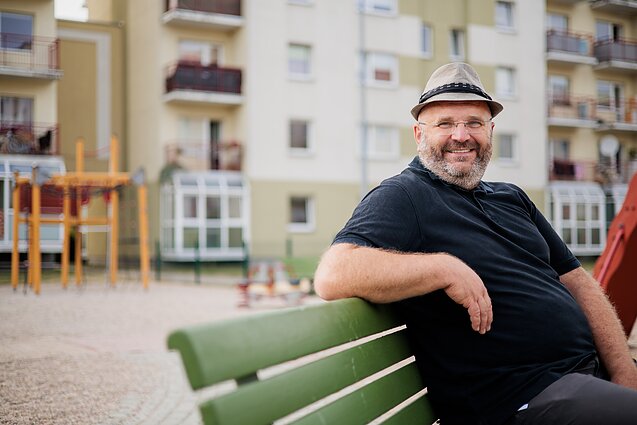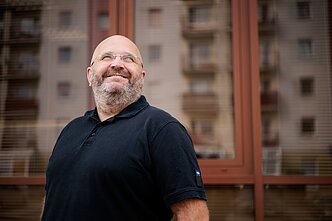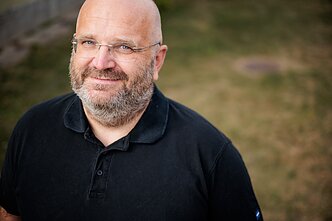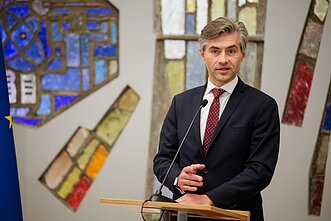













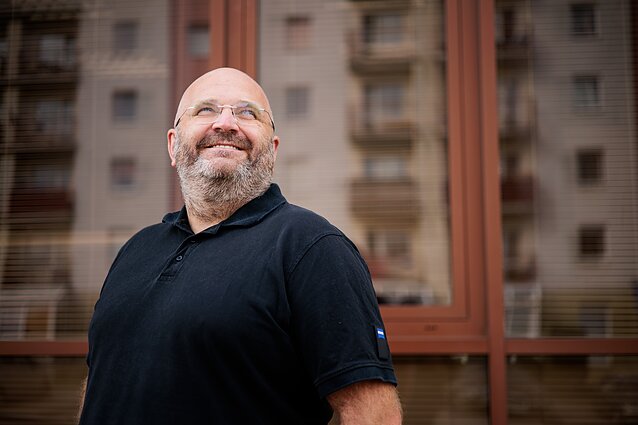
Tomas Kurapkaitis, a social worker who works with young people on the street, has earned the nickname of the Point. Tomas is an unconventional social worker: he is the one who gets out of his comfort zone and tries to help teenagers who have persistent problems, don’t go to school, don’t listen to their parents, or just don’t know what to do with their lives.
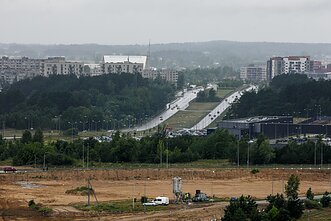
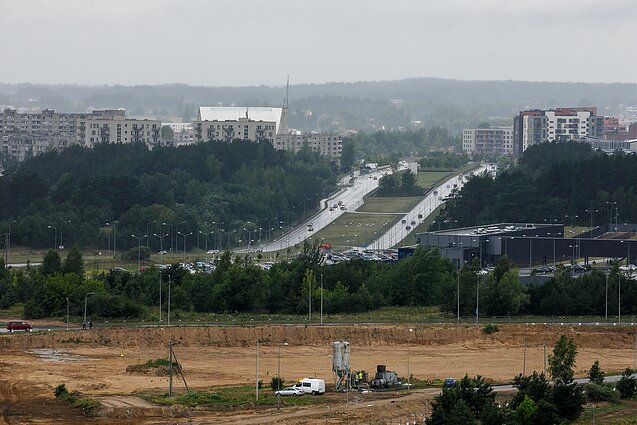
We meet Kurapkaitis in the Pilaitė neighbourhood which lies on the eastern edge of Vilnius and has a relatively high concentration of social housing. The streets are nice and tidy, the blocks of flats have been renovated, but there are people who need assistance of one kind or another: due to disability, poverty, unemployment, lack of social skills, or alcoholism.
“Just before we met, I drove by and counted: there are social flats in 31 entrances to five-storey apartment blocks. That means there are about 500 social housing units. The first houses were built twenty or twenty-five years ago, and they bring the cream of the crop of Vilnius here, as I say,” Kurapkaitis shares.
Hazards of ghettoisation
Tomas is particularly opposed to the concentration of social housing in one place, because it becomes a ghetto for the marginalised, and the better-off residents of Pilaitė start erecting fences around their backyards. People from different strata then stop mixing and you end up with an apartheid-like system.
“I volunteered for a year in Guatemala. I ask the locals there, why is there concertina wire on those fences? They say: Rich people live there. Well, I don’t want a society where these walls go up. Even here in Pilaitė, all the surrounding blocks have fences. Okay, we haven’t come to the concertina yet, but it’s small steps like these that start to widen the divide,” explains the social worker.
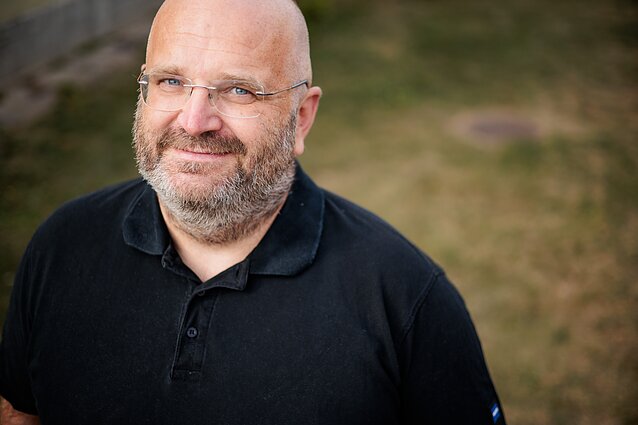
“But if these people were distributed in different places in Vilnius, one or two flats in a block, we would all have the chance to become more human. For example, if we saw a person in a wheelchair, we might help them down the stairs,” Tomas reflects.
“People with disabilities, people going through family crises, children who went through the care system – they are part of our society, we cannot ignore them. And if we don’t see them, we don’t live in reality. My wife goes to psychotherapy to bring things from her past to the surface. And here, in a way, we are trying to put social housing somewhere so that we can’t see these people,” Kurapkaitis continues.
Tomas is critical of the recent decision by the Vilnius District Municipality to build a 40-apartment block in Skaidiškės, which will be intended for people with disabilities, large or foster families, and poorer people. He says that he would like to draw on the experience of Vilnius to suggest that mistakes should not be repeated.
“In the case of the Vilnius District, the intention is to put these people in Skaidiškės, in one place, so that they interact with as few others as possible. In a way, we are hiding the problem, but it is there, it exists,” he regrets.
Robert Duchnevič, the mayor of Vilnius District, has responded to the criticism by saying that although putting marginalised people in one building is not ideal, the municipality is not like the city of Vilnius, there are not enough apartment blocks to distribute people in need of housing assistance.
People learn from each other
On the street with a high concentration of social housing in Pilaitė, we see a group of girls chatting in the courtyard with a bag of sunflower seeds. Kurapkaitis greets them and laughingly tells me that he had a big fight with these girls not long ago.
The girls liked to eat sunflower seeds and drop the shells on the ground. When the social worker asked them not to litter, they started swearing at him. Tomas warned them that unless they stopped, he’d bring sunflower shells and throw them at their apartment door. Since the girls were not impressed, he did.
The girls then threw raw eggs at his car. The police got involved, but in the end, they reached an agreement: Tomas swept the sunflower shells and the girls washed his car. Now they are at peace and the girls keep a bag for the shells.
Stigmatisation
Tomas quotes the sociologist Edwin Lemert who has described how labelling a person forces them to behave in a way that is expected of them. For example, if a person has a history of crime, if they are continually labelled as a criminal and placed among criminals, this can lead to a reinforcement of criminal behaviour.
“The more you see these things, the more you adopt that pattern of behaviour. If you have one or two social housing units in an apartment block, you can expect people to adopt the norms of life and behaviour of the other people in the block” or get stuck in bad patterns if they are surrounded by them, says Kurapkaitis.
“I have worked with one family where the child eventually had to be taken into care. But last month, I saw that the girl, now grown-up, was getting social housing here in this very place. So she is going back to the environment from which she was taken. It’s a vicious circle,” says Tomas regretfully.
A street social worker: how does it work?
Tomas is the director of Duku, an organisation running daycare centres for children from families at risk. Its social workers work with young people in the Pilaitė district. Tomas himself spends a few hours two or three times a week walking in the area and engaging with youth.
“The idea is that some people no longer dare to come to institutions. Social workers have been looking for ways to reach out to these people, to support them, to listen to them, to see how they live,” he says.

The so-called street social work in Pilaitė started when local teenagers began racketeering money from pupils at school. Pilaitė residents started complaining about street gangs and Vilnius authorities decided to set up a street social worker initiative.
“The way we work is that we have to be physically present on site. Sometimes it’s hard for me to force myself because [...] you don’t know what’s going to happen. But gradually you start recognising people hanging out in certain places: by the stadium, by the lake, by the woods. Little by little, we build a relationship with them. Until we have a relationship, we can’t do anything, but once you have a relationship, you try to understand their lives. We learn that, for example, this child has huge problems at school, you listen and you find out that he is being brought up by a single mother who has cancer. For him, school is not a priority, because at home he is preoccupied with whether his mother is going to die or not. When you see the situation, truancy and bad behaviour appear in a different light,” says Tomas.
“Then it’s my job not only to understand them, to listen to them, but also to stand up for their interests: to tell the school that this is the situation in the family, so it’s understandable why they behave this way. And to look for ways of easing the pain. After all, the child is afraid that at any moment they could be left without a guardian and be taken away to a foster home,” he explains.
Unlocking a stadium
Tomas also describes situations where the authorities build a beautiful stadium next to a school, but it is kept locked. Meanwhile, officials brag to the media about excellent facilities the local community gets to enjoy. “And you see the discrepancy... So we made posters from papers and boxes asking to unlock the stadium, and eventually, the stadium was unlocked,” Tomas remembers.
His organisation also takes teenagers on foreign exchange trips. Moreover, Kurapkaitis and his colleagues run a community centre where kids can spend their time instead of hanging out in shopping malls.
“There is a lot of process in our work,” says Kurapkaitis. “For example, there is one young man who came back from foster care. He doesn’t want to go to a regular school anymore. We are now thinking about how to get him into a vocational school – his parents say it’s too early for him to go to a vocational school and he won’t go to a regular school. It is already the third week of the school year and he has never been to school.”
“Sometimes there are beautiful cases. A small act of support for another person changes their whole world. Usually, when schools have a large number of students and don’t have the support they need, they tend to assign home-schooling to troubled children. We had one young man who was home-schooled for three years, then came back to school for a short time and said: That’s it, I’m dropping out because I failed three subjects. We helped him pass two of them, but one remained. The teacher said: Well, okay, I’ll take pity on you and let you advance to the next grade. Those simple words from the teacher were enough for that child, so much so that he is now in the eleventh grade and will probably finish twelfth. It was a breakthrough because of a very simple act of mercy,” says Tomas.
How do social workers get to know those who need their help? Tomas says that the street workers bring a ball, cards, invite kids to grill sausages, offer to take them to a camp and that’s how the connection is made. Of course, there is also a connection with the teenager’s parents, so that there are no misunderstandings.
“Young people know that we are here and when there is a situation, they just turn up. I had an unexpected situation last month. A young man I had worked with about seven years ago came forward. And I can’t say that we had a very close relationship. He told me that his parents were throwing him out of the house, everything was falling apart. He realised he had an addiction and asked if I could help him get treatment. I never thought he would turn to me, I didn’t feel that close, but the situation happened and he did turn to me. And sure enough, he went and got treatment,” says Kurapkaitis.

Newsletter
Every Friday morning.